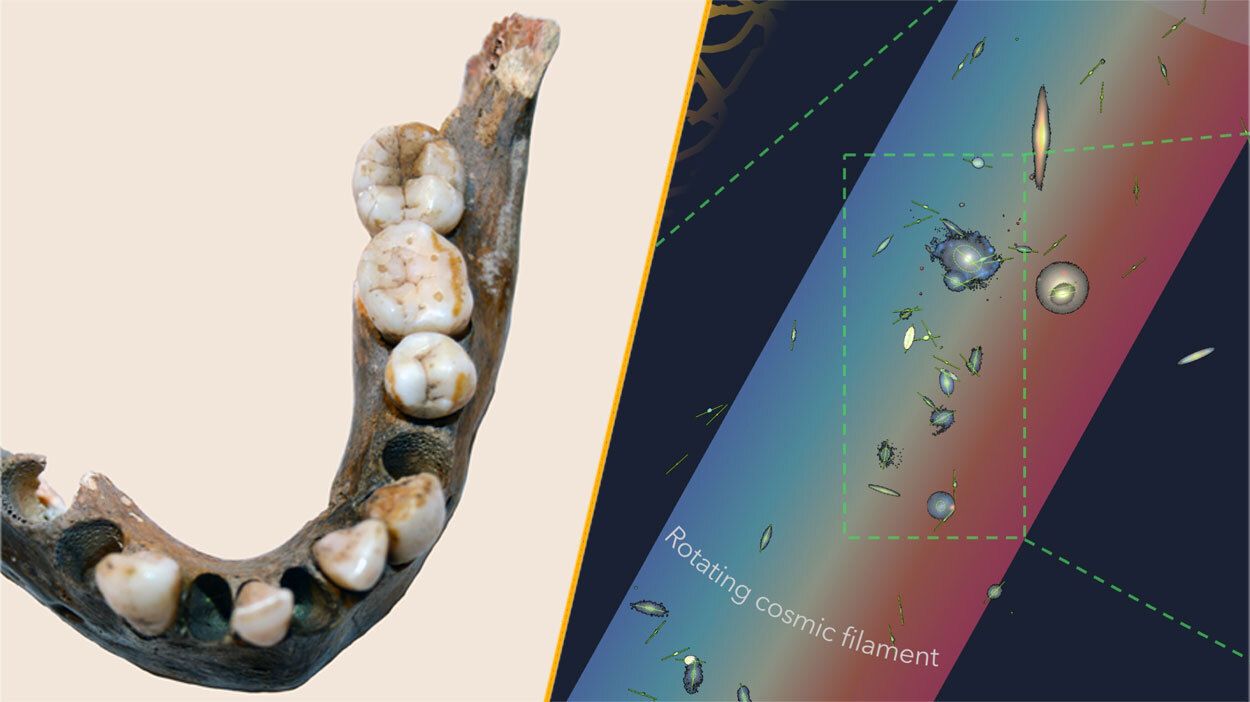
This week in science brought forth groundbreaking discoveries from the depths of our planet to the far reaches of the universe. Researchers unveiled a massive spinning structure located approximately 140 million light-years away, while significant findings about ancient human populations and modern ecological impacts captured attention.
Cosmic Discoveries: The Largest Spinning Structure
Astronomers have identified the largest spinning object in the known universe, a colossal rotating filament that is wider than the Milky Way. This discovery was made possible through a connection to a chain of 14 galaxies, which enabled scientists to track the filament’s rotation at an astounding speed of about 68 miles per second (110 kilometers per second). Such discoveries not only enhance our understanding of cosmic structures but also challenge existing theories regarding the formation of galaxies.
In a fascinating juxtaposition of time and space, researchers turned their focus to southern Africa, where an isolated human population has remained genetically distinct for 100,000 years. Excavations near the Limpopo River, which flows from South Africa into Mozambique, uncovered human skeletons dating back up to 10,000 years. The findings revealed that these ancient individuals displayed a genetic makeup dramatically different from that of contemporary humans, representing “an extreme end of human genetic variation,” as noted by the researchers involved in the study.
Archaeological Insights and Environmental Concerns
On the other side of the globe, archaeologists in China made a significant discovery outside the gates of a 4,000-year-old city, where they unearthed a pit filled with skulls. Notably, the majority of these skulls belonged to males, diverging from the typical sacrificial patterns observed in surrounding sites. This anomaly raises questions about the practices and beliefs of the civilization that inhabited the area.
In Greece, researchers encountered an elaborate tomb dating back 2,700 years, housing a woman adorned with an upside-down crown—a finding that has left experts puzzled and eager for further investigation.
Turning to modern challenges, a decades-old tree-planting initiative in China, known as the Great Green Wall, has yielded unexpected results. While the project aimed to combat desertification, recent analyses indicate that it has inadvertently altered rainfall and evaporation patterns across the country, leading to decreased water levels in densely populated regions.
In addition, new research suggests that the world record for the highest temperature, set in Death Valley in 1913, may have been influenced by human error. Meanwhile, a collapse of a significant Atlantic current in Europe threatens to usher in centuries of drought, underscoring the interconnectedness of our planet’s climatic systems.
In a lighter cosmic development, interstellar comet 3I/ATLAS has captured the imagination of astronomers. Recent observations indicate that the comet is exhibiting “ice volcanoes,” with spiral jets erupting from its surface as it approaches the sun. This behavior suggests that ice is sublimating from the comet, adding to our understanding of such celestial bodies.
In innovative technological news, engineers at MIT have developed a method to extract drinking water from the air using ultrasound. This new technique, which is 45 times more efficient than previous methods reliant on evaporation, could prove invaluable in regions facing water scarcity. While the device requires a power source, researchers are optimistic about integrating it with solar technology to overcome this hurdle.
As the week concludes, the scientific community continues to unveil the mysteries of our planet and beyond. From ancient human populations to the vastness of space, each discovery contributes to a deeper understanding of our world and the cosmos.