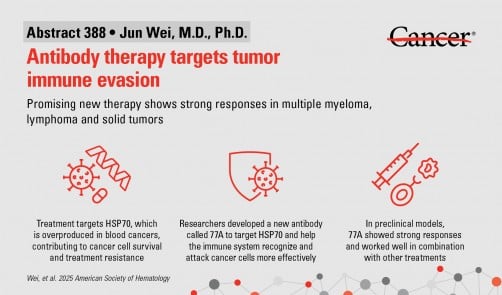
Research from The University of Texas MD Anderson Cancer Center has unveiled an investigational therapy known as 77A, which demonstrates significant potential in treating blood cancers and solid tumors. Presented on December 6, 2025, at the 67th American Society of Hematology (ASH) Annual Meeting, this new antibody therapy aims to enhance immune system responses against various cancers, including myeloma and lymphoma.
The study, led by Jun Wei, M.D., Ph.D., an assistant professor of Lymphoma & Myeloma, along with principal investigator Robert Z. Orlowski, M.D., Ph.D., highlights how the 77A antibody works by targeting a protein called HSP70. This heat shock protein often helps tumors evade detection by the immune system, promoting an environment that supports cancer cell survival.
Mechanism of Action and Laboratory Findings
In laboratory models, 77A has shown the capability to boost the activity of both innate and adaptive immune cells, particularly natural killer (NK) cells and T cells. These immune cells play a crucial role in identifying and destroying cancer cells. Notably, 77A appears to enhance the effectiveness of existing treatments, including chemotherapy, radiation therapy, and immunotherapies, thereby reshaping the tumor environment and fostering long-lasting immune responses.
Wei expressed optimism about the findings, stating, “There is tremendous promise in the way 77A is capable of rewiring the immune system, enabling it to respond effectively against multiple cancers.” This research suggests that 77A may open new pathways for immunotherapy and patient treatment strategies.
The antibody’s unique ability to enhance immune responses also indicates its potential for combination therapies. Early tests involving human immune cells demonstrated that 77A could boost immune activity in healthy donors, suggesting a versatile application for various cancer types.
Future Directions and Clinical Trials
The results from this preclinical study pave the way for future clinical trials. The team plans to develop a humanized version of the 77A antibody, which could be tested in patients across multiple cancer types. Orlowski stated, “These results give us confidence that 77A could become a versatile immunotherapy. Our next step is to advance a humanized version of this antibody into clinical trials to evaluate its potential in patients.”
This research was supported by Blood Cancer United, formerly known as the Leukemia & Lymphoma Society. The findings underscore the continued efforts to innovate cancer therapies and the potential for 77A to become a significant player in the fight against cancer.
As the scientific community looks forward to the next steps, the prospects for 77A as a new therapeutic option remain promising, highlighting the ongoing commitment to improving cancer treatment and patient outcomes.