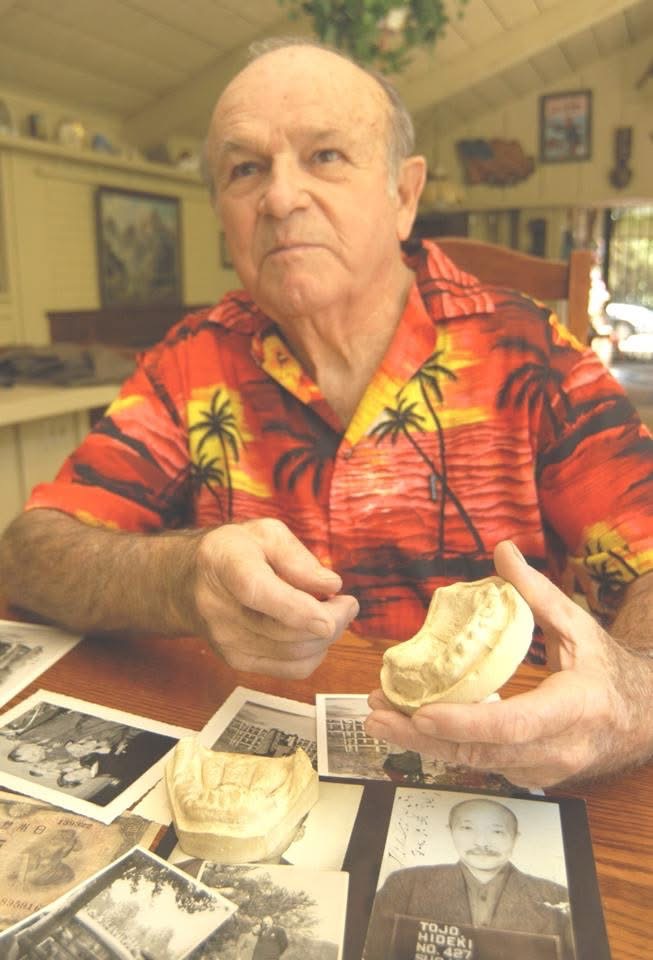
In a remarkable twist of history, the story of a young Navy dentist who crafted dentures for General Hideki Tojo has resurfaced, revealing a prank that has captivated audiences since its inception. E.J. “Jack” Mallory, who served as a dentist from 1948 to the mid-1980s in Paradise and Chico, California, was tasked with creating a set of dentures for Tojo while he awaited trial for war crimes in Tokyo’s Sugamo Prison.
Mallory, just 22 years old at the time, was assigned to assist in the dental care of military personnel after the conclusion of World War II. Tojo, often referred to as the “architect of the war in the Pacific,” was suffering from severe dental issues and required prosthetics in order to speak at his upcoming trial.
“My father always believed in providing the best care possible, regardless of a person’s background,” said Paul Mallory, Jack’s son. The elder Mallory was known for his humility and humor, traits that played a significant role in his interaction with the infamous general.
As Mallory recounted in his memoir, published in 1995 on the 50th anniversary of the Pearl Harbor bombing, he found himself in a unique position when he met Tojo. “I was excited to meet one of the world’s most infamous figures,” he explained. The encounter took place in a modest dental operatory, where Tojo appeared not as the fierce leader depicted in wartime propaganda, but as a weary, grandfatherly figure.
A Prank with Historical Significance
The process of creating Tojo’s dentures involved multiple visits, during which the general remained cordial and cooperative. However, Mallory had a mischievous idea he could not resist. While it was standard practice to inscribe identifying information into dental appliances, he contemplated a different message: “Remember Pearl Harbor.” Recognizing the ethical implications, Mallory opted for a more discreet compromise. He used a dental drill to inscribe the phrase in Morse code around the perimeter of the denture.
“Tojo wore this inscription in his mouth day and night,” Mallory recalled. Initially, only a small group of fellow dentists were aware of the prank. However, the secret eventually leaked. It began to circulate after one of Mallory’s colleagues shared the story with family, leading to widespread media coverage.
In a twist of fate, an article detailing the prank appeared in the Armed Forces newspaper, “Stars and Stripes,” and news of the inscription spread rapidly. “I was terrified, so I went to my commanding officer for guidance,” Mallory said. Major William Hill instructed him to remove the inscription before it could cause any diplomatic fallout.
That night, Mallory and his colleague raced through a snowstorm to Sugamo Prison, where they quickly ground away the evidence of their prank. Despite the frantic circumstances, the story remained a point of fascination.
Legacy of the Prank
The broader implications of Mallory’s tale have resonated through the years. Following the publication of his story, it gained traction in various media outlets, including books by notable authors like Jan K. Herman and Bill O’Reilly. Mallory’s daughter, Lori Eckhart, noted that her father would have been thrilled to see his story recognized, particularly in O’Reilly’s work, given his admiration for the commentator.
Reflecting on the legacy of his encounter with Tojo, Mallory expressed a bittersweet sentiment. “When I visited the war crimes trial toward the end of my service, I could see Tojo recognized me from our past interaction. He smiled and acknowledged me,” he recalled.
Tojo was executed in December 1948, and while he left this world without the denture crafted by Mallory, the story of these unique interactions lives on. The blend of humor and historical significance continues to engage audiences, reminding us of the complex nature of human interactions, even amidst the gravest circumstances.
As we mark the 80th anniversary of the attack on Pearl Harbor, E.J. “Jack” Mallory’s story serves as a poignant reminder of the unexpected narratives that emerge from history, blending humor and humanity in the most unlikely of contexts.