Astronomers have unveiled new detailed images of nova explosions, showcasing a complexity that was previously unrecognized in these stellar phenomena. These thermonuclear eruptions occur on white dwarfs within binary systems, and the latest findings reveal multiple ejections, intricate shock physics, and the generation of high-energy gamma-ray emissions. The observations mark a significant advancement in understanding the mechanics of these powerful cosmic events.
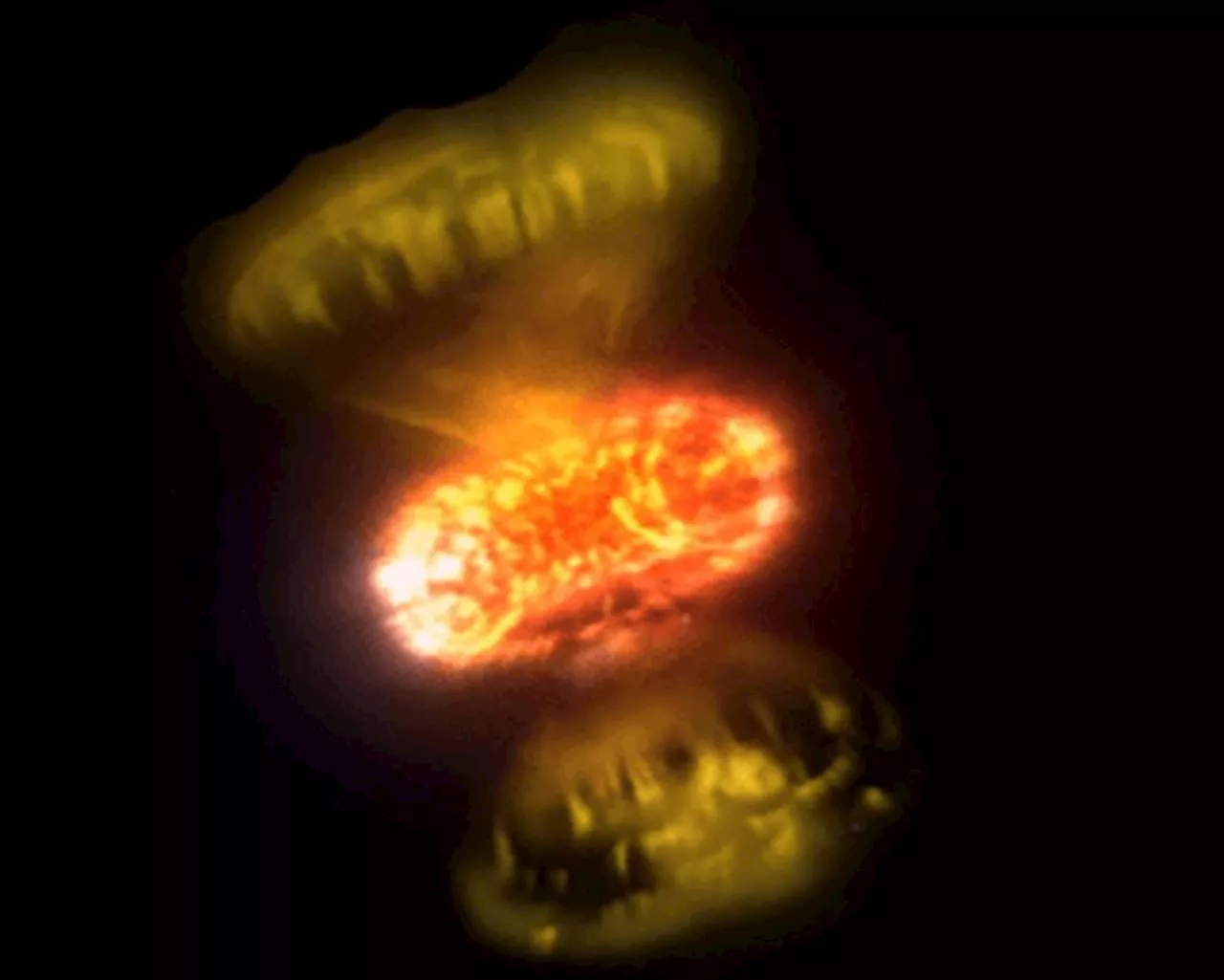
New research published in the journal Nature Astronomy highlights the complexity of novae, which happen when a white dwarf accumulates matter from its companion star, leading to a catastrophic thermonuclear explosion. The study presents images of two different novae, V1674 Her and V1405 Cas, illustrating the varied behavior and characteristics of these explosions.
Revolutionizing Understanding of Nova Mechanics
“Novae are thermonuclear eruptions on accreting white dwarfs in interacting binaries,” explained lead author Elias Aydi from Texas Tech University. The research reveals that while most of the accreted envelope is expelled during a nova explosion, the mechanisms behind this process—such as impulsive ejections, multiple outflows, or prolonged winds—remain uncertain. The authors assert that the energetic shocks responsible for high-energy gamma-ray emissions are poorly understood, with recent evidence suggesting that these shocks are internal to the ejecta and arise from interactions between multiple ejections.
In the case of V1674 Her, identified as a fast nova, images captured just 2-3 days post-explosion revealed material being expelled in two perpendicular outflows, indicating multiple interacting ejections. In contrast, V1405 Cas exhibited a slower eruption, with significant material ejection not observed until 50 days after the initial explosion. This delay is the first evidence of its kind in nova studies, further complicating the existing models of nova behavior.
As Aydi remarked, “These observations allow us to watch a stellar explosion in real time, something that is very complicated and has long been thought to be extremely challenging.” His sentiment reflects a profound shift in astrophysical research, moving from simplistic interpretations of novae to a more nuanced understanding of their dynamics.
Advanced Observational Techniques Lead to New Discoveries
The researchers utilized advanced observational methods, combining interferometry and spectrometry to study the novae. For interferometry, they employed the CHARA Array at Georgia State University, while spectrometry involved data from various observatories. This dual approach not only allowed astronomers to discern fine details in the explosions but also to identify new chemical signatures in the ejecta as it evolved.
Co-author John Monnier, a professor of astronomy at the University of Michigan, highlighted the significance of this research: “The fact that we can now watch stars explode and immediately see the structure of the material being blasted into space is remarkable.” This capability opens new avenues for studying the physics of extreme events in the universe, establishing novae as natural laboratories for understanding shock waves and high-energy radiation.
Professor Laura Chomiuk from Michigan State University added, “Novae are more than fireworks in our galaxy—they are laboratories for extreme physics.” The ability to connect the nuclear reactions occurring on a star’s surface with the geometry of the ejected material and the high-energy radiation detected from space is a breakthrough that enhances our comprehension of these complex cosmic events.
As the research continues to develop, the implications of these findings could redefine our understanding of stellar explosions. Aydi emphasized that this is merely the beginning of a broader investigation, stating, “With more observations like these, we can finally start answering big questions about how stars live, die, and affect their surroundings.”
In conclusion, the study of novae is entering a new era marked by advanced observational techniques and a deeper understanding of the underlying physics. The revelations about the complexity of these explosions underscore the necessity for further research, as astronomers aim to gather more data to determine whether the behaviors observed in V1674 Her and V1405 Cas are common among other novae. The quest to decode the mysteries of stellar explosions continues, promising exciting discoveries in the field of astrophysics.