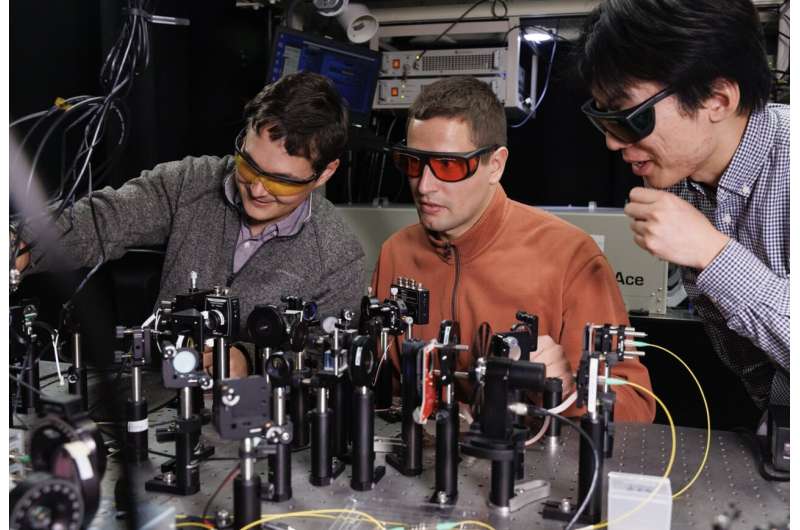
A team from Purdue University has made a significant breakthrough in optical technology by achieving all-optical modulation in silicon through an electron avalanche process. This innovative approach, detailed in a paper published in Nature Nanotechnology on December 11, 2025, promises to enhance the performance of photonic and quantum systems essential for advanced imaging, communication, and information processing.
Over the past few decades, the development of technologies reliant on light has accelerated. However, one critical challenge has been the weak optical nonlinearity of many materials typically used in these systems. This limitation hampers the ability to create ultrafast optical switches, which are vital for controlling light and electrical signals. Such switches play a central role in fiber optic communication systems and quantum technologies.
In their research, the team, led by Demid Sychev and Vladimir M. Shalaev, explored the potential of using an electron avalanche effect to achieve strong optical nonlinearity. This phenomenon occurs when a high-energy electron gains sufficient energy to liberate other electrons, resulting in a cascading effect that amplifies electron density. The researchers aimed to create a modulator that could switch a macroscopic optical beam in response to the presence of a single photon.
The impetus for this study stemmed from an awareness of existing techniques that detect ultrafast femtosecond pulses, which have limitations at the single-photon level. Sychev explained, “This led us to consider whether it might be possible to build an ultrafast modulator capable of switching a macroscopic optical beam in response to just a single photon.”
The team achieved all-optical modulation by illuminating silicon with a beam at single-photon-level intensity, triggering an electron avalanche. Sychev described the process, comparing it to standard photodiode operation, where light generates free electrons within a semiconductor, increasing its electrical conductivity. The researchers’ method resulted in a notable increase in the silicon’s reflectivity, thereby enhancing its optical properties.
This novel approach not only significantly improved the nonlinear refractive index of the silicon device but also demonstrated the unique ability to produce strong interactions between two optical beams, irrespective of their power or wavelength. “While many single-photon-level approaches can mediate interactions between two weak beams, most other methods only enable all-optical modulation at macroscopic power levels,” Sychev noted.
The implications of this research extend beyond theoretical interest. The electron avalanche-based modulation strategy could pave the way for the development of ultrafast optical switches, which are crucial for scaling photonic circuits and quantum information technologies. “Our approach is ideally suited for building ultrafast, large-scale all-optical photonic circuits,” Sychev explained.
Future applications of this technology could span various fields, including computing, communication, bioimaging, and lasing. The research team is optimistic about further refining their technique to realize practical single-photon switches that can be integrated into real devices. As they move forward, they plan to conduct more theoretical and experimental studies to enhance device design and explore new materials.
In conclusion, the work presented by Sychev and his colleagues represents a promising advance in the quest for faster and more efficient optical technologies. With the potential to revolutionize information processing, this research highlights the importance of innovative approaches in the ongoing evolution of photonic and quantum systems.