
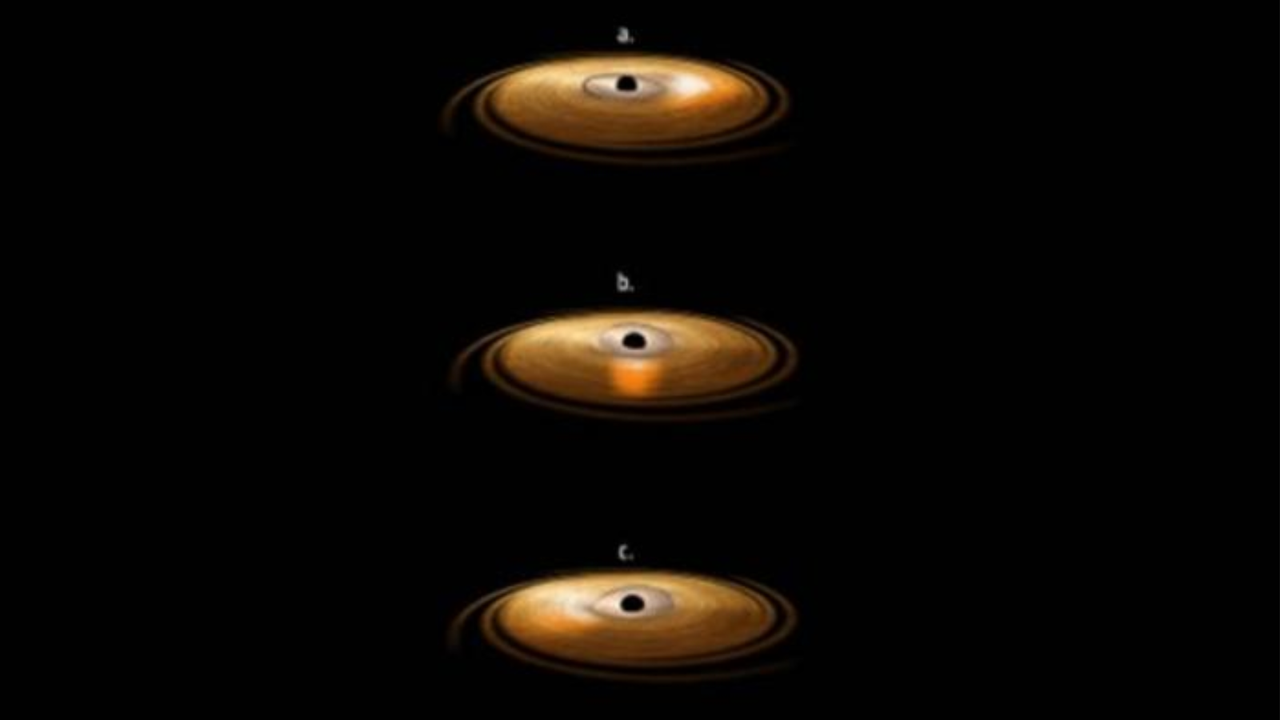
Astronomers have made a groundbreaking discovery by observing a supermassive black hole that is actively consuming a star. This phenomenon, known as a tidal disruption event (TDE), provides compelling evidence of a rare effect predicted by Albert Einstein over a century ago: the Lense-Thirring precession, or frame dragging.
The research, published on December 10, 2023, in the journal Science Advances, reveals how a rapidly spinning black hole drags the fabric of spacetime around with it. This effect arises from Einstein’s theory of general relativity, which posits that massive objects distort spacetime and generate gravitational forces as a result.
The study focused on the TDE designated AT2020afhd, where astronomers observed significant changes in the X-ray and radio-wave emissions from the black hole as it feasted on a star. By utilizing data from NASA’s Neil Gehrels Swift Observatory and the Earth-based Karl G. Jansky Very Large Array, researchers tracked the orbital wobble of the star around the black hole.
Understanding Frame Dragging
Frame dragging occurs when a rotating massive object, such as a black hole, pulls spacetime along with it, similar to how a spinning top might create whirlpools in water. According to Cosimo Inserra, a researcher at Cardiff University, this study provides the most robust evidence yet of Lense-Thirring precession. Inserra explained, “This is a real gift for physicists as we confirm predictions made more than a century ago.”
The observations of AT2020afhd indicate that the accretion disk—the disk of material spiraling into the black hole—exhibits a rhythmic “wobble.” This motion repeats approximately every 20 Earth-days, suggesting that the material within the disk is influenced by the frame-dragging effect of the black hole.
The phenomenon of spaghettification occurs when a star approaches a black hole too closely, leading to extreme tidal forces that elongate and distort the star. The star’s remnants form an accretion disk, and the black hole’s gravitational pull results in powerful jets of plasma being ejected from its poles.
Implications for Astrophysics
This discovery not only confirms Einstein’s theoretical predictions but also enhances our understanding of TDEs and their associated outflows. As Inserra noted, the research offers a novel method for investigating the dynamics of black holes and the mechanics of their interactions with surrounding cosmic material.
By demonstrating that black holes can drag spacetime and create frame-dragging effects, scientists are beginning to uncover the gravitational influences these massive objects exert on nearby stars and other celestial bodies. Inserra emphasized the significance of this research, stating, “It’s a reminder to us… that we have within our grasp the opportunity to identify ever more extraordinary objects in all the variations and flavors that nature has produced.”
The implications of this study extend beyond theoretical physics, as it opens new avenues for exploration in astrophysics. By observing TDEs like AT2020afhd, researchers can gain insights into the growth and behavior of supermassive black holes, as well as the energetic processes that shape the universe.
In summary, the recent findings affirm Einstein’s legacy and illustrate the ongoing relevance of his theories in modern astrophysics. As astronomers continue to explore the cosmos, discoveries like this one will undoubtedly enhance our understanding of the universe and its fundamental laws.


