BOSTON — Despite high levels of health insurance coverage, many residents of Massachusetts are avoiding doctor visits due to affordability issues. A recent survey from the Center for Health Information and Analysis (CHIA) reveals that approximately 28% of respondents refrained from seeking medical care over the past year because of costs associated with high-deductible plans. The survey, conducted between January and April 2023, involved over 5,365 households and highlights ongoing challenges in accessing healthcare across the state.
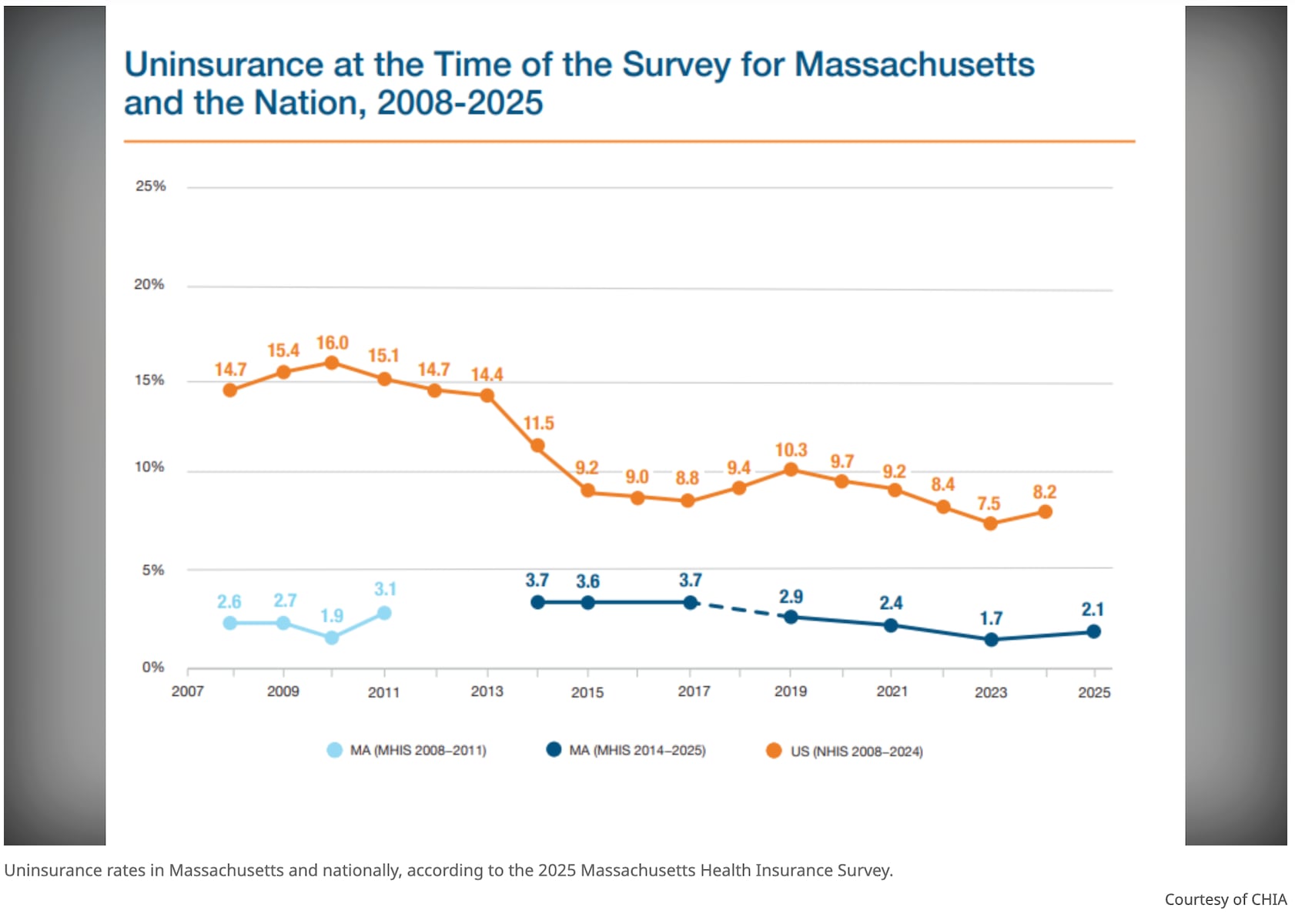
Massachusetts boasts a remarkably low uninsured rate of 2.1%, significantly lower than the national average of 8.2%. According to the biennial Massachusetts Health Insurance Survey released on Thursday, 90% of residents reported continuous insurance coverage for all family members in their household during the past year. This success can be traced back to a 2006 reform law signed by former Governor Mitt Romney, aimed at achieving universal coverage. Despite this progress, affordability remains a pressing concern for many.
Currently, there are 139,741 uninsured individuals in the state, as reported by CHIA spokesperson Emma McNamara. Health officials have warned of significant coverage losses expected among MassHealth and the Massachusetts Health Connector due to impending federal policy changes. Notably, more than 10,000 members of the Health Connector have dropped their coverage during the current open enrollment period, largely due to rising premiums associated with the expiration of federal tax credits.
The survey indicates that a disproportionate number of uninsured residents are between the ages of 19 and 64, underscoring the availability of MassHealth for children and Medicare for individuals aged 65 and older. The primary reasons for lacking insurance include the high cost of coverage and uncertainty about how to obtain it. Under state law, residents are required to have insurance or face a tax penalty.
CHIA Executive Director Lauren Peters emphasized the urgency in addressing the intertwined issues of access and affordability. She stated, “In light of impending federal health care policy changes, it is more critical than ever that we confront these challenges in Massachusetts.”
Rising Medical Debt and High-Deductible Plans
The survey found that approximately 46% of commercially insured residents had high-deductible health plans, defined by the Internal Revenue Service as plans with deductibles of at least $1,650 for individual coverage and $3,300 for family coverage. These plans often lead to high out-of-pocket costs, as individuals must pay their deductible before their insurance covers certain services. Nearly 90% of residents with medical debt reported accruing that debt while they and their family members had insurance, with around 72% attributing it to deductible payments and more than half citing copays or coinsurance as the source.
Despite the challenges, the percentage of residents struggling to pay medical bills has decreased, dropping from 19.6% in 2014 to 13.7% in 2025. This decline may reflect the elimination of copays and cost-sharing for members earning below 139%% of the federal poverty level, according to CHIA.
Administrative hurdles have also plagued many residents, with one in five Bay Staters facing issues related to healthcare coverage in the past year. The most common complaint involved resolving bills with insurance, followed by difficulties in obtaining information about coverage and issues with prior authorization.
Accessing Care Remains a Challenge
The survey highlighted that 87.5% of residents reported having a “usual source of care,” while 90.4% had a primary care provider. However, disparities exist among different racial and ethnic groups, with 92.4% of white residents having access to a primary care provider, compared to 87.4% of Black residents and 83.7% of Asian residents. Despite these statistics, around 43% of residents experienced difficulty accessing care, with approximately 30% facing challenges in obtaining primary care appointments.
Looking ahead, Massachusetts lawmakers are expected to address primary care access in 2026, with reformers advocating for legislation aimed at improving wait times and increasing access to essential care. The survey also found that more than one in five residents had a behavioral health care visit in the past year, with some individuals paying out of pocket for appointments, mainly due to providers not accepting their insurance.
Overall, the findings of the survey underscore the complexities of healthcare access in Massachusetts. While the state maintains high insurance coverage levels, many residents continue to face significant barriers to receiving timely and affordable care.