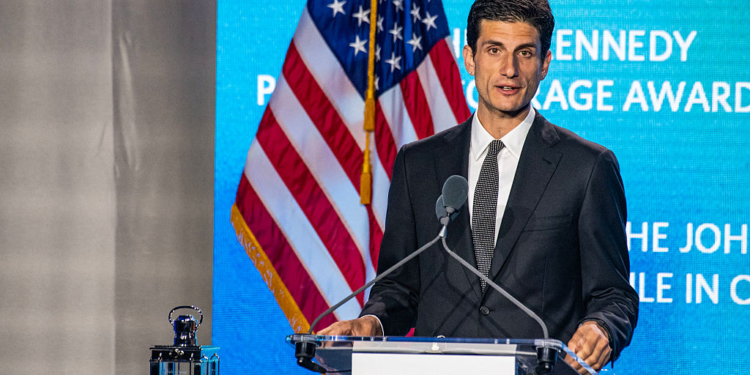
Jack Schlossberg, the grandson of former President John F. Kennedy, has publicly criticized the recent decision to add President Donald Trump’s name to the John F. Kennedy Center for the Performing Arts. The announcement, made by White House Press Secretary Karoline Leavitt on December 18, 2025, claimed that the board’s vote to rename the center was unanimous. Schlossberg, however, disputes this characterization, asserting that the vote was not conducted fairly.
In a post on social media platform X, Schlossberg stated, “Microphones were muted and the board meeting and vote NOT unanimous.” His remarks suggest a lack of transparency in the decision-making process surrounding the prominent cultural institution. The name change will officially designate the center as the “Trump-Kennedy Center,” a move that has sparked controversy and debate.
Schlossberg, who is currently campaigning for a congressional seat, indicated that Trump’s motivations may be linked to personal interests. He referenced his own campaign, stating, “Our campaign represents everything Trump can’t stand or defeat.” This sentiment reflects the broader tensions between different political factions in the United States.
Concerns Over Board Conduct
Ohio Representative Joyce Beatty, a member of the Kennedy Center board, echoed Schlossberg’s concerns. She claimed that she was silenced during the meeting and was unable to voice her opposition to the renaming. “For the record. This was not unanimous. I was muted on the call and not allowed to speak or voice my opposition to this move,” Beatty stated. She described the situation as a form of censorship, emphasizing that the decision was not part of the official agenda and lacked consensus among board members.
Beatty further argued that Congress should have a role in such significant decisions, noting, “This center, the Kennedy Center, was created by Congress. I think it’s important for us to know that this is just another attempt to evade the law and not let the people have a say.”
The controversy surrounding the Kennedy Center’s renaming is not new. Throughout his second term, Trump has expressed interest in reshaping the institution’s legacy. Earlier in 2025, he appointed himself as chairman of the center, replacing existing members with individuals aligned with his political views.
In July 2025, Republican Representative Bob Onder introduced legislation to rename the center the “Donald J. Trump Center for Performing Arts,” though this proposal did not progress into law. Trump has humorously alluded to the renaming on social media, indicating his ongoing interest in the matter.
Legal and Historical Implications
Schlossberg has raised concerns about the legality of the name change, referencing Public Law 88-260, which governs the Kennedy Center’s status as a memorial. He highlighted that the law prohibits the designation of additional memorials within the building. “Plain reading of the statute makes clear — YOU CAN’T DO THAT,” he stated in a recent post.
For Schlossberg, the issue transcends legalities; it is deeply personal. He believes that Trump’s efforts to dominate the narrative surrounding JFK’s legacy diminish the historical significance of his grandfather. Earlier this year, he remarked, “Trump is obsessed with being bigger than JFK. As if that elevates him. It doesn’t.” He underscored the enduring value of art and history, stating, “Art lasts forever, and no one can change what JFK and our shared history stands for.”
As the situation unfolds, questions remain regarding the details of the board’s vote and the broader implications of the renaming. Many observers are left wondering how this decision will impact the legacy of the Kennedy Center and whether the public will ever have full transparency about the process leading to this significant change.