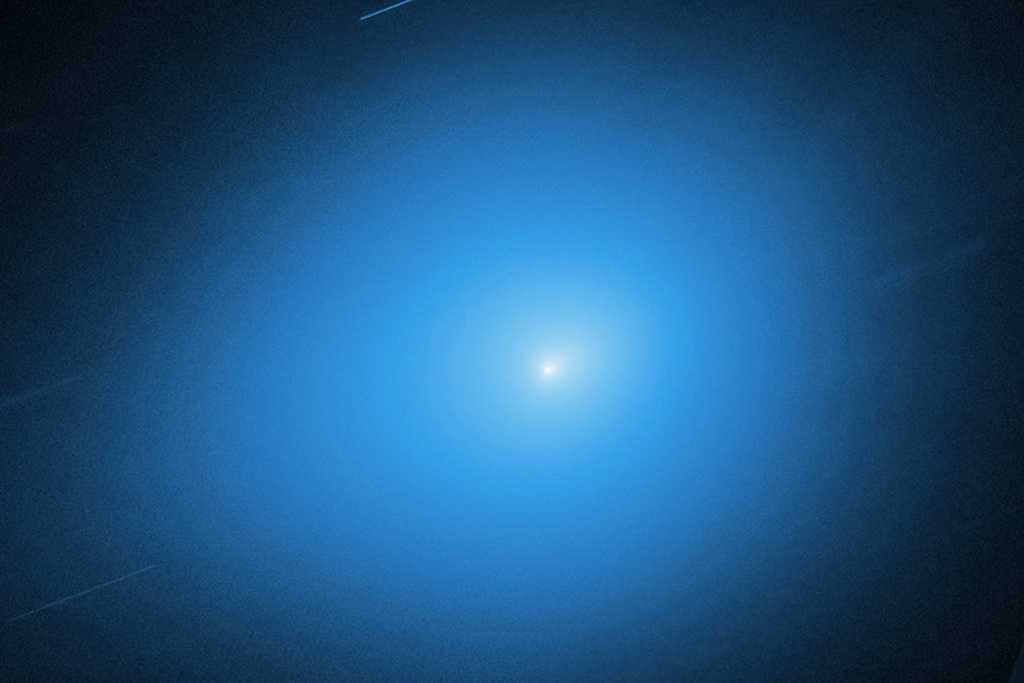
An interstellar comet known as 3I/ATLAS will come within approximately 167 million miles (about 270 million kilometers) of Earth this Friday, marking a significant event for astronomers and space enthusiasts alike. First identified in July 2023, this comet is now making its way out of our solar system after a close encounter with the Sun.
While 3I/ATLAS will not be visible to the naked eye, those keen to observe its passage will require at least an 8-inch (20-centimeter) telescope. The optimal viewing window for this comet began in November but has since closed. To assist in viewing, the Virtual Telescope Project will host a livestream of the comet on Saturday at 04:00 UTC (11:00 p.m. ET on Friday), following unfavorable weather conditions that postponed a previous streaming opportunity, according to Gianluca Masi, astronomer and founder of the project.
Scientific Insights and Observations
Scientists have closely monitored 3I/ATLAS since its discovery, aiming to learn more about its origin and composition. As comets are often described as “dirty snowballs” formed from ice, dust, and rock, their nuclei release gases and dust when they approach stars, creating their distinctive tails. This behavior is of particular interest as 3I/ATLAS nears the Sun, as the materials released can provide insights into its primordial structure.
Advanced instruments—including the Hubble Space Telescope, James Webb Space Telescope, and the SPHEREx satellite—have been utilized to study the comet. Recent observations have detected elements such as carbon dioxide, water, and carbon monoxide being expelled from the comet. Preliminary studies suggest that 3I/ATLAS could be between 3 billion and 11 billion years old, significantly older than our solar system, which is estimated to be around 4.6 billion years.
The comet made its closest approach to Mars on October 3, 2023, coming within 18.6 million miles (30 million kilometers) of the planet. While data sharing from NASA missions observing the comet has been halted due to a government shutdown, the European Space Agency’s (ESA) Mars Express and ExoMars Trace Gas Orbiter managed to capture some images of the comet, albeit as a faint dot.
X-ray Discoveries and Future Observations
In a groundbreaking development, Japan’s X-Ray Imaging and Spectroscopy Mission (XRISM) observed 3I/ATLAS for 17 hours in late November. This observation revealed X-rays radiating from the comet, a phenomenon that had not been confirmed in previous interstellar comets. The findings suggest that there are clouds of gas surrounding the comet, possibly resulting from interactions with solar wind.
Astronomers believe that the X-ray emissions stem from the interaction of gases released by the comet and charged particles from the Sun. The data gleaned from XRISM indicates signatures of carbon, oxygen, and nitrogen near the comet’s nucleus. The ESA’s X-ray space observatory, XMM-Newton, also conducted observations on December 3, 2023, which further enhanced the understanding of this interstellar visitor.
As 3I/ATLAS departs from the solar system, astronomers anticipate several more months of observations, promising exciting scientific discoveries. “We’ve got several more months to observe it, and there’s going to be amazing science that comes out,” noted Seligman, a prominent cometary scientist.
The ongoing research into 3I/ATLAS not only sheds light on the comet itself but also holds potential answers about the early solar system and the building blocks of planetary formation. As the comet journeys away from Earth, the scientific community remains keenly engaged, eager to uncover the secrets this interstellar traveler may reveal.