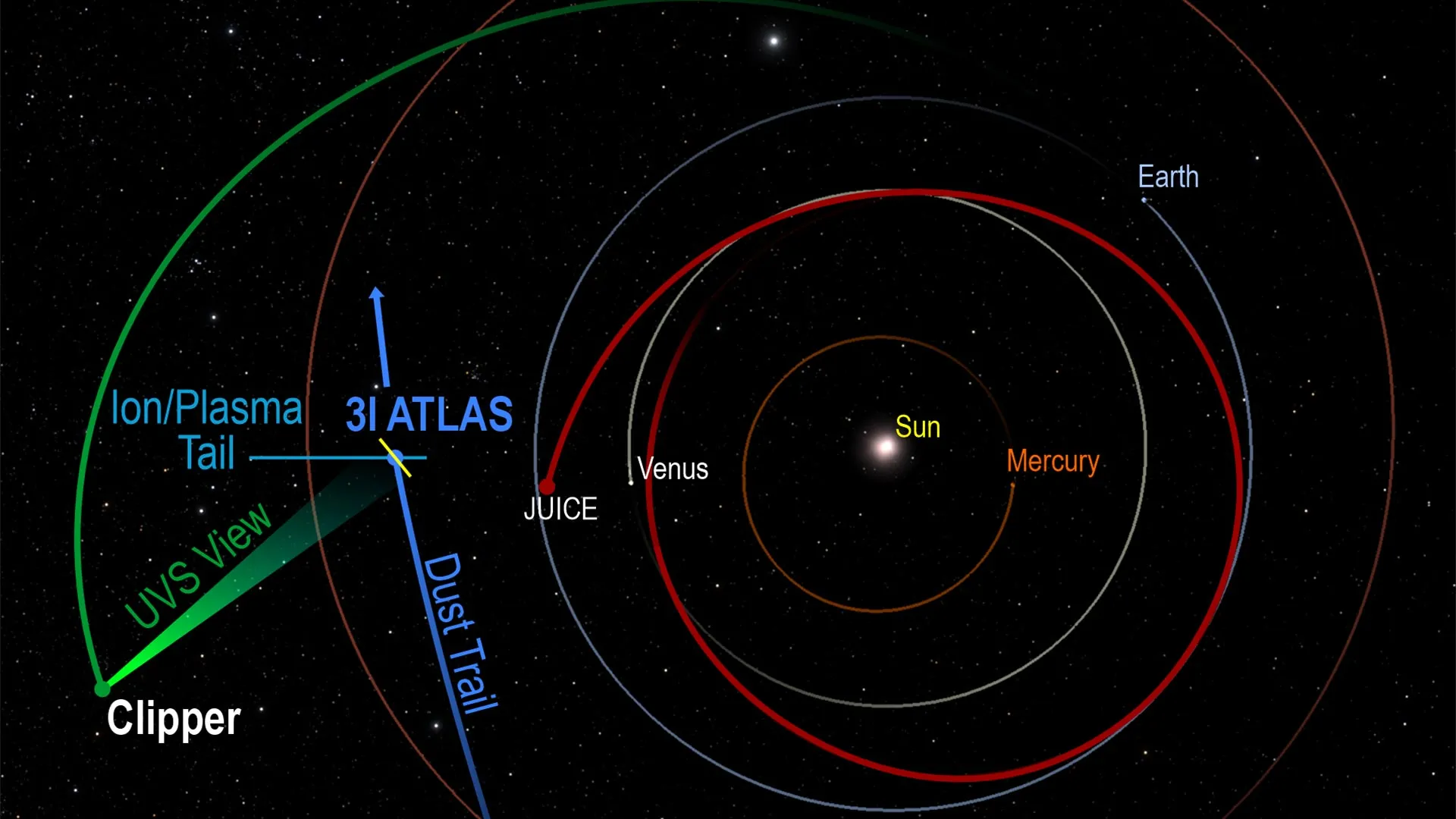
NASA’s Europa Clipper spacecraft has achieved a significant milestone by capturing rare observations of the interstellar comet 3I/ATLAS. This unprecedented data was collected on December 20, 2025, using an ultraviolet spectrograph while Earth-based telescopes were unable to observe the comet due to its proximity to the Sun. The unique vantage point of the Europa Clipper allowed scientists to analyze the comet’s dust and plasma tails from an unusual angle, revealing important characteristics about the object’s behavior and composition.
The observations were made possible thanks to the Southwest Research Institute’s Ultraviolet Spectrograph (UVS) aboard the Europa Clipper. 3I/ATLAS is notable for being the third officially confirmed interstellar object to enter our solar system, having been detected in July 2025. During a critical observation window in November, the spacecraft was able to gather data when visibility from both Earth and Mars was compromised.
Dr. Kurt Retherford, principal investigator for Europa-UVS, expressed excitement about the unexpected opportunity to gather data on an interstellar target. “Our observations have allowed for a unique and nuanced view of the comet,” he stated. The Europa Clipper, which launched in 2024, is on a mission to explore Jupiter and its moons, with an expected arrival in the Jovian system in 2030.
Insights into Comet Activity and Composition
The timing of the observations was particularly fortuitous. Just days after the comet’s discovery, analysts from NASA’s Jet Propulsion Laboratory (JPL) mapped its trajectory. The Europa Clipper team recognized that the spacecraft could observe 3I/ATLAS during a period when Earth and Mars were not well-positioned for viewing. This allowed the mission to fill a critical data gap, linking observations from Mars in late September to those that would later be conducted from Earth.
From its advantageous position, the Europa-UVS was able to capture a downstream view of both the dust and plasma tails of the comet. This perspective is essential because comets typically exhibit two primary tails: a dust tail that trails behind and a plasma tail that extends outward from the Sun. The spacecraft’s position allowed scientists to observe the tails from a “behind-the-tails” perspective, looking towards the comet’s nucleus and surrounding coma.
To enhance this unique view, additional observations from the European Space Agency’s Jupiter Icy Moons Explorer (JUICE) are expected to provide complementary data from an anti-sunward angle. Dr. Thomas Greathouse, co-deputy principal investigator of Europa-UVS, noted, “We’re hopeful that this new view, along with observations from Earth-based assets and other spacecraft, will help us to piece together a more complete understanding of the tails’ geometries.”
Understanding the Comet’s Origins
The Europa-UVS identified signatures of hydrogen and oxygen, along with dust-related features, indicating that 3I/ATLAS experienced a phase of intense outgassing shortly after its closest approach to the Sun. “Europa-UVS is particularly adept at measuring fundamental transitions from atoms and molecules,” explained Dr. Kurt Retherford. “We can see gases come off the comet, and water molecules break apart into hydrogen and oxygen atoms.”
These measurements provide insight into the comet’s composition, potentially revealing its origin and the processes it underwent while traveling through the galaxy. Dr. Tracy Becker, co-deputy principal investigator of Europa-UVS, emphasized the importance of understanding both the chemical processes at play and how they may relate to the formation of our solar system. “What are the chemical processes at play, and how can we unravel the comet’s origin in its own star system? Those are big questions.”
The Europa Clipper mission, managed by JPL for NASA’s Science Mission Directorate, is being developed in collaboration with the Johns Hopkins University Applied Physics Laboratory in Maryland. As this innovative mission progresses, scientists anticipate that the insights gained from 3I/ATLAS will enhance our understanding of the origins of comets and their role in the broader context of the universe.