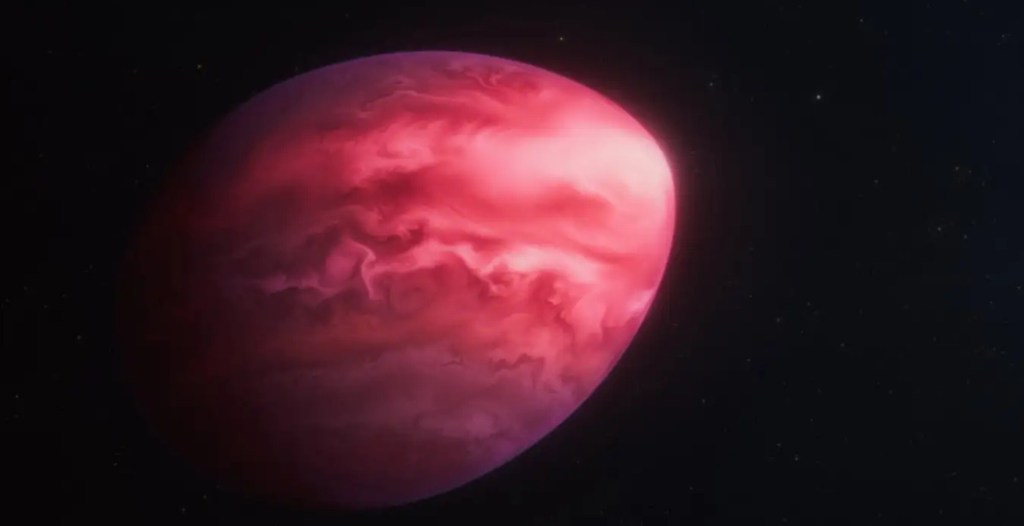
Astronomers have recently identified a planet that challenges existing theories of planetary formation. Known as PSR J2322-2650b, this planet is roughly the size of Jupiter but exhibits a unique lemon-like shape due to extreme gravitational forces. It orbits a pulsar, the ultra-dense core of a deceased star, completing a full orbit every 7.8 hours. This close proximity subjects the planet to intense radiation, resulting in atmospheric temperatures that soar to approximately 3,700 degrees Fahrenheit on the dayside and drop to around 1,200 degrees Fahrenheit on the nightside.
Scientists utilized the James Webb Space Telescope to conduct a comprehensive study of the planet throughout its orbit, aiming to analyze how light passed through its atmosphere. To their surprise, they discovered that the atmospheric composition deviated significantly from the typical blend of hydrogen, oxygen, and nitrogen found on gas giants. Instead, the spectrum revealed an abundance of carbon-based molecules, with clear signals from carbon chains known as C2 and C3. Oxygen and nitrogen were noticeably scarce or missing.
Michael Zhang, the lead author of the study, remarked, “The planet orbits a star that’s completely bizarre—the mass of the Sun, but the size of a city. This is a new type of planet atmosphere that nobody has ever seen before.” The findings indicate an extraordinary carbon-to-oxygen ratio exceeding 100 to one and a carbon-to-nitrogen ratio surpassing 10,000 to one. These figures are unprecedented, as no known planet around a typical star exhibits such extreme ratios.
Typically, systems like this are referred to as “black widows,” where a pulsar strips material from a companion star, often leaving behind a dense remnant. The expected outcome of this process usually includes a diverse mix of elements. However, the significant carbon dominance in this case raises questions. The research team explored various hypotheses, including unusual stellar chemistry or the influence of carbon-rich dust, but none fully explained the observations made by the James Webb Space Telescope.
Adding to the planet’s uniqueness, its heating dynamics differ from those of conventional hot Jupiters. Gamma rays penetrate deeper into the atmosphere, creating wind patterns that redistribute heat westward rather than directly away from the pulsar. As a result, the hottest region does not align with conventional models.
At present, PSR J2322-2650b stands out as a clear anomaly in planetary science. While the James Webb Space Telescope has confirmed the planet’s existence and its unusual characteristics, the question of how it formed remains unanswered. As scientists continue to explore the cosmos, this lemon-shaped planet serves as a reminder of the complexities and mysteries that still exist in our understanding of the universe.