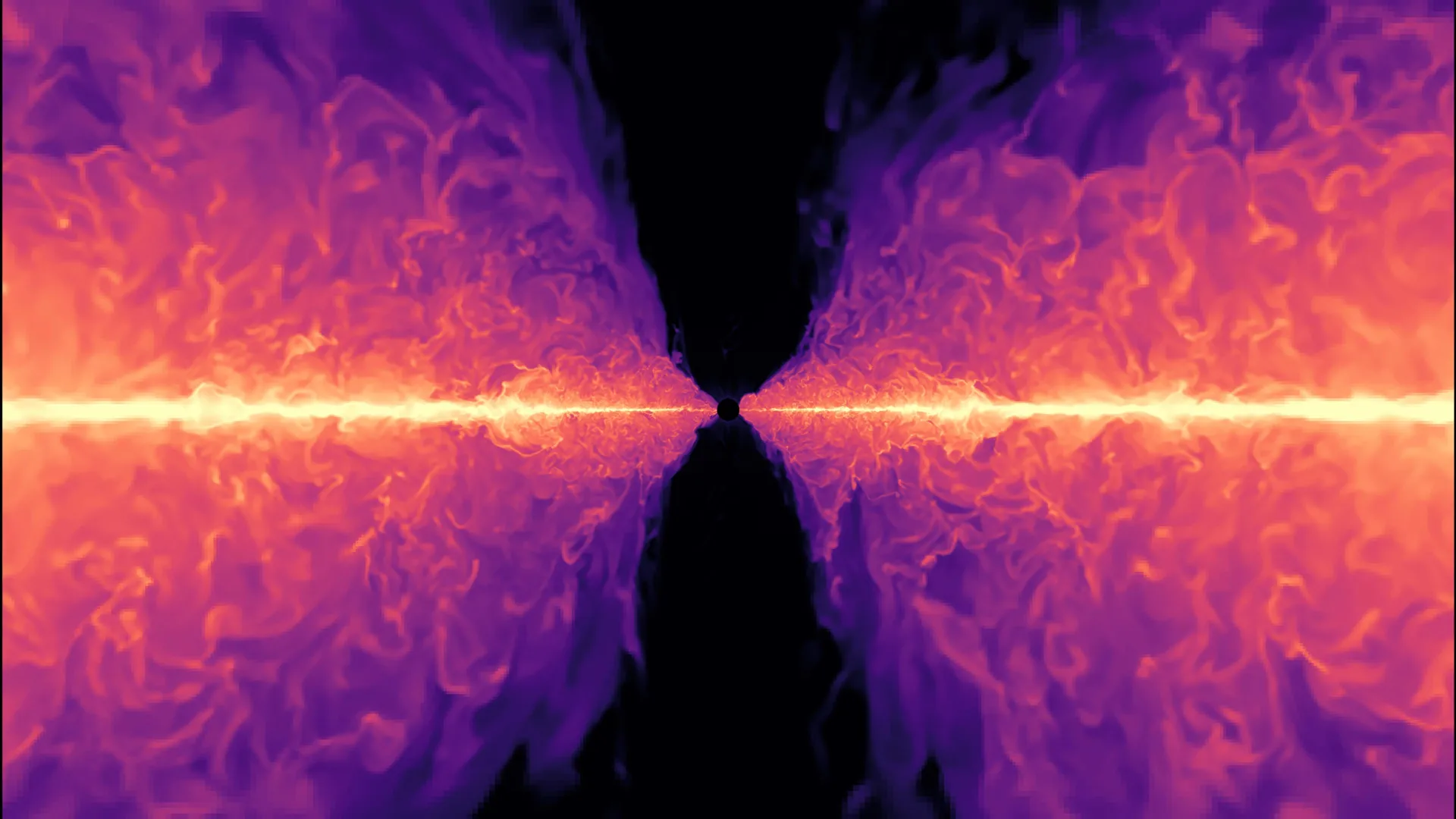
A team of researchers has developed groundbreaking simulations that provide unprecedented insights into the behavior of black holes. Published on December 22, 2025, in The Astrophysical Journal, this study represents a significant advancement in the field of computational astrophysics, allowing scientists to model black holes with remarkable accuracy.
The researchers, affiliated with the Institute for Advanced Study and the Flatiron Institute, utilized powerful supercomputers to combine Einstein’s theory of gravity with realistic modeling of light and matter. This innovative approach captures the dynamic processes surrounding black holes, illustrating how matter forms chaotic, glowing disks and generates powerful outflows as it approaches these enigmatic cosmic entities.
Significant Breakthrough in Black Hole Research
After years of gradual progress, the team has achieved a pivotal milestone in black hole research. Their simulations accurately depict the accretion process, where black holes draw in surrounding matter and emit intense radiation. This marks the first time researchers have performed calculations in full general relativity without relying on simplifying assumptions.
Lead author Lizhong Zhang, a joint postdoctoral research fellow, emphasized the importance of this work. “This is the first time we’ve been able to see what happens when the most important physical processes in black hole accretion are included accurately,” Zhang stated. The study focuses primarily on stellar mass black holes, which are approximately ten times the mass of the Sun, and explores their unique characteristics.
Understanding black holes requires a nuanced approach that incorporates both general relativity and the effects of radiation. As matter falls toward a black hole, it releases significant energy in the form of radiation. Accurately modeling this interaction is crucial for interpreting astronomical observations. Previous simulations, which treated radiation as a fluid, failed to reflect its complex behavior, leading to incomplete results.
Advanced Algorithms Enable Realistic Simulations
The research team developed new algorithms that directly solve the intricate equations governing black hole behavior, eliminating the need for approximations. “Ours is the only algorithm that exists at the moment that provides a solution by treating radiation as it really is in general relativity,” Zhang explained. This advancement has opened new avenues for simulating black hole environments with a realism previously unattainable.
The simulations reveal chaotic, radiation-dominated disks forming around stellar mass black holes, alongside strong winds and powerful jets. Critically, the simulated light spectra correspond closely to actual observations from various black hole systems, enhancing scientists’ ability to draw conclusions from limited data and deepening their understanding of these distant cosmic phenomena.
The research also highlights the substantial computational power required for such complex simulations. The team utilized two of the world’s most advanced supercomputers, Frontier at Oak Ridge National Laboratory and Aurora at Argonne National Laboratory. These exascale machines, capable of performing quintillion calculations per second, were essential in facilitating the intricate modeling efforts.
Moving forward, the team plans to apply their new computational framework to a variety of black hole systems, including supermassive black holes that play a crucial role in galaxy formation. Co-author James Stone, a professor at the Institute for Advanced Study, noted the significance of this research, stating, “What makes this project unique is the extensive time and effort dedicated to developing the applied mathematics and software capable of modeling these complex systems.”
This study signifies a major step forward in our understanding of black holes, providing a clearer picture of their behavior and the processes occurring in their vicinity. As researchers continue to refine their models and explore the implications of their findings, the mysteries surrounding these cosmic phenomena may gradually be unveiled.