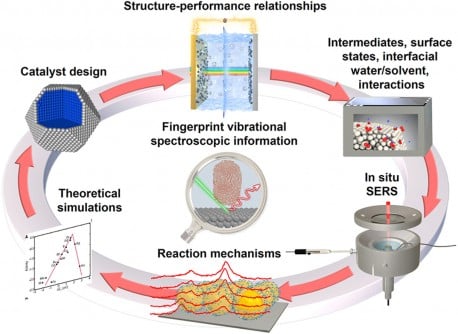
Advancements in electrochemistry have taken a significant leap with the introduction of in situ electrochemical surface-enhanced Raman spectroscopy (EC-SERS). This innovative technique enhances Raman signals through the use of plasmonic nanostructures, allowing for real-time detection of interfacial species during chemical reactions. A comprehensive review published in the journal eScience outlines how this method captures the vibrational signals of trace and transient interfacial species under operational conditions.
The review discusses how EC-SERS tracks dynamic Raman peaks of interfacial species, revealing the relationships between electrocatalyst properties and interfacial environments that influence reactions in fuel cells, water electrolysis, and carbon dioxide reduction. These findings establish critical links between interfacial species, reaction pathways, and mechanisms, providing essential guidance for the design of high-performance electrocatalysts and electric double layers (EDLs) vital for sustainable energy technologies.
Understanding the Mechanisms of Electrocatalysis
Published in 2025, the review elaborates on the principles and experimental designs that facilitate the coupling of Raman enhancement with electrochemical control. As described by the researchers, EC-SERS enables the identification of intermediates, surface states of electrocatalysts, and interfacial interactions in hydrogen, oxygen, and CO2 conversion systems. This molecular-level perspective significantly enhances the interpretation of reaction pathways and mechanisms during operational conditions.
A key feature of the technique is its reliance on localized surface plasmon resonance (LSPR) generated by gold (Au), silver (Ag), and copper (Cu) nanostructures. These “hotspots” amplify Raman signals by several orders of magnitude, allowing for the detection of species at the monolayer level. The review summarizes various strategies for constructing SERS substrates, including electrochemical roughening and chemical reduction, to improve the performance of electrocatalysts that lack inherent Raman activity.
By employing potential-dependent Raman shifts, vibrational Stark effects, and isotope tracing, EC-SERS is able to distinguish critical intermediates such as H*, OH*, and COOH*. The researchers provide case studies demonstrating how EC-SERS differentiates between associative and dissociative oxygen-reduction pathways on platinum (Pt) single crystals and reveals hydrogen-evolution kinetics on ruthenium (Ru) surfaces.
Implications for Future Energy Technologies
The review highlights the structural evolution of interfacial water, examining its hydrogen-bond network and cation-hydration states—insights that were previously inaccessible through other characterization methods. By integrating EC-SERS with density functional theory (DFT) and ab initio molecular dynamics (AIMD) simulations, the study correlates vibrational frequencies with adsorption energies, reaction barriers, and electric-double-layer structure.
The authors assert that EC-SERS offers “molecular-level clarity that was previously unattainable in operando electrocatalysis.” They emphasize that minute shifts in vibrational modes can track the reorganization of electrocatalytic surfaces and the modulation of electron-proton transfer by interfacial water and cations. This capability to visualize species under working conditions establishes EC-SERS as a vital link between spectroscopy and theoretical analysis.
By validating computational predictions and refining reaction models, EC-SERS equips researchers with a robust analytical framework for designing efficient electrocatalysts and EDLs. The authors argue that this technique opens powerful avenues for rational design in hydrogen production, fuel cells, and CO2 utilization, ultimately supporting the development of high-efficiency, sustainable energy-conversion systems crucial for a low-carbon future.
Future advancements in EC-SERS, including wider potential windows and improved spatial resolution, could solidify its position as a standard diagnostic tool for operando catalysis. The insights gained from this research will be instrumental in guiding the precise tuning of electrocatalyst composition and morphology, enhancing the performance of energy technologies essential for addressing climate change challenges.
According to the authors, the study was supported by various grants from the National Natural Science Foundation of China and the Natural Science Foundation of Fujian Province. The comprehensive review is available online at DOI: 10.1016/j.esci.2024.100352.