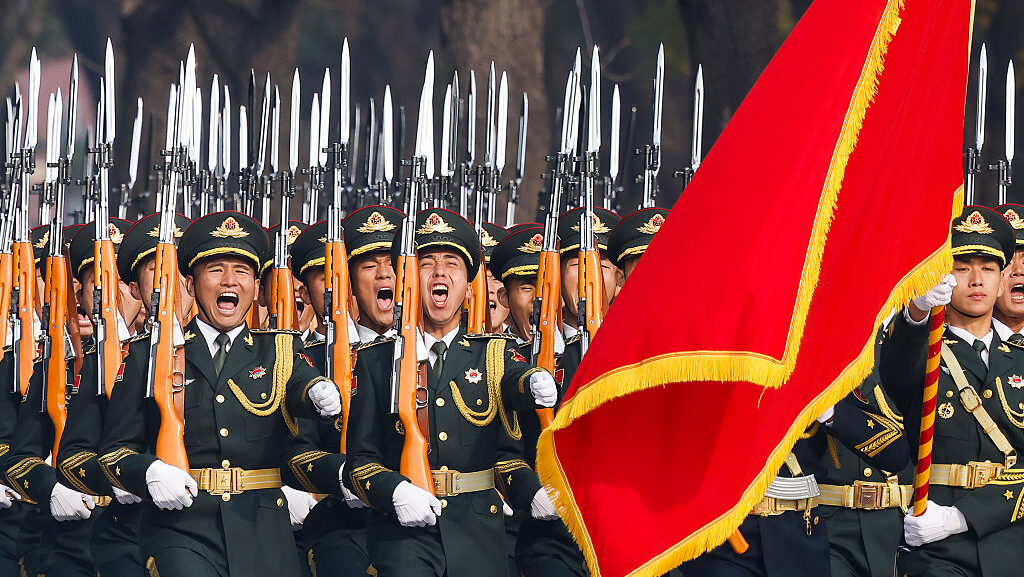
A new report from the Pentagon indicates that the ongoing military buildup and modernization efforts by China are rendering the American homeland “increasingly vulnerable” to various threats. This annual assessment, mandated by Congress and released on March 12, 2024, details how these developments pose direct risks to American security.
The report spans 100 pages and outlines significant advancements in China’s military capabilities across several strategic domains, including cyber, space, and nuclear warfare. It suggests that while the administration under President Donald Trump seeks to foster better relations with Beijing, China is actively enhancing its military readiness, particularly regarding Taiwan. According to the report, China aims to achieve a “strategic decisive victory” over Taiwan by 2027, should it be commanded to do so by President Xi Jinping.
Key Findings on Military Developments
The Pentagon’s assessment reveals alarming insights into China’s military strategies. By 2024, China had tested essential components for potential invasion plans concerning Taiwan. This included exercises aimed at striking both sea and land targets, targeting U.S. military forces in the Pacific, and blocking access to critical ports. The report straightforwardly states, “In other words, China expects to be able to fight and win a war on Taiwan by the end of 2027.”
Additionally, the report highlights several areas of concern:
1. **Space Capabilities**: As of January 2024, China had tripled its Intelligence, Surveillance, and Reconnaissance (ISR) satellite platforms in space since 2018. This expansion significantly boosts China’s ability to monitor and target U.S. and allied forces.
2. **Nuclear Arsenal**: The report notes that China’s nuclear stockpile remained in the low 600s through 2024, reflecting a slower rate of production compared to previous years. Nonetheless, a substantial expansion is anticipated, with projections suggesting that the People’s Liberation Army (PLA) could possess over 1,000 nuclear warheads by 2030, a stark contrast to the approximately 3,700 held by the U.S. and 4,300 by Russia.
3. **Missile Developments**: The assessment claims that China has likely loaded more than 100 solid-propellant Intercontinental Ballistic Missile (ICBM) silos with DF-31 class missiles, intended to support early warning counterstrike capabilities.
4. **Recent Tests**: In September 2024, China launched an unarmed ICBM into the Pacific Ocean for the first time since 1980, likely as part of a practice for wartime nuclear deterrence operations.
5. **Cyber Activities**: The report indicates that Chinese cyber actors engaged in extensive espionage and pre-positioned cyberattack capabilities against the U.S. and its allies in 2024, aligning with Beijing’s objectives to dominate the information domain.
Geopolitical Implications
Relations between China and Russia were also highlighted in the report. It details that in July 2024, the two countries conducted a combined bomber patrol into the U.S. Alaska Air Defense Identification Zone for the first time. This coincided with their inaugural combined coast guard patrol in the Bering Sea. The Pentagon report asserts that the deepening strategic relationship between Beijing and Moscow is likely driven by a mutual interest in countering U.S. influence, although they have not formalized a defense alliance.
The report arrives shortly after the Trump administration released its National Security Strategy, which notably shifts American focus toward the Western Hemisphere and economic relations with China. Interestingly, China is not mentioned until page 19 of that 33-page document.
When asked if he viewed China as a potential adversary for the newly announced Trump-class battleship, President Trump responded, “It’s counter to everybody; it’s not China. We get along great with China. I have a great relationship with President Xi.”
This juxtaposition of diplomatic optimism against the backdrop of military assessments underscores the complexities of U.S.-China relations. The Pentagon report aims to find a balance, stating that under President Trump’s leadership, ties between the two nations are stronger than in recent years. Yet it emphasizes the necessity for the U.S. military to remain prepared to defend national interests in the Indo-Pacific region.
As the report concludes, the U.S. does not seek to “strangle, dominate, or humiliate China,” but it firmly reiterates that American interests in the region are fundamental and must be safeguarded.