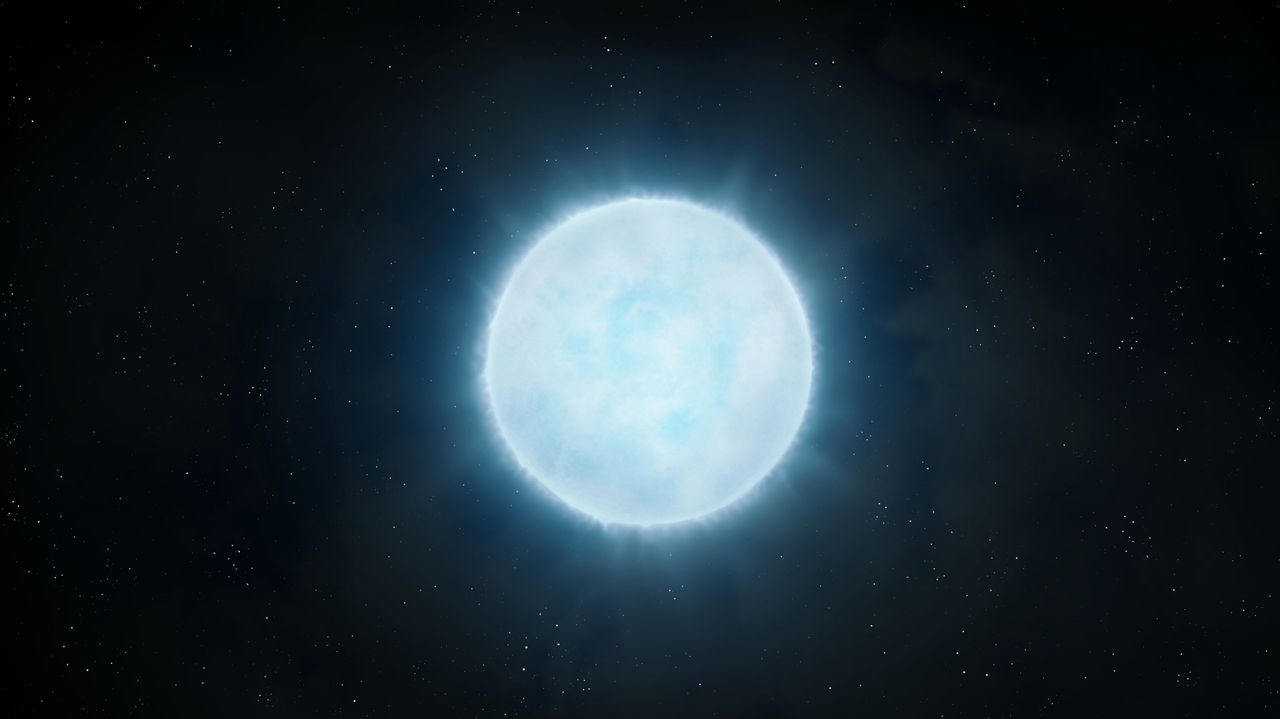
Researchers are using ancient white dwarfs and data from the Hubble Space Telescope to investigate the axion, a theoretical particle proposed decades ago to address challenges in understanding the strong nuclear force. Although initial searches for axions in particle collider experiments yielded no results, new insights suggest that these elusive particles could play a significant role in explaining dark matter.
The recent study, published in November 2025 on the open-access server arXiv, aimed to refine models of axion production and explore their potential effects on white dwarfs. White dwarfs, which are the dense cores of dead stars, can contain the mass of the sun within a volume smaller than Earth. Their unique characteristics make them ideal candidates for examining the potential influence of axions.
According to the study, white dwarfs resist gravitational collapse through a phenomenon known as electron degeneracy pressure. In this process, a large number of free electrons arrange themselves in such a way that they prevent further compression, as quantum mechanics dictates that no two electrons can occupy the same state. Some theoretical models propose that axions could be generated by fast-moving electrons. If electrons within a white dwarf were to reach sufficient speeds, they could produce axions that escape into space, thereby depleting the star’s energy and causing it to cool more rapidly than expected.
The researchers utilized advanced simulation software to model the evolution of white dwarfs, factoring in both standard cooling processes and those influenced by potential axion production. By doing so, they were able to predict the expected temperature of a white dwarf based on its age, with and without the cooling effect of axions.
To put their findings to the test, the team analyzed archival data from the globular cluster 47 Tucanae, which contains a large population of white dwarfs that formed around the same time. This consistency in age provides a valuable dataset for comparison. Their analysis, however, did not reveal evidence of axion-induced cooling among the white dwarfs studied.
The research did yield important constraints on the efficiency of electron-axion interactions. The findings suggest that electrons cannot produce axions more effectively than once in a trillion interactions. This does not entirely eliminate the possibility of axions existing, but it does indicate that direct interactions between electrons and axions are unlikely.
As scientists continue their search for axions, this study highlights the importance of innovative methods in the quest for understanding dark matter. The results contribute to a clearer picture of the universe’s complexities and set the stage for future investigations into these mysterious particles. Further exploration and refined techniques will be essential for unraveling the secrets that dark matter holds.