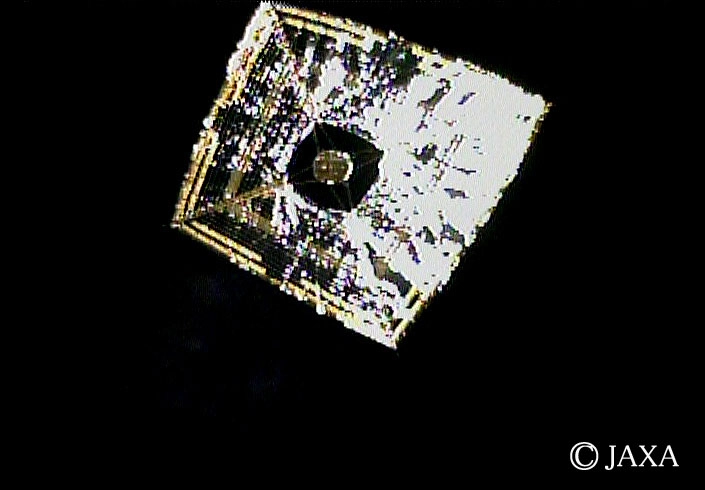
A team of researchers from the University of Pennsylvania has introduced a groundbreaking method for maneuvering solar sails, using a technique called kirigami. This innovation addresses a long-standing challenge in solar sailing: how to effectively change the direction of these sails without relying on traditional propulsion methods.
Solar sails, which harness sunlight for propulsion, have the distinct advantage of not requiring propellant. Traditional sailing utilizes sail adjustments and rudders for direction, but the absence of a rudder in solar sailing complicates maneuverability. The new study, authored by Gulzhan Aldan and Igor Bargatin, proposes using kirigami, an ancient Japanese art form that involves cutting paper to create intricate designs.
Understanding Kirigami’s Role in Solar Sails
The researchers designed a solar sail with intentional cuts in a grid pattern on the aluminized polyimide film, commonly used in solar sails. This method allows the material to “buckle” when pulled, transforming the flat sail into a three-dimensional surface. Each segment of the sail tilts in relation to the source of light, acting like numerous tiny mirrors that reflect sunlight at varying angles. According to the principles of momentum conservation, this design enables the sail to be propelled in the opposite direction of the reflected light.
Traditional methods for turning solar sails, such as reaction wheels, are heavy and inefficient, requiring propellant. Recent developments like tip vanes and Reflectivity Control Devices (RCDs) provide some solutions but often come with their own drawbacks. RCDs, for example, use liquid crystal panels that consume power to maintain their state, leading to potential energy depletion over time.
The kirigami approach, in contrast, primarily relies on servo motors to create the necessary buckling. These motors are energy-efficient and only consume power during operation, offering a significant advantage over previous technologies. Although some power is still required, it is minimal compared to alternatives.
Experimental Validation and Future Implications
To validate their method, Aldan and Bargatin conducted simulations using COMSOL, a widely recognized physics simulation software. They performed a series of ray tracing experiments to measure the forces on the sail under various conditions of buckling and solar angles. The results, while indicating a small force of 1 nanonewton per watt of sunlight, demonstrated sufficient capability to maneuver a small solar sail and its payload effectively.
In addition to simulations, the researchers performed practical tests by cutting the film and placing it in a test chamber. They directed a laser at the film and applied tension. Observations showed that the laser’s movement across the chamber walls corresponded closely with the predicted angles based on the strain levels applied.
The implications of this technology extend beyond simple maneuverability. By reducing the energy and propellant costs associated with turning capabilities, kirigami solar sails could revolutionize space exploration. However, the landscape remains competitive, with various technologies vying for dominance, and the lack of extensive experimental missions presents a hurdle for widespread adoption.
While it may take time before this innovative technique is deployed in actual space missions, its potential to transform solar sailing is undeniable. As research progresses, the development of these sails promises to yield visually stunning and functionally efficient spacecraft.
For further information, refer to the paper by G. Aldan and I. Bargatin, titled “Low-Power Solar Sail Control using In-Plane Forces from Tunable Buckling of Kirigami Films.”