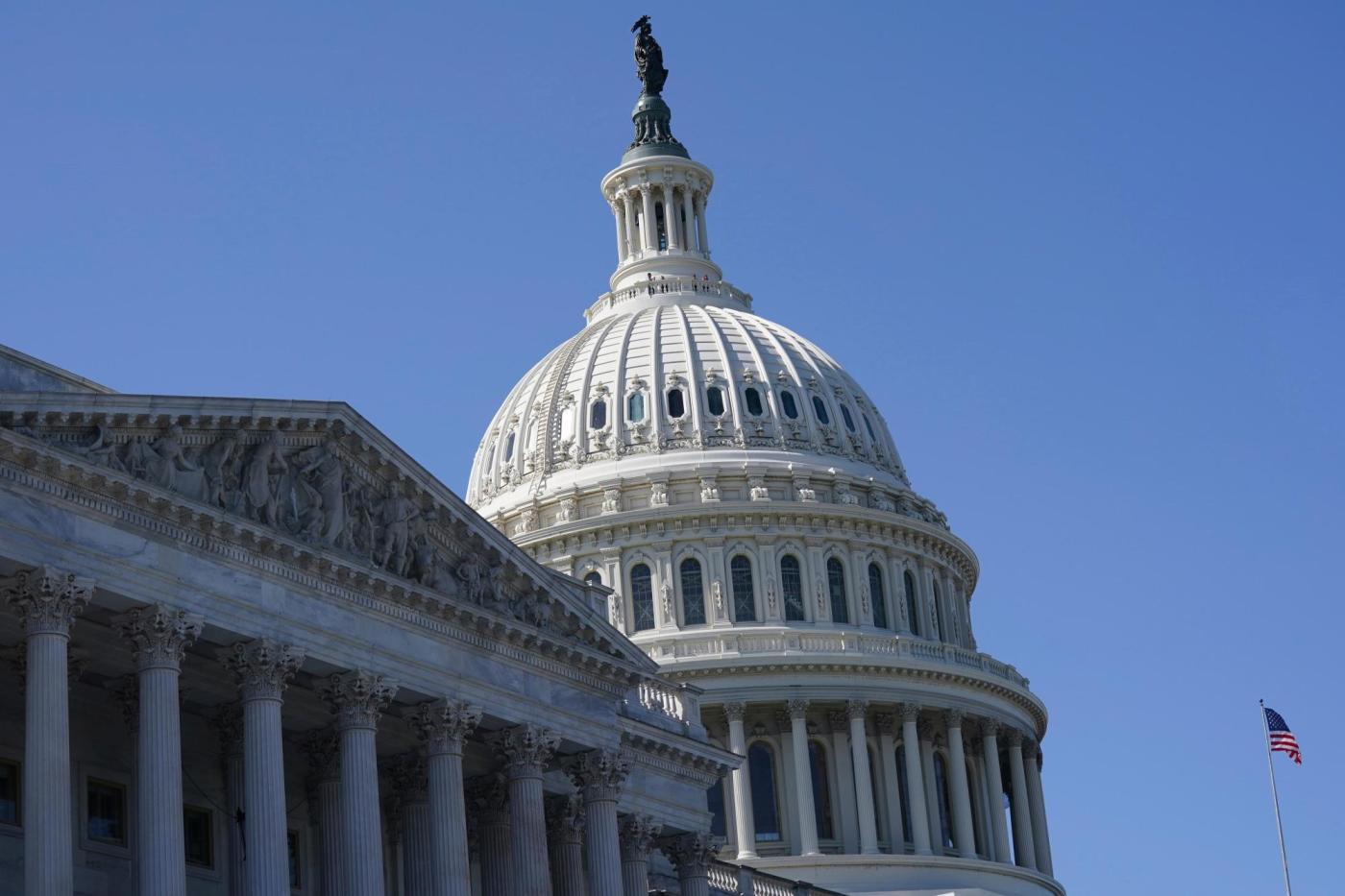
A notable increase in executive orders has marked the political landscape this year, coinciding with a significant decline in legislative activity from Congress. As the 2026 midterm elections approach, political analysts suggest that lawmakers are unlikely to reassert their power significantly.
Todd Belt, the political management program director at George Washington University, remarked, “Politicians are risk-averse creatures.” This tendency is especially pronounced during midterm election years, which often see a downturn in congressional output. Belt elaborated, “Nobody wants to do anything too provocative during an election year, during a congressional election year.” This sentiment holds true for both major political parties.
In 2023, President Donald Trump signed an impressive total of 225 executive orders, surpassing the number he issued during his first term within just 11 months. In stark contrast, The Washington Post reported that Congress achieved a modern record low for legislative activity in the first year of a new presidency, with only 38 bills passed and signed into law by December 19. After a few days, Trump added six more bills, bringing the annual total to 44 bills. This figure is significantly lower than the 76 laws he signed in his first year, the 68 laws signed by Joe Biden in his first year, and the 115 laws enacted during Barack Obama’s initial year in office.
Casey Burgat, director of legislative affairs at George Washington University, noted a lack of enthusiasm for legislative initiatives. Despite the Republican Party controlling the White House and both chambers of Congress, the narrow margins in the House and Senate hinder substantial legislative accomplishments. Internal divisions within the Republican Party also complicate matters. Burgat stated that while there may be general consensus on certain policies, support often wanes over specific details, allowing Trump to govern primarily through executive orders.
Congressional Republicans have recognized the challenges of achieving legislative success this year, which has contributed to their willingness to allow Trump to operate from the executive branch. Burgat explained, “He can do it with the stroke of a pen,” allowing the party to claim policy victories while lawmakers still receive credit.
The impending midterms present a complex challenge for the Republican Party, according to Oklahoma State University politics professor Seth McKee. He pointed out that even the party’s flagship initiative, the “One Big Beautiful Bill,” is not well-received among voters. McKee commented, “If you’re in a deep-red district, you can say, ‘Look, I support the president’s policies,’ and you’re fine. But if you’re more near the center… I don’t know what you tell your voters.”
This situation creates an advantageous environment for Democrats, who currently lack control in Washington. They are poised to campaign against a so-called do-nothing Congress in 2026, a strategy Burgat described as a “tried-and-true minority party attack.” However, he cautioned that broader public sentiment about the economy and perceptions of Trump’s performance will be more influential in motivating voters.
Historically, the president’s party has lost seats in the House during midterm elections, a trend observed in eight of the last ten elections over the past 40 years. In the 2018 midterms, Trump’s Republicans lost 40 House seats. Currently, The Cook Political Report identifies only 17 of 435 House seats as competitive, while just two Senate seats are deemed toss-ups. Political analysts believe Democrats are well-positioned to regain control of the House, with the Senate remaining in play but likely favoring Republican retention.
Despite Congress’s low legislative output in 2025, experts note that the GOP’s One Big Beautiful Bill encompasses a wide array of policy initiatives. Charles Hunt, a politics professor at Boise State University who specializes in Congress, highlighted a trend toward omnibus legislation, where multiple legislative priorities are consolidated into one extensive bill. He stated, “This effect is to maybe make it look like Congress has been less active than it actually has been in terms of total policy output.”
Nevertheless, Hunt described the current Congress as dysfunctional. He stated, “There’s no denying that Mike Johnson has, in this term, been a really ineffective Speaker of the House,” although he acknowledged the unique challenges Johnson faces. The Speaker must navigate a caucus divided between far-right members and those more centrist who are concerned about their competitive districts.
Hunt also observed that Trump has been consolidating power away from the legislative branch. However, he believes Congress has recently taken steps to reassert its authority. He cited votes that compelled Trump to release the Epstein files and efforts to ban stock trading for members of Congress.
As Congress looks ahead, lawmakers still have spending bills to pass for the current fiscal year. Belt anticipates minimal activity outside of budgetary matters in 2026. He suggested that if the courts challenge Trump’s powers, particularly regarding tariffs, there may be some congressional legislation aimed at empowering the president. Additionally, the potential lapse of Obamacare subsidies could compel lawmakers to address that issue, influenced by public pressure.
For further information or tips, contact Cory Smith at [email protected] or on social media at x.com/Cory_L_Smith.