As protests erupted across India in response to a controversial Supreme Court ruling in November 2025, a video falsely claimed to depict one of these demonstrations. The video, however, was actually recorded during a community meeting in January 2025, several months prior to the court’s decision.
The Supreme Court’s verdict involved a significant alteration to the definition of the Aravalli hills, one of the world’s oldest mountain ranges, spanning across Rajasthan, Haryana, Gujarat, and Delhi. Under the new ruling, areas below 100 metres (approximately 328 feet) in altitude would no longer be classified as part of the protected mountain range. This change raised alarms among environmentalists, who warn it could jeopardize many lower hills that are ecologically crucial, making them susceptible to mining and construction activities.
The protests that followed the Supreme Court’s decision were fueled by concerns regarding environmental protection. According to the Asian News International (ANI), environmental advocates argue that the ruling will expose vital ecological areas to exploitation. In contrast, the government has asserted that the ruling is intended to standardize regulations and enhance environmental safeguards rather than diminish them.
Shortly after the ruling, the Supreme Court stayed its own order on December 29, 2025, and established an expert panel to further evaluate the ecological implications of its decision.
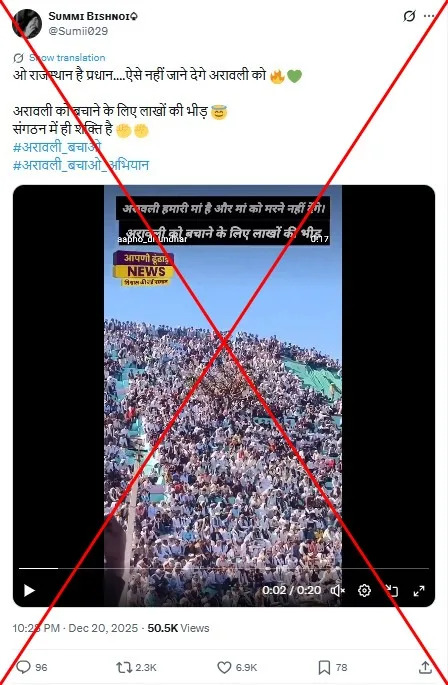
The misleading video began circulating on social media on December 20, 2025, with claims that it showcased a protest in support of the Aravalli hills. The video was shared along with a Hindi-language post stating, “A crowd of millions to save the Aravalli hills! There is strength in unity,” accompanied by the hashtag #SaveAravalli.
However, investigations revealed that the video depicts a gathering known locally as a mahapanchayat, which took place on January 28, 2025, in a village in Rajasthan. This community assembly addressed a dispute between two families over a cancelled wedding ceremony and attracted an estimated 12,000 to 13,000 attendees. A local media organisation, News18, published a report on this event, confirming the details of the gathering.
Amit Meena, a participant in the January meeting, clarified in a phone interview with AFP on December 24 that the video was not related to the Supreme Court’s ruling. He noted that the meeting was held at a wrestling ground in the village and that there were no protests occurring in his community.
The misleading representation of the video underscores the ongoing challenges surrounding the dissemination of information, especially during times of social unrest. Past instances of similar misinformation have already been debunked, highlighting the importance of verifying claims before sharing content on social media platforms. As the debate over environmental protections continues, clarity and accuracy in reporting remain crucial.