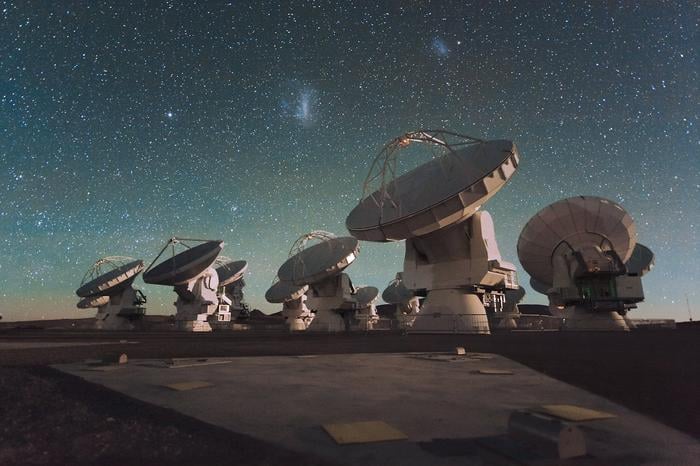
The Atacama Large Millimeter/Submillimeter Array (ALMA) in Chile has significantly enhanced its observational capabilities with the installation of 145 new low-noise amplifiers (LNAs). This upgrade, announced by the Fraunhofer Institute for Applied Solid State Physics (IAF) and the Max Planck Institute for Radio Astronomy (MPIfR), expands the array’s Band 2 coverage to frequencies between 67 to 116 GHz. This advancement will enable scientists to conduct more detailed studies of the cosmos, particularly in the investigation of the cold interstellar medium.
ALMA, renowned for its ability to explore the universe’s most elusive regions, employs 66 parabolic antennas to detect millimeter and submillimeter radiation emitted by cold molecular clouds. These clouds are crucial as they are the birthplaces of new stars. Previously, ALMA’s frequency range included 35–50 GHz and 787–950 GHz, known as Band 1. The addition of the new amplifiers will allow researchers to delve deeper into areas previously inaccessible, enhancing our understanding of star formation, planet-forming disks, and the complex organic molecules (COMs) that may indicate the building blocks of life.
The LNAs feature advanced monolithic microwave integrated circuits (MMICs), developed by Fraunhofer IAF using indium gallium arsenide (InGaAs). These circuits utilize metamorphic high-electron-mobility transistor (mHEMT) technology, which optimizes performance for high-frequency receivers. The integration of these components significantly amplifies low-noise signals while minimizing background interference, thereby increasing the sensitivity of ALMA’s observations.
Dr. Fabian Thome, who oversees the subproject at Fraunhofer IAF, emphasized the collaborative nature of this achievement. Both Fraunhofer IAF and MPIfR were tasked by the European Southern Observatory (ESO) to deliver these amplifiers. While Fraunhofer IAF managed the design, manufacturing, and testing of the MMICs, MPIfR was responsible for assembling and qualifying the LNA modules, followed by rigorous testing under cryogenic conditions.
Prof. Dr. Michael Kramer, executive director at MPIfR, praised the collaboration, stating, “This is a wonderful recognition of our fantastic collaboration with Fraunhofer IAF, which shows that our amplifiers are not only ‘made in Germany’ but also the best in the world.”
With these upgraded capabilities, ALMA is poised to provide unprecedented insights into the formation and evolution of stars and planetary systems. Researchers anticipate that the enhanced ability to study COMs in nearby galaxies will shed light on the fundamental processes leading to the emergence of life in the universe.
As the scientific community looks forward to the implications of this upgrade, it is clear that ALMA remains at the forefront of astronomical research, equipped to explore the depths of space with renewed vigor.