Research led by Meizhen Wang at Zhejiang Gongshang University has revealed that plant-derived compounds can effectively reduce the risks associated with human bacterial pathogens in manure-amended soils. Published on November 26, 2025, in the journal Biocontaminant, the study highlights how these natural extracts interfere with bacterial communication rather than directly killing harmful bacteria.
The use of manure in agriculture is vital for maintaining soil fertility and enhancing crop yields. However, it can introduce harmful microbes, known as human bacterial pathogens (HBPs), which may contain antibiotic resistance genes (ARGs) and virulence factor genes (VFGs). These pathogens can spread through mobile genetic elements (MGEs), potentially contaminating crops and entering the food chain, posing serious risks to both ecosystems and human health.
Existing methods to mitigate these risks, such as biochar or engineered nanoparticles, can often be costly or raise environmental concerns. In contrast, plant extracts have been extensively studied for their potential in soil remediation and plant protection. Despite this, their effects on soil-borne pathogens and gene transfer mechanisms had not been thoroughly investigated—until now.
Study Findings and Methodology
Wang’s research utilized a combination of manure-amended soil microcosms, metagenomic profiling, targeted gene quantification, pure-culture assays, and molecular docking analyses to explore the impact of three specific plant-derived compounds: curcumin, andrographolide, and thymol. The team identified a total of 323 HBPs from a curated database and monitored changes in their abundance, community composition, and diversity after treatment with these extracts.
The study revealed significant reductions in total HBP abundance, with approximately 25–28% decrease observed. Notably, the extracts selectively targeted pathogens associated with Actinobacteria and Proteobacteria. Overall microbial richness declined, although there were no significant changes in alpha diversity. Key indicators of risk were also reduced, with ARGs decreasing by about 20–27%, VFGs by 6–11%, and MGEs by 25–34%.
Network analysis demonstrated pronounced declines in high-risk HBPs that co-hosted ARGs and VFGs, underscoring the potential of plant extracts to mitigate microbial health risks.
Mechanisms of Action
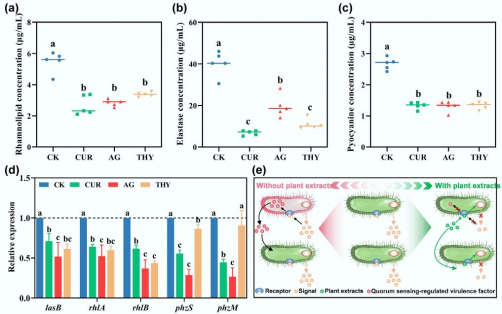
The study investigated the mechanisms by which plant extracts disrupt quorum sensing (QS)—the communication system that enables bacteria to coordinate their behavior, including biofilm formation and virulence. Results indicated that the plant compounds reduced the abundance of QS-related genes and the concentration of acyl-homoserine lactone signals, leading to the downregulation of QS-regulated genes.
This disruption translated into a significant reduction in virulence factor secretion, with up to 40% inhibition of biofilm formation and as much as 90% suppression of conjugative transfer of ARGs and VFGs. Molecular docking analyses confirmed that the plant compounds bind to the QS receptor LasR with greater affinity than natural signal molecules, effectively blocking bacterial communication.
The findings suggest that using plant extracts as soil amendments can provide an environmentally friendly strategy to reduce the health risks associated with manure application. Unlike conventional antibiotics or nanomaterials that aim to kill pathogens, these compounds offer a unique approach by disarming them, thereby reducing selective pressure for developing resistance.
The research was supported by various funding sources, including the ‘Leading Goose’ R&D Program of Zhejiang and the National Key R&D Program of China. This work contributes to the growing body of evidence that highlights the potential of natural solutions in addressing agricultural challenges and protecting public health.