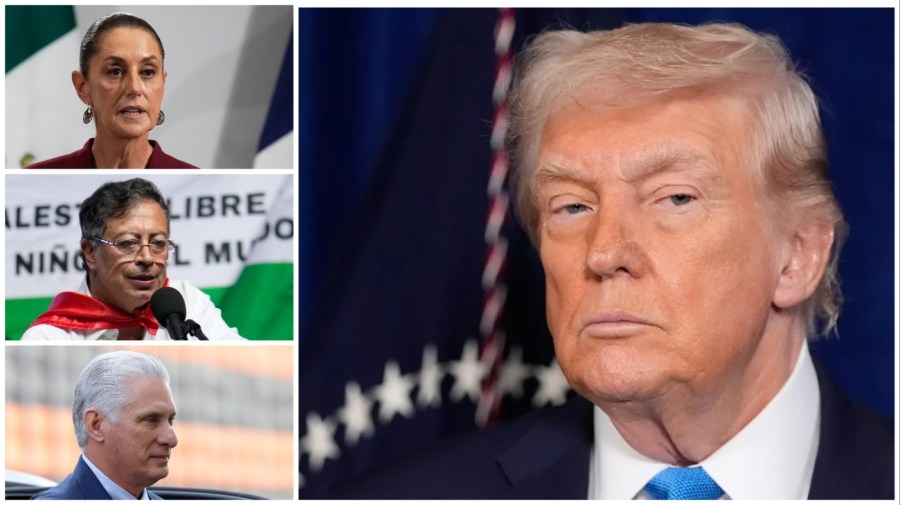
President Donald Trump has escalated pressure on Latin American leaders following the recent upheaval in Venezuela. The U.S. president’s actions come after his administration’s successful efforts to oust Venezuelan leader Nicolás Maduro, creating a significant shift in regional dynamics. Trump’s statements suggest a commitment to exert influence over Venezuela’s future governance.
In a raid early on April 7, 2023, U.S. forces captured Maduro, a move that has sent shockwaves through the region. Trump has since made it clear that the United States intends to take a leading role in shaping Venezuela’s political landscape. During a weekend press conference, he warned other Latin American leaders that they must align with U.S. interests or face consequences.
The president’s remarks signal a broader strategy to reinforce U.S. influence in Latin America, particularly in countries that have been sympathetic to Maduro’s regime. Trump has targeted nations like Cuba and Nicaragua, suggesting that their support for Venezuela could lead to a recalibration of diplomatic relations with the United States.
In the aftermath of Maduro’s capture, the U.S. Department of State issued a statement underscoring its commitment to restoring democracy in Venezuela. Secretary of State Antony Blinken emphasized the importance of a democratic transition, stating, “The United States stands ready to support the Venezuelan people in their quest for freedom.”
Responses from Latin American leaders have varied. Some have expressed concern about the potential for increased U.S. intervention, while others have welcomed the change in leadership in Venezuela. The Organization of American States (OAS) has convened an emergency session to discuss the implications of the U.S. actions and the future of regional stability.
As the situation unfolds, the impact on trade, security, and migration patterns across Latin America remains uncertain. Analysts warn that increased U.S. involvement could lead to further polarization among nations in the region. Countries that have previously aligned with Maduro may resist Trump’s approach, potentially leading to diplomatic tensions.
The next few weeks will be crucial as the U.S. seeks to establish a stable government in Venezuela. The international community is watching closely as Trump’s administration navigates this complex landscape, balancing assertive actions with diplomatic efforts to avoid escalating conflicts.
In summary, Trump’s recent actions regarding Venezuela reflect a decisive shift in U.S. foreign policy towards Latin America, with potential ramifications for regional leaders and their relationships with the United States. The unfolding developments are likely to shape the political landscape in Latin America for years to come.