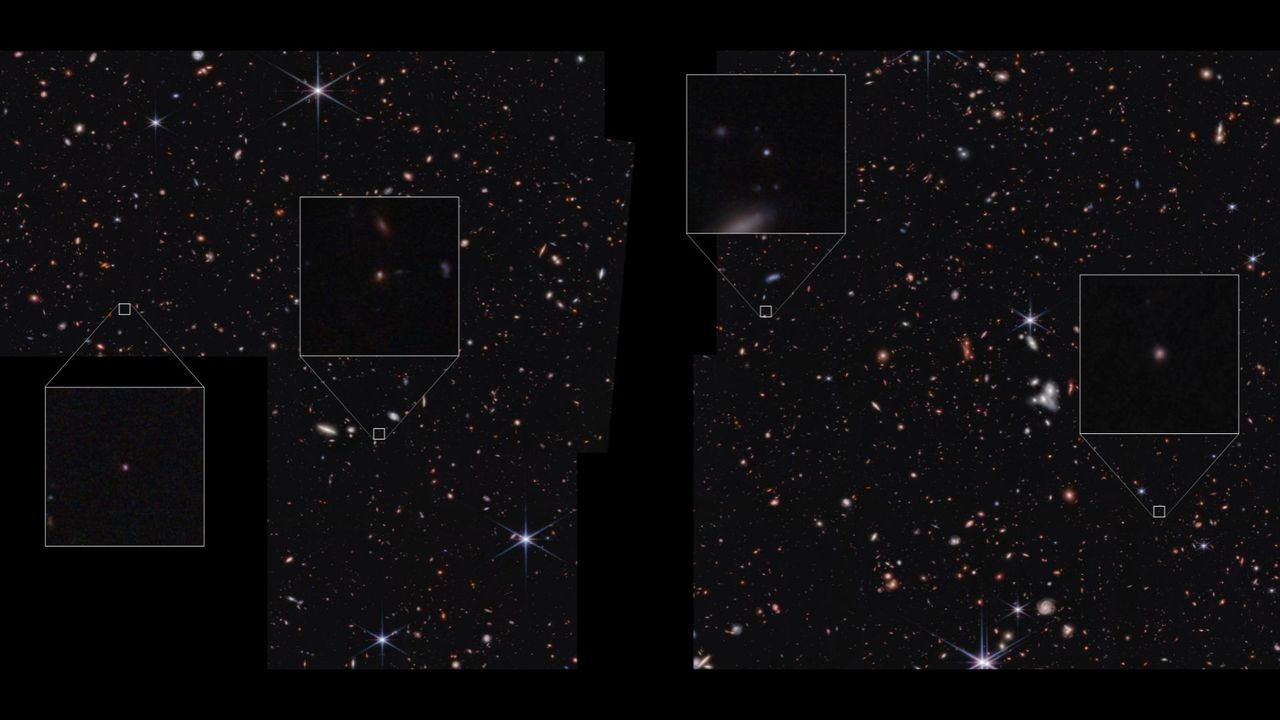
NASA’s James Webb Space Telescope (JWST) has identified a series of unusual cosmic objects that have intrigued astronomers. These objects, which exhibit characteristics of both stars and galaxies, have been informally dubbed “platypus galaxies” due to their peculiar features. Researchers suggest that these findings could offer insights into the formation of galaxies during the early universe.
At first glance, the newly discovered objects appear as small points of light in JWST data, resembling stars. However, closer examination revealed distinct galaxy-like traits. According to Haojing Yan, an astronomer at the University of Missouri, “If you look at any of the features separately, just putting them together makes a platypus look so odd. Our objects are exactly like that.” Yan presented these findings at a news conference on January 6, 2024, during the annual meeting of the American Astronomical Society in Phoenix.
Unraveling the Mystery of Cosmic Objects
After the JWST began operations in 2021, it quickly showcased various unusual celestial objects. Motivated by these discoveries, Yan and his students began investigating additional compact sources to determine if any anomalous objects had gone unnoticed. The researchers examined approximately 2,000 objects, identifying nine that were slightly larger than typical point sources.
While most compact celestial objects are classified as stars, these nine exhibited characteristics that led researchers to label them as “point-like.” “It’s very close to a point source, but not exactly,” Yan explained. Instead of the broad emission lines associated with stars, they identified narrow lines indicative of active star formation commonly found in galaxies.
The team initially considered whether these newfound objects could be quasars—quasi-stellar objects powered by supermassive black holes at the centers of galaxies. However, they found that these objects did not fit the traditional quasar classification due to their unexpected dimness and narrower spectral fingerprints. “Our objects are not quasars,” Yan confirmed.
Potential New Class of Galaxies
Despite the discrepancies with known categories, these objects might belong to a new kind of Active Galactic Nuclei (AGN), referred to as narrow-line AGN. Yan noted, “If our objects end up within the narrow-line AGN classification, they must be of a new kind.”
Another possibility is that these peculiar objects are young star-forming galaxies. Bangzheng Sun, also from the University of Missouri, explained that star-forming galaxies evolve at an accelerated rate and produce narrow emission lines. If this hypothesis holds, the objects would likely be no more than 200 million years old. “They are still in their infancy,” Sun stated.
Should these objects be classified as galaxies, their slightly enlarged size raises questions regarding their formation. “These galaxies must be sitting there, forming stars from the inside out,” Sun added. This inside-out formation process is unprecedented and may be occurring in multiple galaxies, according to Yan.
Typically, stellar formation results in chaotic motion, but Yan suggested that these objects might indicate a more tranquil process, allowing their point-like appearance to remain intact.
The research team believes they have identified a new population of celestial objects, but whether they represent a novel AGN or unique young galaxies remains uncertain. They anticipate further observations with the JWST will clarify these findings. “These nine objects are special,” Yan remarked. “They are our platypuses.”
As astronomers continue to analyze these enigmatic cosmic entities, they may uncover more about the early universe and the processes that shaped it.