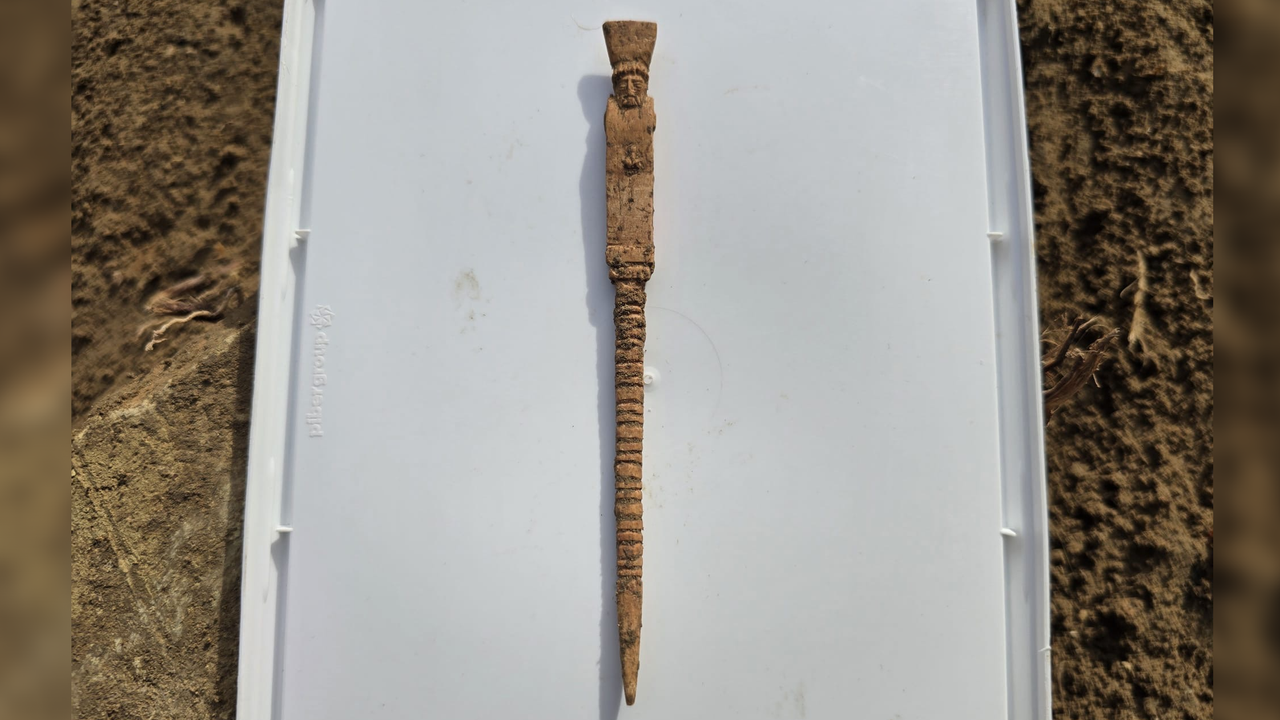
Archaeologists in southern Sicily have made a significant discovery with the unearthing of a 2,500-year-old bone stylus featuring an intricate depiction of the Greek god Dionysus along with an erect phallus. This artifact, skillfully crafted and measuring approximately 5.2 inches (13.2 centimeters) long, dates back to the 5th century B.C., a period when Sicily was a prominent Greek colony.
Details of the Discovery
According to Daniela Vullo, the head of the Superintendency for Cultural and Environmental Heritage of Caltanissetta, this stylus represents a unique find in the archaeological landscape of that era. The stylus, which served as a pointed instrument for writing on or marking clay or wax, features a grumpy-looking male head at its top. The central part of the stylus distinctly portrays an erect penis, suggesting it was carved to resemble a herm of Dionysus.
In ancient Greece, herms were sculptures typically made from upright blocks of stone, characterized by a carved head and male genitalia. They were believed to ward off evil and were often placed at crossings, borders, and in front of temples. The term “herm” is linked to the Greek god Hermes, who is associated with fertility and protection.
Context and Significance
The stylus was discovered during excavations in the city of Gela. Archaeologists speculate it may have been used by a ceramicist to mark pottery before being dedicated as an offering to a deity. “Due to its unique characteristics, it deserves to be exhibited and made available for public enjoyment,” Vullo stated.
In addition to this remarkable stylus, the excavation site has revealed a substantial Hellenistic-era neighborhood, dating from the 4th to 1st centuries B.C., which continues to be explored. This ongoing research promises to provide further insights into the cultural practices and artistic expressions of ancient Sicilian society. This discovery not only enriches our understanding of the past but also highlights the enduring legacy of Greek influence on the island.