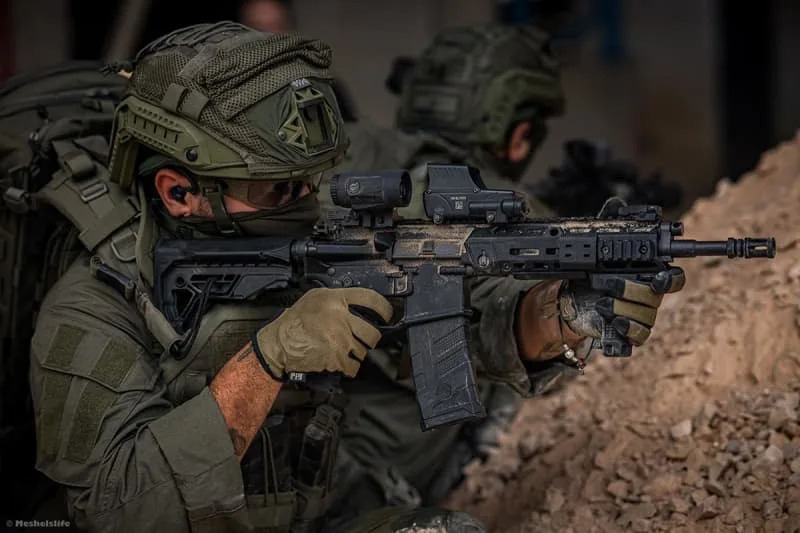
The Israel Defense Forces (IDF) is grappling with challenges related to the armament of reservists during ongoing military operations following the prolonged conflict with Hamas. Reports indicate that logistical complexities and economic strains stemming from the war have raised concerns about the adequacy of weaponry supplied to reservists.
The conflict, which escalated significantly on October 7, 2023, has resulted in a sustained military engagement that has tested the IDF’s logistical capabilities. Initial assessments suggest that reservists faced significant delays in receiving proper armament, particularly during the late stages of 2023 and early 2024. Although there was some progress in supplying better gear due to public pressure, the situation has fluctuated, leading to renewed issues.
Shortages of M4 rifles, especially the sharpshooter variants, have been reported among certain reservist units. Some soldiers expressed dissatisfaction with the performance of the Arad rifles, which are being used in place of the more reliable M4. Furthermore, concerns have surfaced regarding outdated night vision equipment, as many reservists continue to rely on the obsolete Akila 4 system.
In a statement from the IDF Spokesperson’s Office, it was confirmed that the military is in the process of acquiring tens of thousands of M4 rifles for both mandatory and reserve soldiers. Additionally, thousands of Arad rifles are being purchased for specific units. The IDF highlighted that the distribution of M4 rifles is underway but acknowledged that the process is not uniform. Soldiers in Gaza operations are prioritized for receiving the latest weaponry, while others stationed for guard duty may face delays.
Logistical Challenges and Soldier Sentiment
As the conflict drags on, the economic repercussions are impacting the IDF’s budget for reservists. The Defense Ministry’s recent announcement to distribute Arad rifles to local border-village volunteer security teams sparked frustration among some reservists. They perceived the move as a signal that the IDF is providing less effective weaponry to local teams while they themselves have been armed with these same rifles during critical operations.
The M4 rifle is recognized as superior to the Arad, leading to discontent among soldiers who feel that they are being equipped with less effective tools. Some have noted that while the Arad rifles may be an improvement for local security teams, they are still considered inferior to the M4, raising questions about the IDF’s prioritization in equipment distribution.
The transition away from the Tavor rifle, which had seen extensive use, has also contributed to confusion among reservists. The IDF’s decision to adopt the M4 was based on assessments of affordability, sustainability, and ease of maintenance. As a result, the Arad rifles have been issued primarily when M4s or Tavors are unavailable.
Looking Ahead: The Future of Reservist Armament
The current state of armament among IDF reservists is inconsistent. Some units are adequately equipped, while others face shortages, and the economic situation could further complicate matters. The process to upgrade the night vision capabilities from the Akila 4 system to the newer T75 thermal imaging weapon sight is separate and expected to take several months.
The IDF acknowledges that for the time being, some reservist units will continue to use outdated equipment. As the situation evolves, clarity and transparency regarding the distribution of weaponry could improve morale and operational effectiveness among reservists.
As the IDF navigates these logistical challenges, the question of whether reservists are properly armed remains complex. The answer varies across units, highlighting the need for ongoing assessment and adaptation to ensure that all soldiers are adequately equipped as they serve in critical operations.