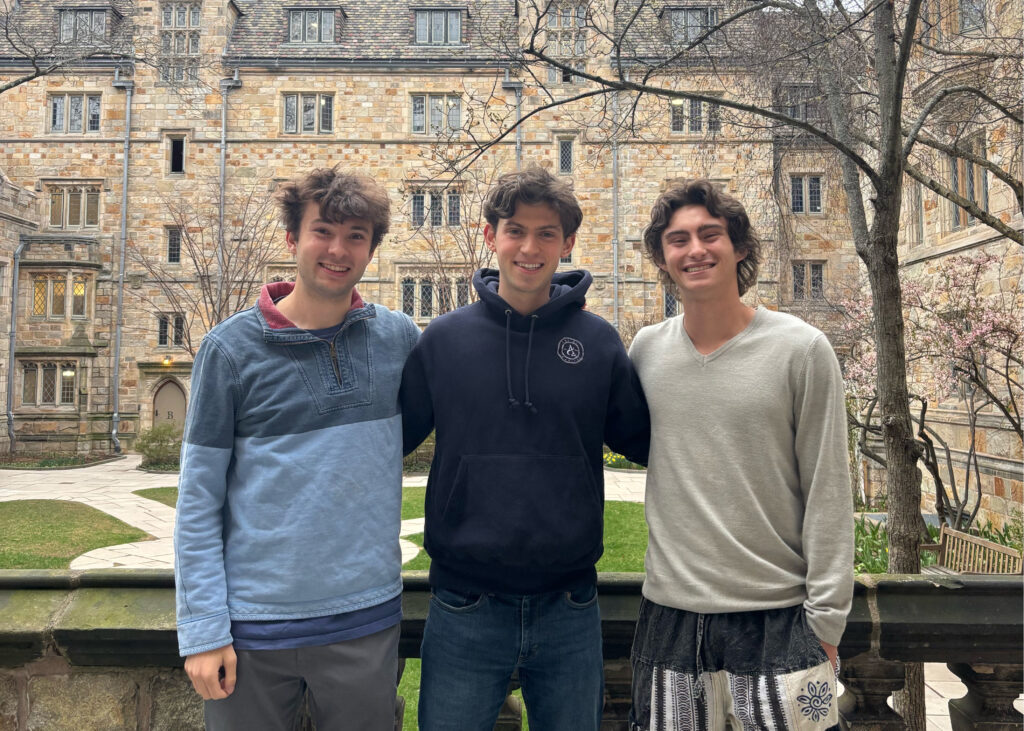
Three students from Yale University have developed a new application called Scroll Toll, designed to help users minimize their screen time while supporting charitable causes. Launched in November 2023 by Asher Barondes, Benjamin Siegel, and Chase Reynders, the app incentivizes users to donate to selected charities when they exceed their predetermined screen time limits.
Scroll Toll operates by allowing users to set time restrictions on specific applications on their smartphones. If users surpass these limits, the app prompts them to donate to one of its partner charities. This approach not only encourages reduced screen time but also fosters a sense of social responsibility. “We wanted to add more friction to really get people off their phones,” Barondes stated, emphasizing the app’s dual purpose of promoting healthier habits while contributing to social good.
Upon downloading the app, users can designate time limits for each application they wish to monitor and select a donation amount for each instance they exceed those limits. For instance, a user could opt to donate $0.25 for every additional five minutes spent on Instagram. The app further provides an option for users to enable automatic donations or to donate manually, allowing flexibility in how they manage their contributions.
The concept behind Scroll Toll was born from a shared recognition between Barondes and Siegel, who were both independently exploring similar ideas prior to their collaboration. Their partnership was solidified during Siegel’s gap year before attending Yale, where they met through mutual acquaintances. Reynders subsequently joined the project, enhancing its development.
Siegel’s previous experiences with social media have influenced his perspective on screen time. During his gap year, he and friends created an Instagram account that amassed two million followers. Reflecting on his time spent on social media, Siegel noted, “I would look at the stats on the phone after I posted something on it. You’re like, holy crap. I just wasted 100 years of people’s lives in this few-second video I just posted.” He aims to change the relationship users have with their phones through Scroll Toll, promoting a healthier balance.
Since its announcement within the Yale community, the app has garnered attention from early users. Barondes reported that even with a modest group of 65 users, the app achieved an average reduction of 20% to 30% in screen time. As of January 2024, the user base has grown to 130 participants, and the team has implemented user feedback by introducing weekly reports on screen time usage.
Among the initial users, Evan Daneker has found value in the app’s approach. Residing with Reynders, he has been donating to American Forests, a non-profit focused on forest restoration. Daneker previously used other screen time management apps but appreciates that Scroll Toll does not impose strict limitations. He stated that when an app blocker shuts down usage completely, users often delete it and revert to their previous habits. “I sort of appreciated that Scroll Toll was a little more permissive but still incentivized you to gradually reduce your screen time usage to a healthier amount,” he noted.
Another user, Sofia Jacobson, had never used an app blocker until she tried Scroll Toll. The app helped her establish realistic screen time limits, reducing her reliance on extending her usage. She found that the notifications prompted her to reconsider her phone habits, particularly during mindless scrolling sessions.
The developers are focused on refining their app and are interested in collaborating more closely with partner charities. They plan to create monthly challenges, such as promoting charities related to breast cancer during Breast Cancer Awareness Month in October.
While the founders understand that not every user may be motivated by a financial incentive to reduce screen time, they remain optimistic about their target audience. Reynders expressed, “At the end of the day, you can always delete the app, and while we would love them to stick with it, we’re really trying to be intentional about our audience. We know this isn’t for everybody, but we also believe the people it is for, it really is for.”
As Scroll Toll continues to evolve, its founders hope to empower users to cultivate healthier relationships with technology while contributing positively to society.