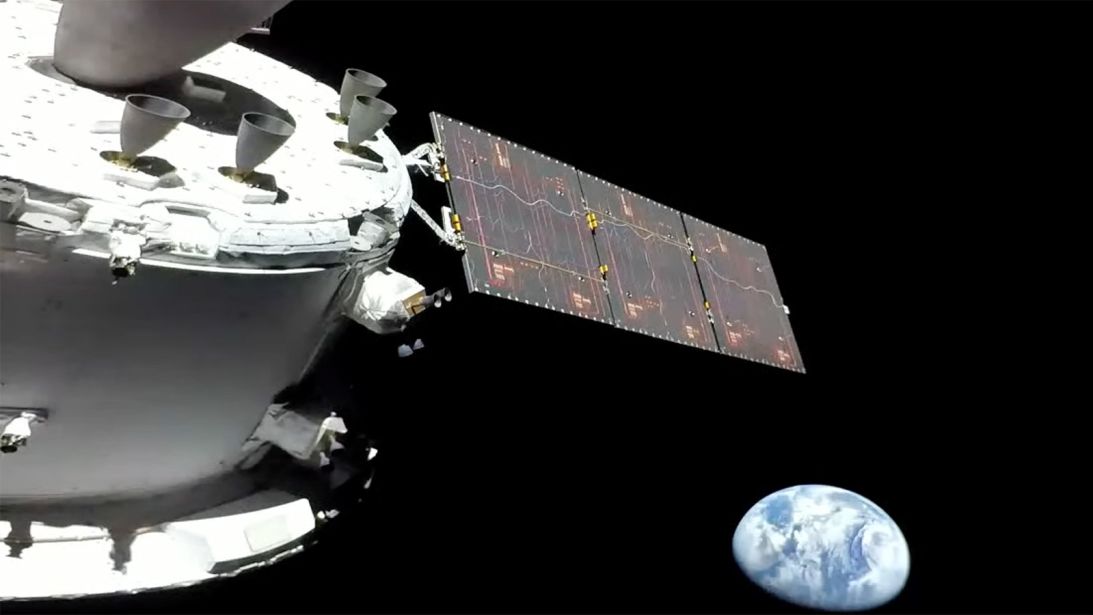
NASA is set to embark on a historic lunar mission, Artemis II, which will carry four astronauts into the vicinity of the moon without landing on its surface. The mission is scheduled to lift off as early as February 6, 2024, from the Kennedy Space Center in Florida. This journey will mark the first return of humans to near-moon space since the Apollo 17 mission in 1972, as astronauts Reid Wiseman, Victor Glover, Christina Koch, and the Canadian Space Agency’s Jeremy Hansen prepare to push the boundaries of human spaceflight.
The spacecraft, comprising NASA’s Space Launch System (SLS) rocket and Orion capsule, will undergo a rollout event on Saturday, transitioning from the Vehicle Assembly Building to its launchpad. This marks a significant step towards an unprecedented mission, which is set to redefine the parameters of human space exploration.
Understanding the Mission’s Objectives
Unlike previous Apollo missions, Artemis II will not attempt to land on the moon. According to Patty Casas Horn, deputy lead for Mission Analysis and Integrated Assessments at NASA, “The short answer is because it doesn’t have the capability. This is not a lunar lander.” The focus of this mission will be on crew safety and health, which includes ensuring that astronauts are comfortable and well taken care of during their journey.
The Orion capsule is designed to carry humans, which introduces new considerations, such as thermal stability, moisture levels, and basic necessities like food and water. “Now, with our four humans on board, we’ll be testing out a lot of new capabilities that were not there for Artemis I,” Horn explained, emphasizing the importance of these elements in ensuring a successful mission.
Artemis I, the uncrewed predecessor launched in November 2022, successfully orbited the moon and set the stage for this upcoming crewed flight. The Artemis II mission will take the astronauts around the moon and back to Earth, aiming to establish a new distance record for humans from our planet, potentially surpassing the 248,655 miles (400,171 kilometers) achieved by Apollo 13 in 1970.
Historic Milestones and Future Aspirations
This mission will also be notable for its historic milestones. It will be the first time a woman, a person of color, and a Canadian astronaut will travel beyond low-Earth orbit. The mission’s profile parallels that of Apollo 8, which did not land on the moon but was pivotal in demonstrating the capabilities of human spaceflight. Like Artemis II, Apollo 8 was a mission of exploration and navigation that helped pave the way for future lunar landings.
Horn noted that while the Artemis II mission does share similarities with Apollo 8, there are key distinctions. “Apollo 8 actually went into lunar orbit, did 10 revolutions and then came home,” she said. In contrast, Artemis II will employ a “free return” trajectory, meaning that once the spacecraft leaves Earth’s orbit, it will automatically swing around the moon and head back to Earth, simplifying navigation and prioritizing crew safety.
While the Artemis III mission, scheduled for 2028, aims to land astronauts on the lunar surface using the Human Landing System (HLS) developed by SpaceX, Horn acknowledged that the current timeline for the lunar lander remains uncertain. This uncertainty has led NASA to explore contracting additional companies to assist with lunar landing capabilities.
James W. Head, a professor of Earth, environmental and planetary sciences at Brown University and an Apollo program veteran, expressed optimism about the impact of Artemis II. “Artemis II will be that same kind of awakening moment — we’re going back to the moon,” he stated, highlighting the potential for this mission to inspire global unity during challenging times.
NASA’s Artemis program is built on rigorous testing protocols, with Horn emphasizing the importance of a methodical approach. “Just like Apollo, you test every element one step at a time,” she said. This philosophy ensures that safety remains the top priority as the organization navigates the complexities of human spaceflight.
As the countdown to the Artemis II mission continues, anticipation builds for what this groundbreaking journey may reveal about our capabilities in space exploration and the future of human presence beyond Earth.