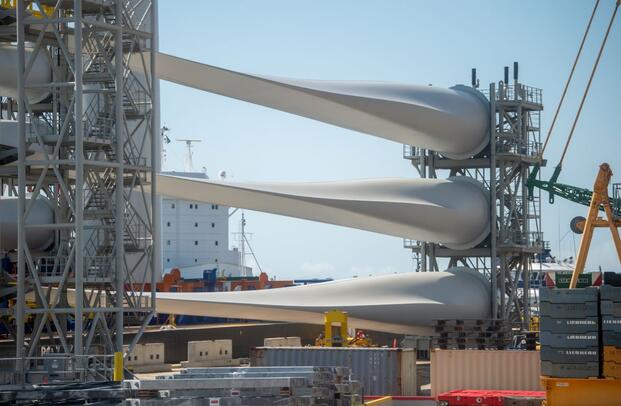
A series of recent federal court rulings have provided a significant boost for the offshore wind industry on the East Coast. Courts have ruled in favor of developers, including New London-based Revolution Wind, as they challenge the Trump administration’s ongoing efforts to halt their operations. The administration has long criticized offshore wind turbines, labeling them as visually unappealing and environmentally harmful.
The latest legal battles center around a classified Pentagon report that allegedly identifies offshore wind turbines as a national security threat. This claim has raised questions and skepticism both in Congress and the courts. Critics suggest that the assertion stems from concerns that the large turbine blades could interfere with military radar systems, creating unwanted images known as “clutter.”
Despite the Pentagon’s refusal to provide details, proponents of the wind projects argue that any such issues were previously addressed. The U.S. Department of Interior, which oversees offshore energy leasing, has indicated that it has consistently collaborated with various military agencies to mitigate concerns regarding military operations. A report from 2023 highlights that Revolution Wind developers invested significant resources to resolve radar issues, including a costly software patch for the U.S. Air Force.
The Pentagon has not elaborated on its security concerns, even when pressed by influential lawmakers such as U.S. Representative Joe Courtney, who serves as the ranking member of the House Armed Services Committee’s Seapower subcommittee. Courtney has expressed frustration, stating, “The Department of Defense said this has to be handled by the Department of the Interior, which is crazy if it is a national security issue.”
On Thursday, four senior House Democrats formally requested briefings from both the Defense and Interior Departments regarding the offshore wind security risks. The Pentagon’s lack of engagement is particularly troubling for Courtney, whose district encompasses New London—a city poised for revitalization due to investments in offshore wind.
Norwegian multinational Orsted, which is spearheading Revolution Wind, has made substantial investments in the area, including a $300 million redevelopment of State Pier into a supply hub for offshore wind construction. The company has committed to creating thousands of jobs in the region, with approximately $5 billion already invested in offshore wind developments.
Revolution Wind is pivotal for Connecticut, which has set an ambitious goal to obtain 2,000 megawatts of energy from offshore wind by 2030. The project is designed to contribute 880 megawatts to the New England electric grid, with Connecticut committed to purchasing 304 megawatts—enough to power over 100,000 homes.
Despite previous attempts by the Trump administration to halt Revolution Wind, courts have consistently ruled in favor of the project. In a ruling from last December, the administration’s order to suspend activities for national security reasons was challenged, with U.S. District Court Judge Royce Lamberth stating that the administration must demonstrate a national emergency to justify a work stoppage. He expressed doubt about the existence of such an emergency.
Revolution Wind has navigated numerous federal permitting hurdles over more than a decade of planning and construction. According to Courtney, the project has been thoroughly vetted, with the Pentagon’s involvement throughout the process. He emphasized, “Orsted and the Navy and the Department of Defense have been working on this for years.”
The Bureau of Ocean Energy Management has indicated that the project underwent extensive consultation with at least a dozen federal agencies, including the Department of Defense. These discussions have addressed potential impacts on military operations, including radar installations and U.S. Navy training routes.
Courtney reiterated the importance of communication between the Pentagon and Orsted, stating, “If there is some new question, it’s not like they can’t get Orsted to sit down and talk.” The ongoing uncertainty surrounding the Pentagon’s claims poses a significant threat to the future of the Revolution Wind project and the broader offshore wind industry on the East Coast.