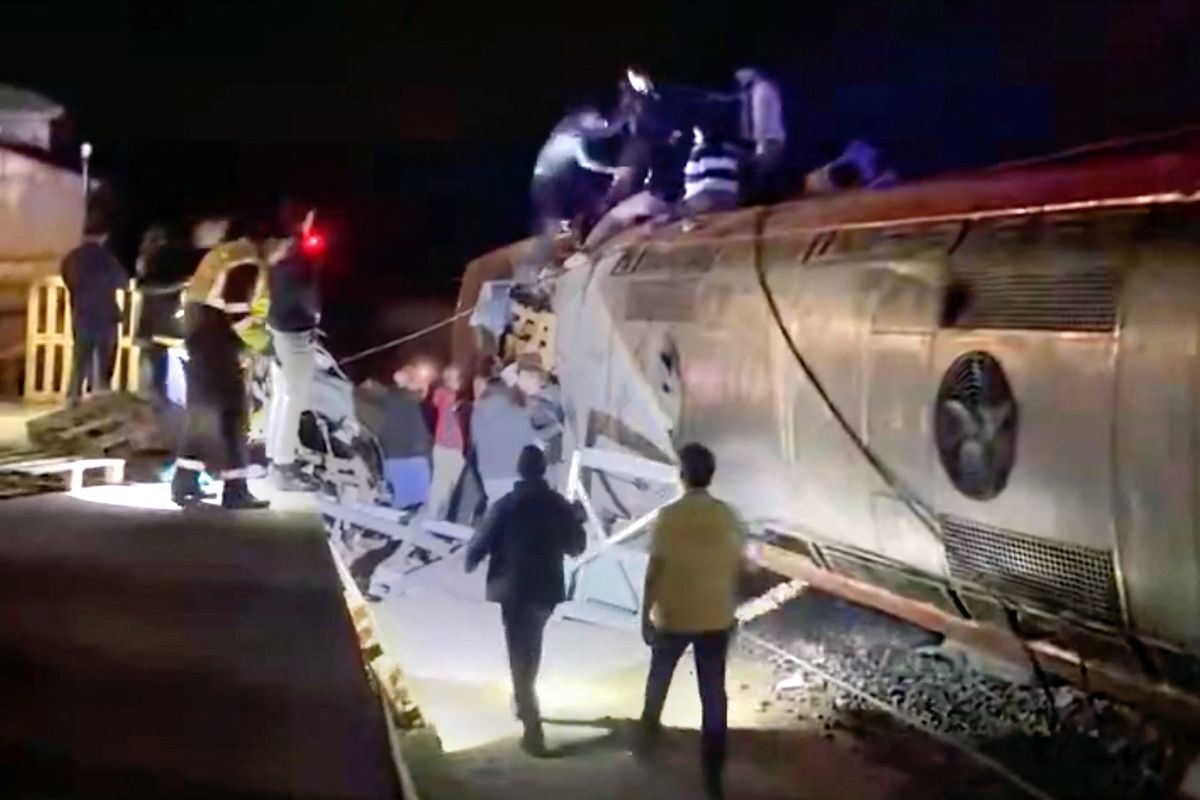
At least 39 people have died and hundreds have been injured following a devastating collision involving two high-speed trains in southern Spain. The incident occurred on March 3, 2024, near Cordoba at approximately 19:45 local time. According to Spanish police, a train traveling from Malaga to Madrid derailed and collided with an oncoming service from Madrid to Huelva.
Rescue operations have been ongoing since the crash, with many passengers requiring urgent medical attention. Regional leader Juan Moreno confirmed that 75 individuals were hospitalized, with 15 in serious condition. Most of the injured are receiving treatment in Cordoba, located around 390 kilometers south of Madrid.
Emergency services have established a help center in the nearby town of Adamuz to support families seeking information. Members of Spain’s Civil Guard and Civil Defence have worked tirelessly at the crash site throughout the night, where images depict derailed train carriages scattered across the ground.
Passengers described harrowing moments as they attempted to escape the wreckage. Salvador Jiménez, a journalist with Spanish broadcaster RTVE who was on one of the derailed trains, recounted the chaos, stating, “There was a moment when it felt like an earthquake and the train had indeed derailed.” Many passengers used emergency hammers to break windows and free themselves from the wreckage.
As investigations begin, Spain’s Transport Minister Óscar Puente stated that the cause of the collision remains undetermined. He highlighted the unusual nature of the incident, given that it occurred on a flat stretch of track that had undergone renovation as recently as May 2023. Furthermore, the derailed train was less than four years old. The train operated by private firm Iryo was struck by the second train, owned by the public rail operator Renfe. According to Puente, the rear section of the first train derailed and collided with the front of the Renfe train, causing severe damage and knocking two of its carriages down a four-meter (approximately 13-foot) slope.
Authorities have suspended train services between Madrid and various Andalusian cities while they assess the damage and conduct their investigation. Spain boasts the largest high-speed rail network in Europe, with over 3,100 kilometers (approximately 1,900 miles) of track for trains exceeding 250 kilometers per hour (about 155 miles per hour). The network is well-utilized and considered safe, with Renfe reporting over 25 million passengers traveled on its high-speed trains in 2024.
This incident marks one of the deadliest train crashes in Spain since 2013, when 80 people lost their lives in a derailment in the northwest of the country. An investigation into that tragedy revealed that the train was traveling at 179 kilometers per hour (approximately 111 miles per hour) on a section of track with a speed limit of 80 kilometers per hour (around 50 miles per hour).
As the nation mourns the loss and assesses the implications of this tragic event, authorities are urging for a thorough and swift investigation to uncover the facts surrounding this high-speed disaster.