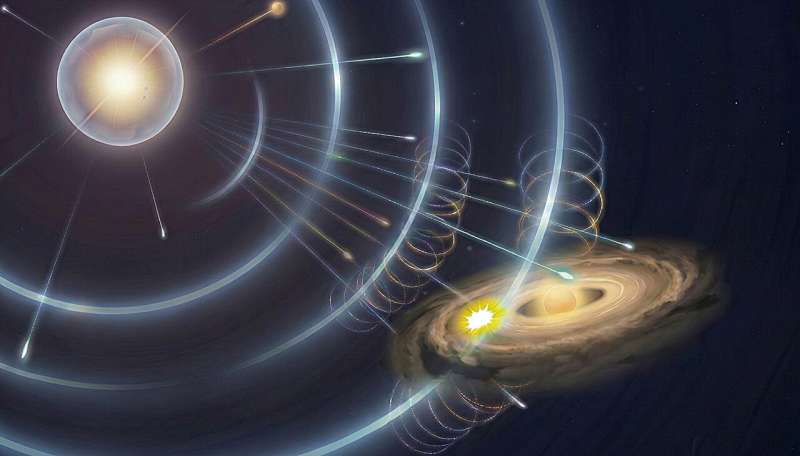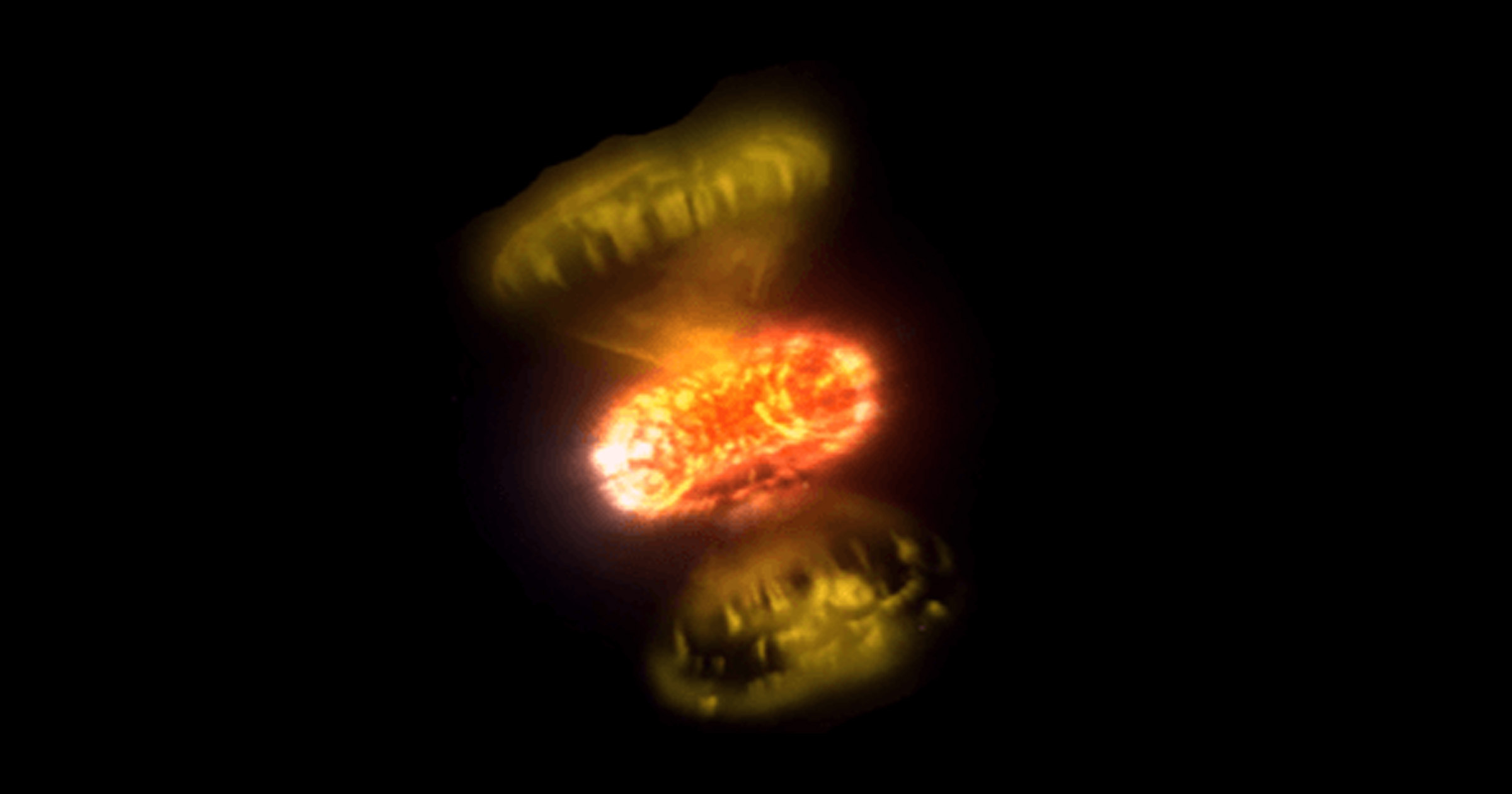
Astronomers have achieved a significant breakthrough by capturing stunning images of two stars exploding in real time. These images, taken with multiple telescopes at the CHARA Array at Georgia State University, depict a phenomenon known as a nova. A nova occurs when a white dwarf star, remnants of a star similar to our Sun, siphons material from a nearby companion star. This process leads to a thermonuclear explosion, allowing the white dwarf to survive the blast.
The explosion happens when accumulated hydrogen on the white dwarf’s surface reaches critical mass, resulting in a release of energy comparable to that emitted by our Sun over the course of approximately 100,000 years. While these stellar explosions have been observed lighting up the night sky, direct observations of their early stages have proven challenging. The exploded material often appears as a singular point of light, making detailed analysis difficult.
New Insights Into Nova Explosions
Elias Aydi, the lead author of a study published in the journal Nature Astronomy, emphasized the importance of these new observations. “These observations allow us to watch a stellar explosion in real time, something that is very complicated and has long been thought to be extremely challenging,” said Aydi, who is also a professor of physics and astronomy at Texas Tech University. “Instead of seeing just a simple flash of light, we’re now uncovering the true complexity of how these explosions unfold.”
The team utilized a technique known as interferometry, which combines multiple light sources to create an interference pattern for analysis. The CHARA Array, consisting of numerous antennas spread across a wide area, functions as a single telescope when aimed at the same point in the sky. Complementary data was gathered from other telescopes, including NASA’s Fermi Telescope, which specializes in detecting high-energy emissions like gamma rays, and the Gemini Observatory in Hawaii.
Revealing Stellar Complexity
The findings revealed that novas are more complex than previously understood and cannot be reduced to a single explosive event. One nova, designated V1674 Herculis, is noted for being one of the fastest on record, reaching peak luminosity within a matter of days before rapidly fading. Observations indicated two distinct outflows of gas, suggesting that multiple powerful ejections of material interacted during the explosion. Notably, these ejections emitted gamma rays, highlighting their capacity for producing some of the cosmos’s most energetic emissions, typically associated with supernovas that form black holes.
In contrast, the nova V1405 Cassiopeiae displayed a slower progression, taking over fifty days to fully eject its material. During this extended period, the white dwarf enveloped itself in a shell of stripped gas, forming a rare structure known as a common envelope. When this envelope dispersed, it generated its own gamma-ray blast detected by NASA’s Fermi, indicating that such events serve as “laboratories for extreme physics,” according to coauthor Laura Chomiuk, a professor of physics and astronomy at Michigan State University.
This research not only enhances our understanding of stellar explosions but also provides insights into the nuclear reactions occurring on the surfaces of stars and the high-energy radiation detected from these cosmic events. As scientists continue to explore the complexities of novas, the implications for astrophysics and our understanding of the universe remain profound.