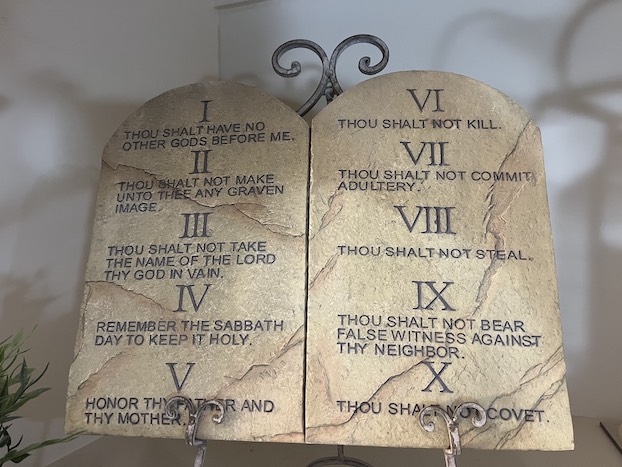
The full Fifth Circuit Court of Appeals has heard arguments in cases challenging laws enacted by Louisiana and Texas mandating the display of the Ten Commandments in public schools. These laws have faced substantial opposition, leading to lawsuits from multiple groups claiming they violate constitutional rights. The court’s decision could have significant implications for religious displays in public education across the United States.
Background of Legislative Actions
Following the passage of the laws, both Louisiana and Texas faced immediate legal challenges. Louisiana Governor Jeff Landry was the first to sign his state’s bill into law, with Texas Governor Greg Abbott following suit. After the laws were enacted, district courts in both states ruled them unconstitutional, blocking their implementation. In Texas, this injunction applies specifically to certain school districts.
Both states have since appealed to the Fifth Circuit. A prior ruling by a panel of three judges deemed Louisiana’s law “plainly unconstitutional.” In response, Louisiana requested a hearing before the full court, which convened on Tuesday to consider the cases.
Arguments Presented in Court
During the hearing, Louisiana’s Attorney General Elizabeth Murrill expressed optimism about the chances of overturning the lower court’s rulings. “I like our chances,” she stated, indicating confidence that a significant number of judges may disagree with the panel’s decision. Murrill emphasized the importance of ongoing discussions about Supreme Court precedents related to these cases.
Moreover, the legal discourse highlighted the broader implications of the laws. Murrill argued that the state has made efforts to present the laws constitutionally, citing the creation of educational posters that illustrate this viewpoint. Governor Landry reinforced the notion that the United States was founded on Judeo-Christian principles, suggesting that such historical context should be embraced in public education.
“We believe that you can apply this law constitutionally,” Murrill added. “And we went to the trouble of creating numerous posters to illustrate that point.”
Landry also called on parents to instill a moral code in their children, referencing the Ten Commandments as a foundational document of the nation’s legal traditions. “You either read the Ten Commandments or your child is going to learn the Criminal Code,” he remarked, framing the issue as one of moral education.
Opposition and Legal Representation
The American Civil Liberties Union (ACLU) is representing plaintiffs in both states, including a coalition of multifaith and nonreligious families. They argue that the laws infringe upon the separation of church and state guaranteed by the First Amendment. The plaintiffs encompass a diverse group, including Protestant pastors, Islamic leaders, and nonreligious parents, all of whom assert that public education should remain neutral regarding religious matters.
Rev. Jeff Sims, a Louisiana pastor, articulated concerns over the potential implications for students. “I send my children to public school to learn math, English, science, art, and so much more – but not to be evangelized by the state into its chosen religion,” he stated. Similarly, Texas Rabbi Mara Nathan emphasized that while the Ten Commandments are sacred to many, they should not be displayed in public schools. “Children’s religious beliefs should be instilled by parents and faith communities, not politicians and public schools,” she asserted.
The outcomes of these cases will likely set precedents for how religious expressions are handled in public educational institutions across the country. Regardless of the Fifth Circuit’s ruling, both sides are prepared to appeal to the U.S. Supreme Court, indicating that the debate over the role of religion in public schools is far from settled.