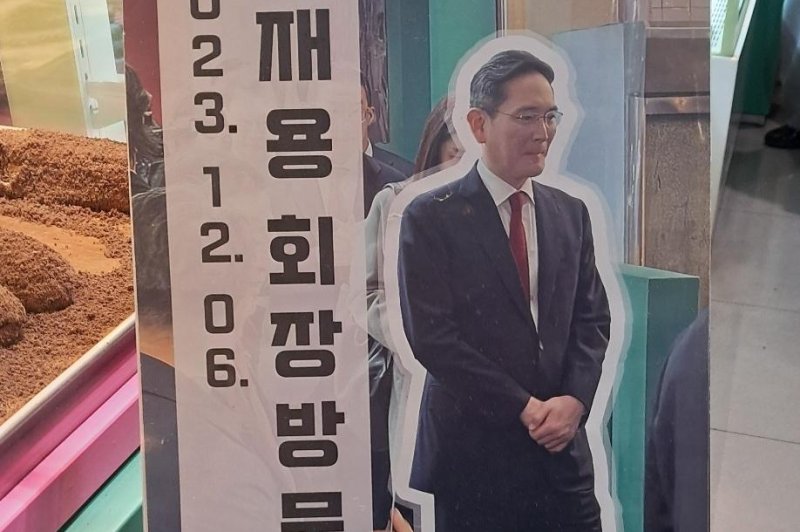
Lee Jae-yong, the chairman of Samsung Electronics, has emerged as a prominent figure in the South Korean business landscape, transcending his role as the heir to the Samsung Group. His recent visit to a fusion cake shop in Busan has sparked renewed interest in his leadership, leading to increased foot traffic and sales at the establishment.
During his visit in late 2023, the cake shop became an unexpected local attraction, drawing customers eager to sample the same treats enjoyed by Chairman Lee. According to Shin Jae-yeon, an employee at the shop, “People still ask what Chairman Lee ate in 2023 and tend to order the same cakes.” The chairman’s influence has not only boosted the store’s popularity but also its sales, showcasing the interconnectedness of consumer behavior and celebrity endorsements.
One visitor, Choi Hyun-jin, a housewife from Seoul, expressed her admiration, stating, “I hope I can become wealthier by eating this cake. I know I will never be as rich as Chairman Lee, but I hope to receive some of that good energy and fortune.” This sentiment underscores how Chairman Lee’s public persona has evolved, with many now viewing him as a capable and accomplished businessman rather than merely a fortunate heir.
Chairman Lee’s Ascendance in Korea Inc.
Under Chairman Lee’s stewardship, Samsung’s affiliates have flourished. Samsung Electronics, the world’s leading memory chip manufacturer, and Samsung C&T, the nation’s top construction firm, have posted impressive results. This success has propelled share prices and, consequently, Chairman Lee’s personal wealth. He holds a 1.45% stake in Samsung Electronics and 20.82% in Samsung C&T. According to the business tracker CXO Institute, Chairman Lee’s stock values have surpassed $20 billion, making him the first South Korean businessman to reach this milestone.
Oh Il-sun, chief of CXO Institute, emphasized that Chairman Lee’s wealth is expected to grow further due to the AI boom, which is anticipated to drive demand for semiconductors. He noted, “Government efforts to boost the stock market have also provided support.” This context indicates a shifting public perception, with more people recognizing Chairman Lee as the definitive leader of South Korea’s largest conglomerate.
Overcoming Challenges to Leadership
Lee Jae-yong’s path to prominence has not been without obstacles. Born in 1968, he studied history at Seoul National University and later pursued business administration at Keio University in Japan and Harvard University in the United States. In 2014, he stepped in as the de facto leader of Samsung Group following the sudden heart attack of his father, Lee Kun-hee, who passed away in 2020.
His leadership faced significant challenges, particularly during the political corruption scandal involving former President Park Geun-hye, which resulted in his imprisonment. Following a presidential pardon in 2022, he returned to management, although Samsung Electronics struggled against rival SK hynix in the high bandwidth memory (HBM) market. Recent reports suggest that Samsung has made strides in narrowing the competitive gap, focusing on next-generation HBM technologies.
Economic commentator Kim Kyeong-joon noted that many believe Chairman Lee was excessively punished during his legal troubles. He likened public sentiment to sports, stating, “In business, performance often reshapes reputation.” As Samsung continues to deliver strong profits, public perception of Chairman Lee has shifted positively.
Another factor contributing to Chairman Lee’s improved reputation is the military service of his only son, who renounced his U.S. citizenship and joined the South Korean Navy late last year. This decision contrasts sharply with many children of business leaders who reportedly seek to avoid military service. Kim believes this choice has strengthened public respect for Chairman Lee and the Samsung family.
As Samsung Electronics continues to thrive, Chairman Lee’s journey from heir to respected business leader illustrates the dynamic nature of public perception in the corporate world. His story reflects both personal resilience and the broader narrative of South Korea’s economic landscape.