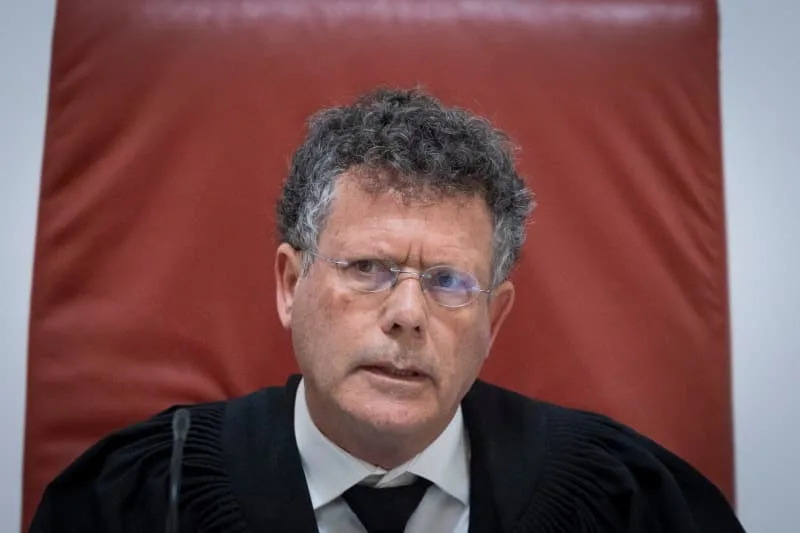
In a significant statement during a radio interview on KAN Reshet Bet, Supreme Court President Isaac Amit warned that the escalating judicial reform legislation advanced by the Israeli government will inevitably reach the High Court of Justice. Amit’s comments came on January 27, 2024, coinciding with International Holocaust Remembrance Day, highlighting the pressing constitutional crisis surrounding the government’s reform agenda.
The judicial reforms have sparked intense debate and division within Israeli society, leading to a standoff between the judiciary and political branches. Amit indicated that the ongoing wave of reform legislation could not be ignored by the court, stating, “With the storm of legislation being advanced across various areas, it stands to reason that it will arrive at our door at some point, and we will have to address it.” He refrained from discussing specific bills but emphasized the court’s obligation to respond to the situation as it develops.
Tensions have escalated particularly following Justice Minister Yariv Levin‘s refusal to recognize Amit’s appointment as president of the Supreme Court. This refusal has effectively frozen routine coordination between the judiciary and political leadership, intensifying the struggle over the balance of power in Israel’s government. Amit expressed his commitment to ensure the judiciary functions effectively, stating, “I view the justice system the same way I view the health system. Just as the health system provides essential medical services, the justice system provides a critical service to citizens.”
Looking forward, Amit noted the judiciary faces a dense legal agenda in the upcoming months, with several initiatives expected to challenge judicial review, appointments, and the authority of legal institutions. Many of these initiatives are anticipated to provoke petitions to the High Court, further entrenching the judiciary in the political conflict currently unfolding in Israel.
Legal tensions have also risen surrounding the attorney-general’s office. Recently, Attorney-General Gali Baharav-Miara blocked Levin’s attempt to initiate disciplinary proceedings against Amit, citing a lack of sufficient factual basis and deviation from established administrative practices. Levin responded critically, accusing Baharav-Miara of overstepping her authority in this matter.
The interview featured sharp exchanges, particularly from Simcha Rothman, chair of the Constitution, Law and Justice Committee. Rothman criticized Amit for allegedly overstepping his role and interfering in political matters, urging him to focus solely on adjudicating cases according to laws enacted by the Knesset.
Amit’s decision to participate in the interview was motivated by the significance of Holocaust Remembrance Day. He shared insights into his personal background as the son of Holocaust survivors, discussing the lasting impact of the Holocaust on his family. He recounted his father’s survival through multiple labor and concentration camps, including Buchenwald and Płaszów, and highlighted his mother’s experience as a hidden child during the war.
In addressing contemporary antisemitism, Amit noted that it has evolved, often manifesting as anti-Zionism or a denial of the Jewish people’s right to a national home. He expressed concern over the resurgence of such sentiments, emphasizing the importance of vigilance against these developments.
As the judicial reform debate continues to unfold, Amit’s remarks underscore the critical intersection of law and politics in Israel, an intersection that will likely shape the country’s future governance and civil rights landscape.