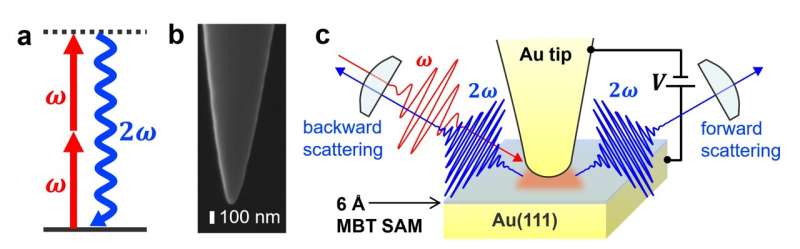
Researchers at the Institute for Molecular Science (NINS) in Japan and SOKENDAI have made significant strides in nonlinear optics, achieving over a 2,000% increase in light output per volt. This remarkable enhancement was made possible by utilizing an angstrom-scale gap created between a metallic tip and a substrate within a scanning tunneling microscope (STM). The findings were published on February 3, 2026, in the journal Nature Communications.
The study revealed that by varying the voltage across the junction within ±1 V, researchers observed a quadratic change in the intensity of second-harmonic generation (SHG). This resulted in a modulation depth of approximately 2000%/V, marking a significant improvement over existing electroplasmonic systems, which typically operate at much lower efficiencies.
In addition to SHG, the researchers also noted similar enhancements in sum-frequency generation, another nonlinear optical process that converts mid-infrared light into visible or near-infrared light. This broad applicability indicates that the newly discovered electrical modulation mechanism is not confined to specific wavelengths or optical processes.
The underlying principle of this breakthrough lies in the intense electrostatic fields generated within the angstrom-scale gap. Applying a voltage across two closely placed electrodes creates electrostatic fields that increase dramatically as the gap size decreases. Specifically, a mere 1 V across a gap of just a few angstroms can produce electric fields on the order of 10^9 volts per meter. These extreme fields impact the electronic states of molecules confined within the gap, greatly enhancing their nonlinear optical responses.
Conventional plasmonic structures, which typically range from tens to hundreds of nanometers, cannot produce similar levels of electrical control, making this discovery particularly noteworthy.
“This work shows that angstrom-scale metal gaps serve as a powerful platform for electrically controlling nonlinear light generation processes with large modulation depth,” said Dr. Shota Takahashi, Assistant Professor at the Institute for Molecular Science. He emphasized that such advancements could lead to the development of next-generation ultra-compact electro-photonic devices, where electrical and optical signals are processed and converted at an extremely small spatial scale.
Looking ahead, Dr. Toshiki Sugimoto, Associate Professor and the principal investigator of the project, expressed intentions to further enhance electrical modulation depth. “We plan to explore nonlinear optical materials that exhibit stronger electric-field responsiveness,” he stated. Additionally, the team aims to develop a more rigorous theoretical framework to quantitatively describe the electrical modulation mechanisms operating in angstrom-scale environments.
These advancements are expected to accelerate progress across various fields, including nonlinear optics, nanophotonics, condensed-matter physics, and electronic engineering.
The full study, titled “Giant near-field nonlinear electrophotonic effects in an angstrom-scale plasmonic junction,” can be accessed in Nature Communications and is also available on arXiv.