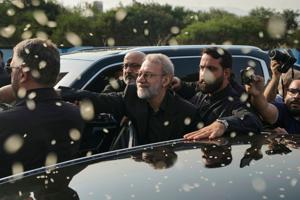
A senior Iranian security official, Ali Larijani, traveled to Oman on March 5, 2024, for discussions likely focusing on Iran’s nuclear program and ongoing negotiations with the United States. The visit underscores Oman’s role as a mediator in the complex dialogue aimed at preventing potential military confrontation over Iran’s nuclear ambitions.
Larijani, who is currently the secretary of Iran’s Supreme National Security Council and a former parliament speaker, met with Badr al-Busaidi, Oman’s foreign minister, as part of the ongoing efforts to stabilize the situation following earlier indirect talks held in Muscat. These discussions are critical as tensions rise due to military posturing and accusations surrounding Iran’s nuclear activities.
During their meeting, photos surfaced showing Larijani with a letter, which appeared to be significant in the context of U.S.-Iran communications. Notably, Iranian state media later reported that al-Busaidi “handed over a letter” to Larijani, though the origin and content of this letter remain undisclosed. Larijani’s visit also included a nearly three-hour meeting with Sultan Haitham bin Tariq, although neither side provided details on the discussions.
Context of Ongoing Negotiations
The backdrop of Larijani’s trip is a series of nuclear talks that resumed last week in Oman, where Iranian officials reiterated their stance on uranium enrichment. Abbas Araghchi, Iran’s foreign minister, emphasized the country’s demand to enrich uranium as a non-negotiable point, crucial to addressing U.S. concerns that have persisted since the Trump administration withdrew from the nuclear deal in 2018.
Iranian Foreign Ministry spokesman Esmail Baghaei characterized the recent Muscat meeting as a preliminary step to gauge the seriousness of U.S. intentions, stating, “For us, it was a way to measure the seriousness of the other side.” This statement highlights Iran’s cautious approach as it navigates the diplomatic landscape.
Meanwhile, Israeli Prime Minister Benjamin Netanyahu is set to discuss the situation with American officials in Washington, where Iran’s nuclear program is expected to dominate conversations. U.S. Ambassador to Israel Mike Huckabee noted a strong alignment between Washington and Tel Aviv regarding strategies to address the Iranian threat.
Military Posture and Regional Tensions
The United States has increased its military presence in the region, deploying the aircraft carrier USS Abraham Lincoln along with additional ships and aircraft. This move aims to exert pressure on Iran to reach an agreement while maintaining the capability to respond to any hostile actions if necessary. Tensions escalated recently when U.S. forces intercepted an Iranian drone near the carrier and responded to an attempt by Iranian vessels to obstruct a U.S.-flagged ship in the Strait of Hormuz.
In light of these developments, the U.S. Department of Transportation issued a warning for American vessels in the strait, advising them to avoid Iranian territorial waters due to the heightened risks. The strait is vital for global oil trade, with approximately one-fifth of all oil shipments passing through this narrow passage.
The intricate web of diplomacy, military readiness, and negotiations continues to unfold as both sides navigate their positions in a volatile regional landscape. The outcomes of Larijani’s discussions in Oman may set the tone for future engagements between Iran and the United States, as stakeholders on both sides watch closely for signs of progress or escalation.