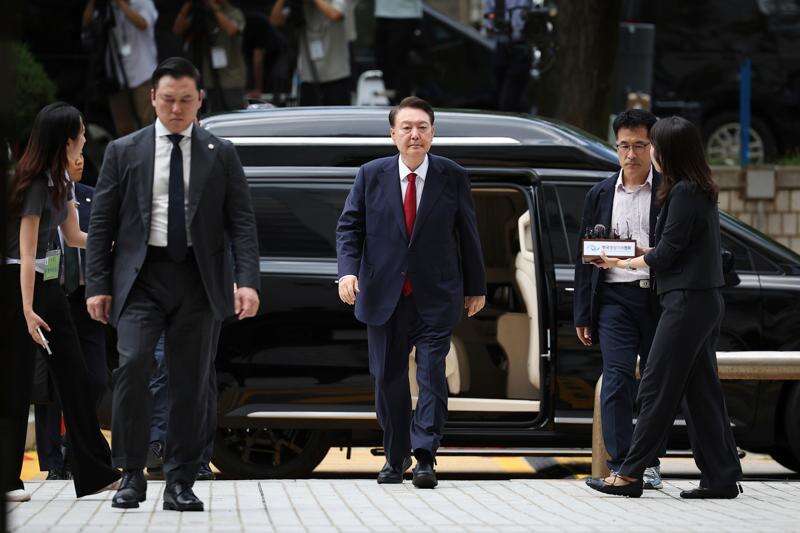
BREAKING: Former South Korean President Yoon Suk Yeol has been sentenced to life in prison for his brief imposition of martial law in December 2024. Judge Jee Kui-youn announced the verdict today, declaring Yoon guilty of rebellion for his illegal attempt to seize control of the National Assembly through mobilizing military and police forces.
This ruling comes amid escalating tensions in South Korea as Yoon’s actions threatened the nation’s democracy. Yoon’s defense of his decree as a necessary measure to curb “anti-state” forces has drawn fierce backlash. The sentence marks a pivotal moment in South Korea’s political landscape, casting a long shadow over the conservative leader’s legacy.
On December 14, 2024, Yoon was impeached by lawmakers, leading to the swift lifting of the martial law he declared after just six hours, when a quorum of lawmakers broke through military blockades. As the sentence was delivered, hundreds of police officers monitored protests outside the court, with supporters and critics clashing over Yoon’s fate.
The special prosecutor had sought the death penalty, highlighting the gravity of the threat posed to democracy. However, analysts anticipated a life sentence due to the lack of casualties from Yoon’s poorly-planned power grab. South Korea has not executed anyone since 1997, creating a de facto moratorium on capital punishment.
Several high-ranking officials were also convicted in connection with Yoon’s martial law decree. Former Defense Minister Kim Yong Hyun received a 30-year prison sentence for his role in the military mobilization, while Prime Minister Han Duck-soo was sentenced to 23 years for attempting to legitimize the decree through falsified records and perjury.
Yoon has been under arrest since July 2025 and faces multiple criminal trials. Just last month, he was sentenced to five years in prison for resisting arrest and fabricating the martial law proclamation. The rebellion charge carries the most severe punishment, underscoring the serious nature of his actions.
As Yoon prepares to appeal the verdict, the court’s decision has ignited fervent discussions about the future of democracy in South Korea. Observers are closely watching how this unprecedented ruling will influence the political climate in the country.
Next steps will include Yoon’s appeal process and potential ramifications for the broader political landscape in South Korea, where calls for democratic accountability continue to grow. The situation remains fluid, and developments are expected in the coming days as both supporters and opponents react to this landmark ruling.