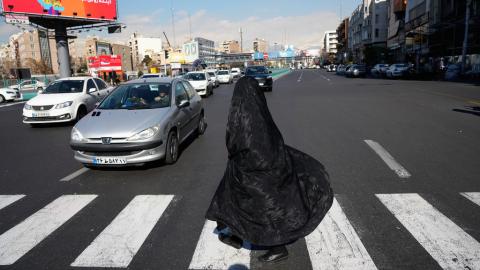
The United States has executed a significant military operation targeting Kharg Island in Iran, a strategic location for oil exports. President Donald Trump announced the airstrike on Friday evening, asserting that the action was aimed at ensuring the secure passage of vessels through the Strait of Hormuz. He described the raid as one of the most powerful in the region’s history, stating it “obliterated every military target” in the area, while refraining from destroying the island’s oil infrastructure. Trump warned that any interference with shipping in the strait would prompt a reevaluation of this restraint.
Details surrounding the airstrike remain sparse, but the action appears to be a direct response to a declaration from Mojtaba Khamenei, Iran’s newly appointed supreme leader. Khamenei’s statement, broadcasted on Iranian state television, asserted Iran’s intention to block the Strait of Hormuz as a means of exerting pressure on adversaries. This declaration comes amid escalating tensions in the region, with more than a dozen vessels reportedly attacked in the Persian Gulf since the onset of the conflict.
The Islamic Revolutionary Guard Corps has claimed responsibility for several recent attacks on commercial shipping, threatening any vessel attempting to navigate through the strait. As a crucial maritime passage, the Strait of Hormuz facilitates approximately 20% of the world’s petroleum liquids and liquefied natural gas trade. Disruptions in this region have already driven Brent crude oil prices above $100 per barrel, a significant increase from approximately $70 prior to the conflict.
Experts warn that Iran’s strategy poses a serious threat to regional stability. Scarlett Suarez, a senior intelligence analyst at Dryad Global, highlighted the indiscriminate nature of Iran’s asymmetric attacks, stating, “These strikes target commercial vessels regardless of flag or ownership, fueling widespread fear and uncertainty.” The potential for chaos in the Gulf could have far-reaching implications for global oil markets and security.
Historical Context of Maritime Conflicts
The current tensions echo the events of the 1980s during the Iran-Iraq War, when Iran’s mining of the Strait of Hormuz led to significant maritime conflict. In 1988, an Iranian mine damaged the USS Samuel B. Roberts, triggering a substantial U.S. military response known as Operation Praying Mantis, which resulted in the destruction of several Iranian vessels and oil platforms.
Today, Iran continues to employ a multifaceted approach to naval warfare, utilizing fast-attack boats, drones, and various mine types. Retired Navy Captain Bill Hamblet, currently serving as editor-in-chief of the U.S. Naval Institute’s “Proceedings,” explained the challenges involved in countering these threats. “Finding and clearing mines is a slow process, and while doing so, you must also protect your operations from other potential threats,” he noted.
The U.S. Department of Defense has indicated that there is currently no evidence of new mines being placed in the Strait of Hormuz. During a briefing at the Pentagon, Secretary of Defense Pete Hegseth characterized Iran’s actions as desperate, emphasizing that the U.S. has been prepared to address such challenges.
As tensions continue to escalate, the international community is closely monitoring the situation. The implications of these military actions extend beyond the immediate region, influencing global oil supply and geopolitical dynamics. The U.S. response may shape the future of maritime security in the Strait of Hormuz and the broader Persian Gulf region.