A recent study from the University of California – San Diego has identified the origin of rainfall as a critical factor influencing drought risks for farmers globally. The research, published in Nature Sustainability, reveals how the source of atmospheric moisture—whether from oceans or land—affects crop vulnerability and agricultural productivity.
The study titled, “Crop water origins and hydroclimate vulnerability of global croplands,” investigates how atmospheric moisture is sourced. When water evaporates from surfaces such as oceans, soils, lakes, and forests, it rises into the atmosphere and eventually returns as precipitation. Moisture from oceans typically travels long distances via global winds, often through significant weather systems like tropical storms. In contrast, moisture from land, referred to as recycled rainfall, is derived from local sources and is more variable.
Understanding the difference in moisture origins is crucial, according to Yan Jiang, the study’s lead author and a postdoctoral scholar at UC San Diego. “Our work reframes drought risk—it’s not just about how much it rains, but where that rain comes from,” Jiang stated. This insight can assist policymakers and farmers in predicting and mitigating drought stress before it occurs.
Forecasting Drought Risks with New Insights
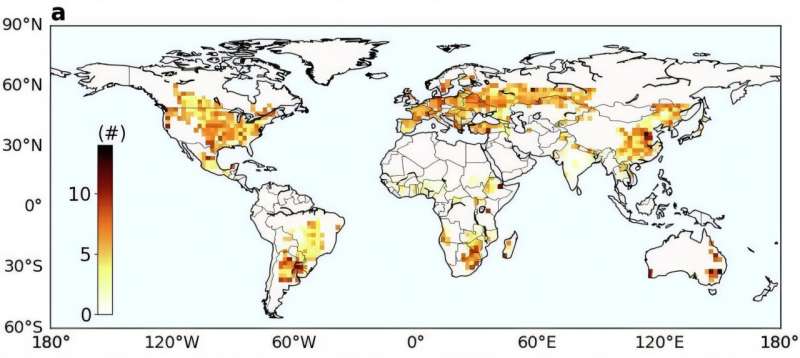
Utilizing nearly two decades of satellite data, Jiang and co-author Jennifer Burney from Stanford University analyzed the contributions of land-based evaporation to global rainfall. Their findings show that when over one-third of rainfall originates from land, croplands are markedly more susceptible to drought and reduced yields. This is attributed to ocean-sourced systems delivering heavier and more reliable rainfall compared to their land-sourced counterparts, which contribute less predictable precipitation.
This understanding enables farmers and policymakers to identify regions at heightened risk for drought and to implement effective strategies. Jiang points out that in areas dependent on land-sourced moisture, such as parts of the Midwest and eastern Africa, local water availability becomes crucial for successful crop production. Changes in soil moisture levels or deforestation can lead to immediate and significant impacts on agricultural yields.
Identifying Vulnerability Hotspots
The study highlights two major areas of concern: the U.S. Midwest and tropical East Africa. In the Midwest, Jiang notes an increase in the frequency and severity of droughts, even in this highly productive farming region. “The Midwest’s high reliance on land-sourced moisture could exacerbate droughts through what we call ‘rainfall feedback loops,'” Jiang explained. As land dries, evaporation decreases, which in turn leads to reduced future rainfall, creating a self-reinforcing cycle of drought.
Such disruptions are not contained within U.S. borders; they have far-reaching implications for global grain markets. Jiang suggests that farmers in the Midwest should focus on soil moisture management, irrigation efficiency, and the timing of planting to alleviate drought stress.
In contrast, East Africa faces a precarious situation exacerbated by rapid cropland expansion and rainforests’ loss, threatening the moisture sources that support rainfall in the region. “Farmers are clearing forests to grow more crops, but those forests contribute to the rainfall that the crops need,” Jiang warned. This conflict may jeopardize local food security, but Jiang believes there is still time for positive change. “Smarter land management—like conserving forests and restoring vegetation—can protect rainfall and sustain agricultural growth.”
The research underscores the importance of forests and natural ecosystems as vital components in agriculture. Forests release significant amounts of water vapor into the atmosphere, effectively seeding clouds that produce rain for adjacent farmlands. “Upland forests are like natural rainmakers,” Jiang noted, emphasizing that protecting these ecosystems is essential not only for biodiversity but also for agricultural sustainability.
Jiang’s findings offer a new framework linking land management practices, rainfall origins, and crop planning, which could play a pivotal role in future drought resilience strategies. This innovative satellite-based mapping technique can aid governments and farmers in identifying priority areas for investment in irrigation infrastructure, soil water storage, and forest conservation to ensure reliable rainfall.
This study provides a fresh perspective on the relationship between rainfall sources and agricultural risks, equipping stakeholders with new tools to navigate the challenges posed by climate change and ensure food security for future generations.