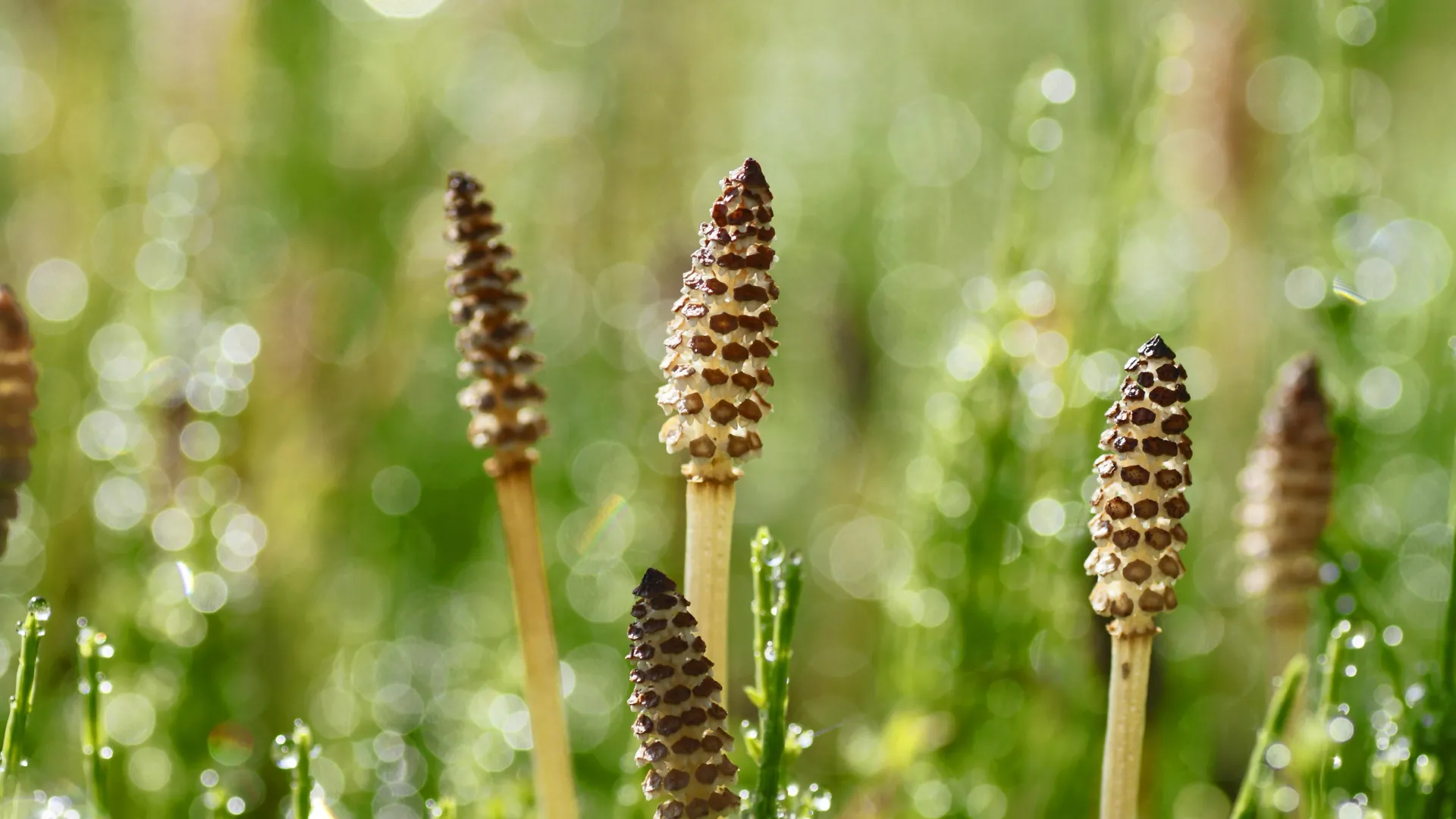
UPDATE: Researchers at the University of New Mexico have made a groundbreaking discovery revealing that living horsetails, a plant species existing for over 400 million years, act as natural distillation towers, producing water with extraordinary oxygen isotope signatures that resemble meteorite water. This finding, announced on November 13, 2025, has the potential to reshape our understanding of ancient climates.
This urgent research, led by Professor Zachary Sharp, has just been published in the Proceedings of the National Academy of Sciences. The study focuses on how these hollow-stemmed plants filter water, resulting in bizarre isotopic changes that have never been documented on Earth. The implications are significant: scientists can now decode ancient humidity and climate conditions by analyzing both modern plants and fossilized phytoliths that preserve isotopic clues for millions of years.
Sharp described horsetails as “a meter-high cylinder with a million holes in it, equally spaced,” emphasizing their unique engineering. Such natural filtration processes create oxygen isotope signatures that mirror those found in extraterrestrial materials. “If I found this sample, I would say this is from a meteorite,” Sharp stated at the recent Goldschmidt Geochemistry Conference in Prague.
The team’s innovative approach clarifies longstanding puzzles surrounding oxygen isotope measurements in desert plants, offering a new method to reconstruct climate in arid regions. Oxygen isotopes serve as crucial tracers, providing insights into water sources, plant transpiration, and atmospheric moisture. The research indicates that heavier isotopes are rare, complicating predictions about how their ratios fluctuate in real-world conditions.
To conduct their study, Sharp’s team collected smooth horsetails (Equisetum laevigatum) along the Rio Grande. They meticulously tracked the changes in oxygen isotope values from the base to the top of the plants. The results revealed extreme readings that previously appeared outside known Earth-based ranges, drawing global attention.
The research also brings forth a new tool for understanding ancient humidity levels. Fossil horsetails, which could grow up to 30 meters tall, contain phytoliths—tiny silica particles that preserve isotope signatures for millions of years. Sharp refers to these phytoliths as a “paleo-hygrometer,” enabling scientists to reconstruct humidity and climate conditions from the age of dinosaurs.
“This research expands our contributions to the geosciences and highlights horsetails as powerful record keepers of Earth’s climate history,” Sharp affirmed. As scientists delve deeper into the mysteries of our planet’s past, these findings may provide invaluable insights into how ancient climates operated.
The urgency of this discovery cannot be overstated, as it opens new avenues for climate research and understanding environmental changes over millions of years. With the potential to reshape our comprehension of historical climate patterns, this study is set to make waves in the scientific community.
Stay tuned for further updates on this remarkable research as more revelations come to light.