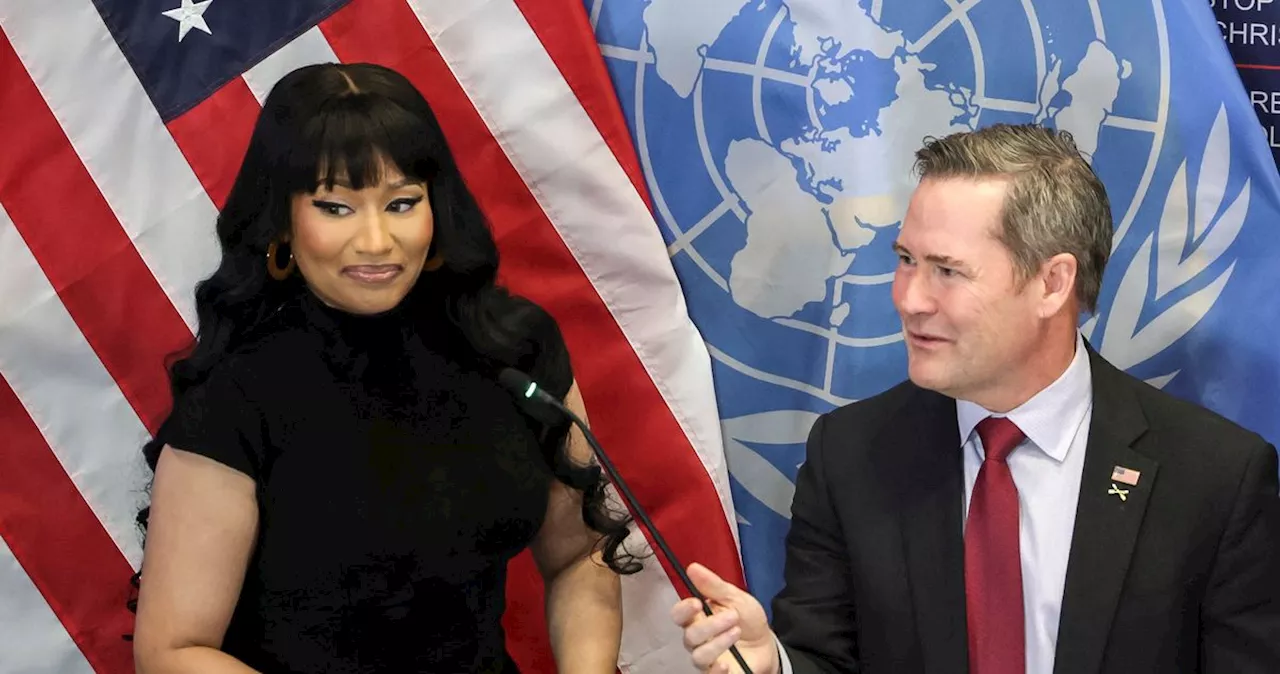
Rapper Nicki Minaj recently delivered a speech at the United Nations, highlighting the persecution of Christians in Nigeria. This event, hosted by the United States Mission to the U.N., featured an introduction by Mike Waltz, the U.S. Ambassador to the United Nations. Minaj expressed appreciation for the religious freedoms enjoyed in the United States and acknowledged the efforts of former President Donald Trump in bringing attention to this issue.
In her remarks, Minaj emphasized the importance of religious freedom, stating, “I stand here as a proud New Yorker with a deep sense of gratitude that we live in a country where we can freely and safely worship God, regardless of one’s creed, background, or politics.” She urged that no group should face persecution for their beliefs, reinforcing the message that respect for differing ideologies is essential.
Minaj’s comments were part of a larger narrative that has gained traction among certain political circles in the U.S., particularly among right-wing figures who argue that Christians in Nigeria face extraordinary threats. Earlier this month, Trump asserted that “Christianity is facing an existential threat in Nigeria,” attributing the violence to “radical Islamists.” Minaj echoed these sentiments, saying it is dangerous to ignore the horrors occurring globally, particularly in Nigeria, where Christians are reportedly persecuted.
The rapper underscored the global reach of this issue, stating, “Numerous countries all around the world are being affected by this horror.” Her speech emphasized the need for collective action against such injustices, and she thanked Trump for addressing these concerns, saying, “This is just the reality we are all living in.”
Amidst her speech, Minaj took a moment to connect with her fans, known as the Barbz, expressing her love and commitment to stand against injustice. “The Barbz & I will never stand down in the face of injustice. We’ve been given our influence by God,” she stated, urging her supporters to recognize the importance of unity in challenging persecution.
Political figures have reacted to Minaj’s involvement in this discourse. Waltz praised her for leveraging her platform to spotlight the alleged atrocities against Christians in Nigeria. He expressed optimism about collaborating with her to address the situation further.
While Minaj’s statements have been welcomed by some, experts have pointed out that the narrative around Christian persecution in Nigeria is complex. Ladd Serwat, a senior Africa analyst at the Armed Conflict Location and Event Data program, noted that while religious violence exists, it does not encapsulate the entirety of the violence occurring in Nigeria. The country’s diverse population and geographical distinctions complicate the portrayal of violence as solely religiously motivated.
Similarly, Nnamdi Obasi, a senior adviser at the International Crisis Group, emphasized that Christians and Muslims often coexist peacefully in many regions of Nigeria. He cautioned against oversimplifying the violence as purely a religious conflict, stating, “Reports of widespread persecution and mass slaughter of Christians are seriously misread and exaggerate the challenges of interfaith relations in the country.”
Additionally, Nigerian officials have refuted claims made by U.S. leaders regarding systematic persecution. Mohammed Idris, Nigeria’s information minister, stated, “There is no systematic, intentional attempt either by the Nigerian government or by any serious group to target a particular religion.” Presidential spokesperson Bayo Onanuga expressed shock at the suggestion of U.S. intervention, countering the narrative presented by Trump and other U.S. officials.
The event concluded with a prayer led by Reverend Timothy McMurtry, who introduced Minaj with great reverence, highlighting her role as a voice for justice. As she concluded her remarks, Minaj reiterated the urgency of the situation, stating, “Religious freedom means we all can sing our faith, regardless of who we are, where we live, and what we believe.”
Minaj’s appearance at the United Nations marks a significant intersection of celebrity influence and international discourse on religious persecution, bringing attention to a pressing issue that continues to provoke debate among political, religious, and social circles.