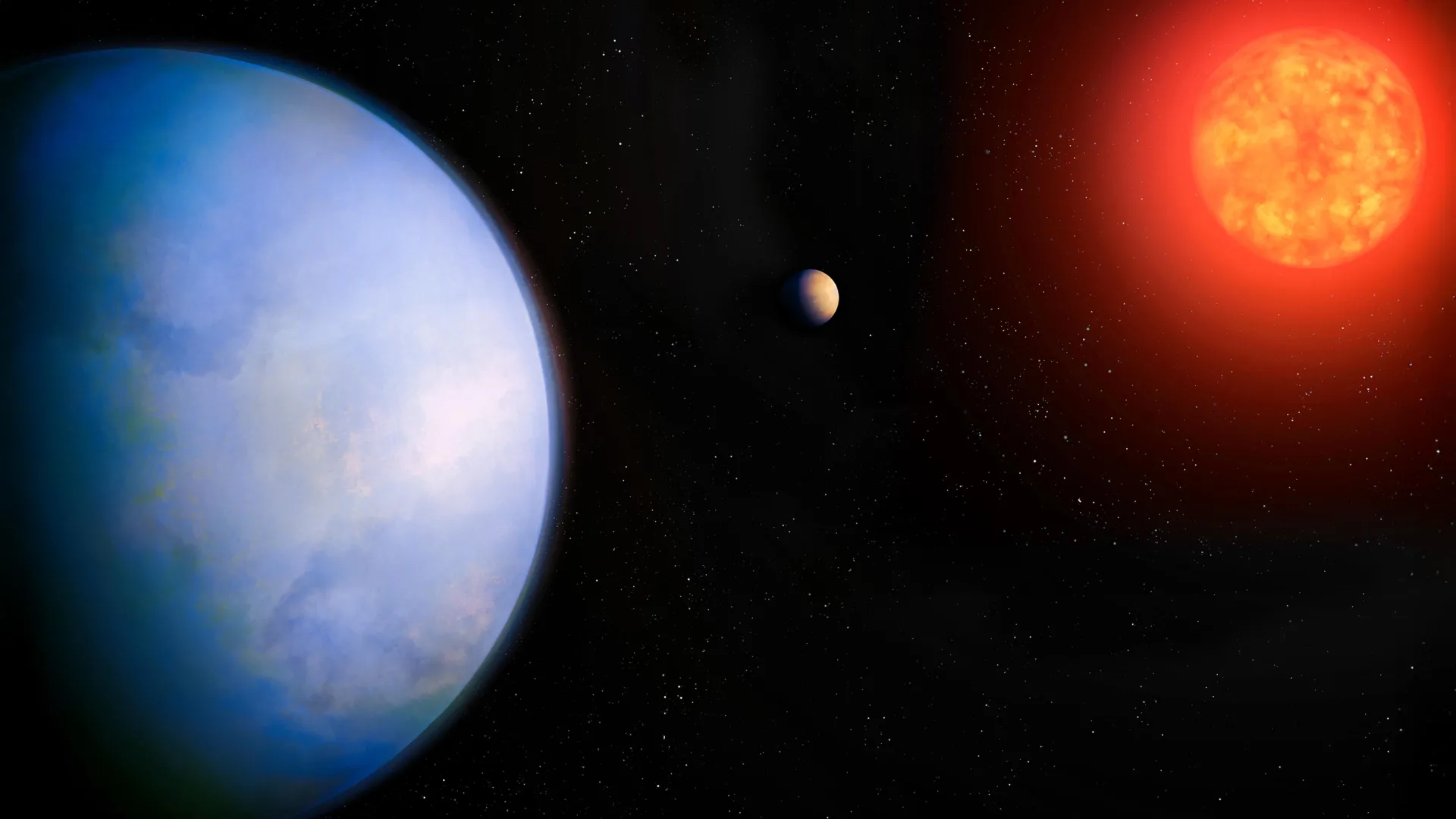
Astronomers at the University of California, Irvine have discovered an exoplanet named GJ 251 c, located within the habitable zone of an M-dwarf star just 18 light-years from Earth. This finding positions GJ 251 c as a significant target in the ongoing search for extraterrestrial life, particularly due to its potential for liquid water, a crucial component for life as we know it.
The research team, led by Paul Robertson, an associate professor of physics and astronomy, published their findings in The Astronomical Journal. Robertson noted, “The proximity of this star makes it especially valuable. Cosmically speaking, it’s practically next door.”
Understanding the Discovery
GJ 251 c is classified as a “super-Earth” due to its mass, which is several times greater than that of our planet. It orbits an M-dwarf star, a type of star known for its long lifespan and frequent stellar activity, including starspots and flares. These characteristics can complicate the detection of orbiting planets, as they may produce signals that mimic the gravitational influence of a planet.
Nevertheless, the close proximity of GJ 251 c to Earth allows for future observational possibilities. The Thirty Meter Telescope (TMT), currently under development, is expected to have the capability to directly image such distant worlds. Corey Beard, a data scientist and lead author of the study, emphasized the telescope’s unique capabilities: “TMT will be the only telescope with sufficient resolution to image exoplanets like this one.”
Advanced Detection Techniques
The detection of GJ 251 c was made possible using advanced instruments like the Habitable-zone Planet Finder and NEID, which measure the gravitational effects of orbiting planets on their stars. These instruments track minute variations in the star’s light caused by the planet’s gravitational pull, known as radial velocity signatures.
To enhance the accuracy of their findings, the team employed infrared observations, which reduce the interference from stellar activity. Their computational models confirmed the presence of GJ 251 c with a significant statistical confidence, underscoring the need for direct imaging to further explore its characteristics.
The research, which also involves collaborators from various institutions including Pennsylvania State University and UCLA, received funding from the National Science Foundation (NSF) and NASA. The team advocates for further investigations into GJ 251 c, especially as the TMT prepares for operational readiness.
In conclusion, the identification of GJ 251 c not only enriches our understanding of exoplanets but also enhances the prospects of finding life beyond Earth. As telescopes evolve, researchers hope to unlock the mysteries of this nearby super-Earth, potentially revealing whether it can sustain life.