An international research team has made a significant advancement in understanding the tectonic evolution of terrestrial planets. Their study reveals six distinct tectonic regimes, including a newly identified one termed the “episodic-squishy lid.” These findings provide important insights into the differences in geological activity between Earth and Venus. The research was published in the journal Nature Communications on November 24, 2025.
Understanding Planetary Tectonics
Tectonic regimes are vital for explaining how a planet’s surface evolves and its potential to support life. This groundbreaking study, led by researchers from the Department of Earth and Planetary Sciences at The University of Hong Kong, including postdoctoral fellow Dr. Tianyang Lyu, Professor Man Hoi Lee, and Mok Sau-King Professor Guochun Zhao, systematically classified these regimes for the first time.
Earth operates under a “mobile lid” regime, characterized by active plate tectonics, while Mars showcases a “stagnant lid” regime, leading to minimal surface movement. The differences in these tectonic mechanisms directly influence geological features, magnetic fields, and atmospheric conditions, ultimately affecting a planet’s capacity to harbor life.
The research highlights the longstanding mystery of why Earth exhibits active plate tectonics while Venus, its similar-sized counterpart, has a vastly different geological profile. The study’s authors utilized advanced numerical models to analyze the relationship between tectonic activity and planetary evolution, enhancing our understanding of both planets.
New Insights into Tectonic Activity
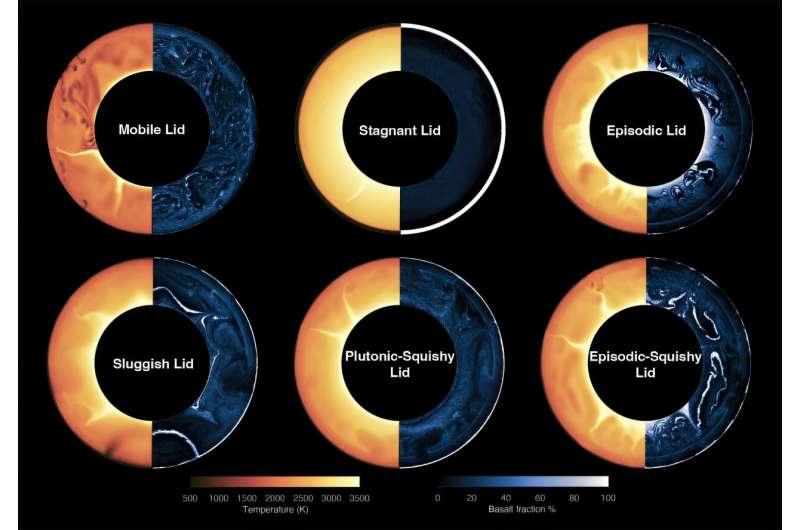
The team identified six tectonic regimes: the mobile lid, stagnant lid, and the newly discovered episodic-squishy lid, which alternates between periods of activity. This new classification offers a fresh perspective on how tectonic activity can vary across different planetary environments.
Dr. Lyu stated, “Through statistical analysis of vast amounts of model data, we were able to identify six tectonic regimes for the first time quantitatively.” This advancement allows for a clearer understanding of how planets transition from inactive to active states.
A significant challenge in predicting tectonic evolution has been the “memory effect,” where a planet’s tectonic state is influenced by its historical conditions. Professor Lee explained that their models demonstrate this effect can be predictable, especially for planets like Earth, where the lithosphere weakens over time.
The researchers also created a comprehensive diagram mapping the six tectonic regimes under varying physical conditions, revealing possible transition pathways as a planet cools. Professor Zhao noted, “Geological records suggest that tectonic activity on early Earth aligns with the characteristics of our newly identified regime.”
These discoveries also shed light on the geological features of Venus, such as the circular “coronae,” which align with the characteristics of the episodic-squishy lid regime. The findings indicate that volcanic activity may dominate Venus’s surface deformation, contrasting with Earth’s plate-boundary driven tectonics.
The implications of this research extend to future planetary exploration. Professor Zhong-Hai Li from the University of Chinese Academy of Sciences remarked on the importance of aligning model results with geological observations of Venus, providing valuable theoretical references for upcoming missions.
Dr. Maxim D. Ballmer of University College London, another co-author, concluded, “Our models intimately link mantle convection with magmatic activity. This allows us to view Earth’s geological history and Venus’s current state within a unified theoretical framework, crucial for the search for potentially habitable Earth analogs.”
The study establishes a new framework for understanding planetary tectonic diversity, paving the way for future research and exploration into the geological characteristics of terrestrial planets.