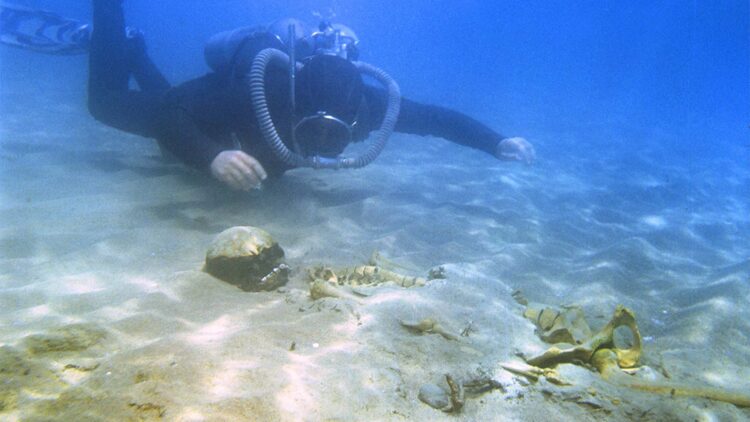
Archaeologists have confirmed the existence of a medieval city submerged beneath the waters of Lake Issyk-Kul in Kyrgyzstan. This finding is set to reshape historical narratives concerning the Silk Road, a vital trade route connecting East and West. The underwater site, located near Toru-Aygyr on the northwest shore of the lake, reveals the remnants of a once-thriving urban center that disappeared following a powerful earthquake in the 15th century.
Surrounded by the majestic peaks of the Tien Shan mountains, the site had long been the subject of local legends. Recent explorations have provided tangible evidence for these tales, uncovering large ceramic vessels, baked brick structures, and remnants of grain mills. These artifacts suggest the presence of public buildings such as madrasas, mosques, and ritual baths, which would have catered to traders, pilgrims, and travelers navigating the route between China and the Islamic world.
Unveiling a Historical Hub
The archaeological team, employing advanced technology, has meticulously mapped the submerged ruins at depths ranging from one to four meters. Their findings include wooden structures, crumbling stone walls, and various architectural fragments, indicating a carefully planned urban environment with a stable local government. To accurately date the materials, the researchers utilized techniques such as accelerator mass spectrometry (AMS) and dendrochronology.
The city is believed to have been a significant urban center during the reign of the Kara-Khanid dynasty, which spanned the 10th to 15th centuries. This period marked the introduction of Islam to the region, yet the archaeological evidence also points to a rich history of religious diversity, with traces of Buddhism, Tengrianism, and Nestorian Christianity present alongside Islamic influences.
The Aftermath of Catastrophe
According to the evidence gathered, the city experienced partial destruction due to a strong earthquake in the 15th century, which caused most of it to submerge beneath Lake Issyk-Kul. Interestingly, some residential areas lack human remains, indicating that they may have been abandoned prior to this final disaster. This phenomenon has drawn parallels to the preservation seen in Pompeii, where time effectively halted the city’s progress.
Additionally, a large Muslim cemetery dating to the 13th and 14th centuries was discovered, encompassing approximately 60,000 square meters. The cemetery adheres to traditional Islamic burial customs, with bodies oriented towards Mecca. So far, the remains of two individuals—a male and a female—have been unearthed, offering potential insights into their diets, health, and origins.
The spread of Islam, particularly through the influence of the Golden Horde, fostered trust and facilitated trade along the Silk Road, further intertwining cultural exchanges across the region. Other artifacts, including medieval ceramics and a large khum—a storage vessel—remain partially buried in sediments, suggesting that further exploration could yield even more significant findings.
As researchers continue to uncover this forgotten city, they are utilizing underwater drones and advanced navigation systems to meticulously document and preserve the remains for future study. The overarching aim is to create a comprehensive interdisciplinary project that encompasses funerary studies, urban archaeology, and the tectonic and climatic history of the Issyk-Kul area.
This remarkable discovery underscores the potential for future research to reshape our understanding of Central Asia’s historical significance during the Middle Ages. As more of the city is explored, it is likely that new insights into the cultural and economic dynamics of this region will emerge, enriching the narrative of the Silk Road and its enduring legacy.