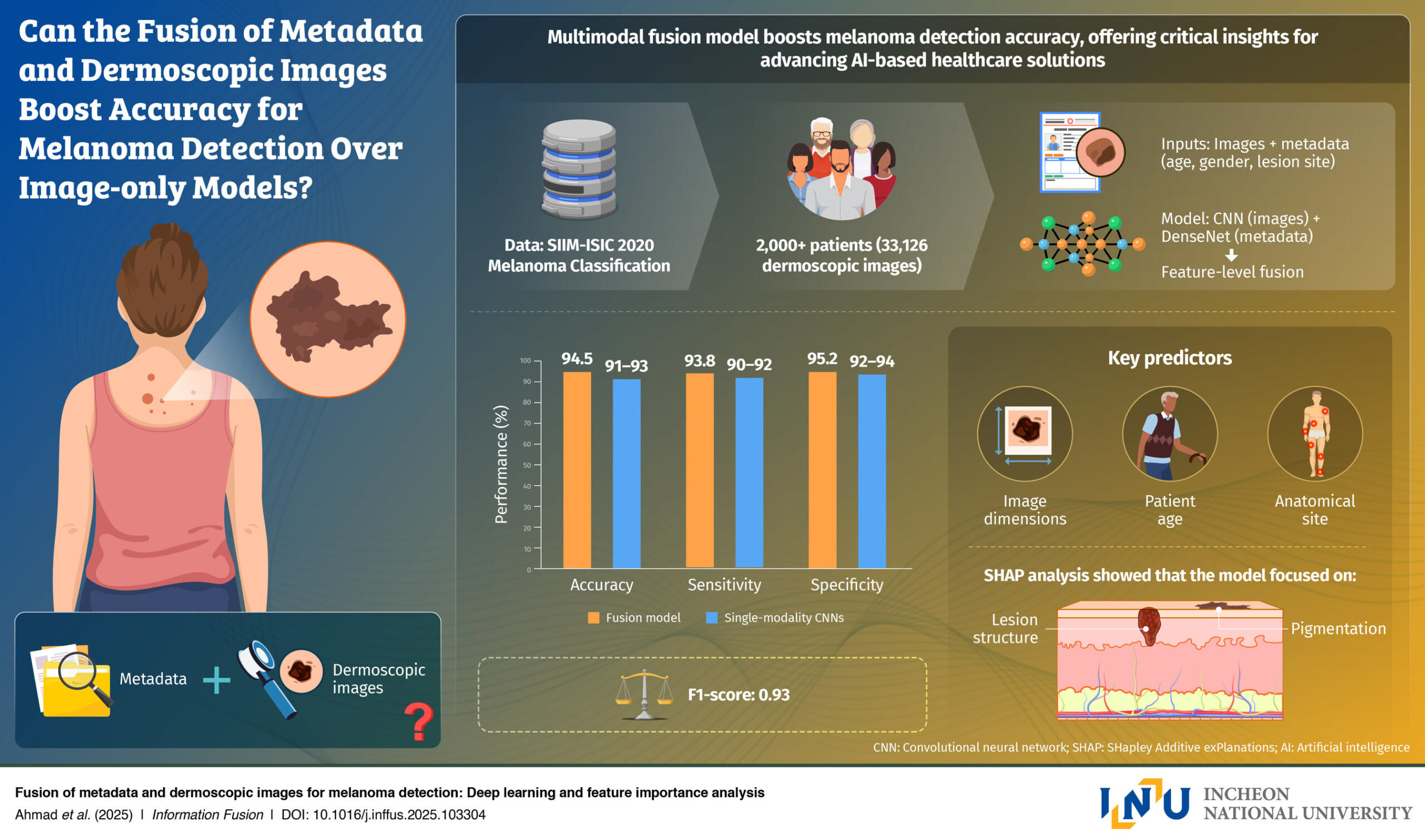
Scientists at Incheon National University have developed a pioneering artificial intelligence (AI) model that significantly enhances the early detection of melanoma, the most deadly form of skin cancer. This advanced system achieves an impressive accuracy rate of 94.5%, marking a critical advancement in the field of smart healthcare.
Melanoma poses a serious health threat, responsible for thousands of deaths annually. Early detection is key to improving survival rates, yet diagnosing melanoma often proves challenging, as it frequently resembles benign moles or lesions. Traditional AI tools typically focus solely on dermoscopic images, neglecting vital patient information such as age, gender, and anatomical location. This oversight can limit diagnostic accuracy.
Innovative Approach to Diagnosis
To address this gap, a team led by Professor Gwangill Jeon from the Department of Embedded Systems Engineering at Incheon National University collaborated with researchers from the University of West of England, Anglia Ruskin University, and the Royal Military College of Canada. They created a deep learning model that integrates both patient metadata and dermoscopic images, allowing for a more comprehensive analysis.
The study utilized the large-scale SIIM-ISIC melanoma dataset, which includes over 33,000 dermoscopic images paired with clinical metadata. This extensive dataset enabled the AI model to identify subtle connections between skin presentations and patient profiles. Achieving an F1-score of 0.94, the model outperformed existing image-only models like ResNet-50 and EfficientNet.
Professor Jeon emphasized the necessity of considering both imaging and patient data, stating, “Skin cancer, particularly melanoma, is a disease in which early detection is critically important for determining survival rates. Since melanoma is difficult to diagnose based solely on visual features, I recognized the need for AI convergence technologies that can consider both imaging data and patient information.”
Implications for Healthcare
The findings of this research, which will be published in the journal Information Fusion on December 1, 2025, offer promising implications for real-world applications. The model not only enhances diagnostic precision but also aids in building trust in AI-assisted diagnoses. By analyzing factors such as lesion size and patient demographics, the system provides valuable insights that can guide healthcare professionals in their evaluations.
As Professor Jeon noted, “The model is not merely designed for academic purposes. It could be used as a practical tool that could transform real-world melanoma screening.” The potential applications are vast, including smartphone-based diagnostic tools, telemedicine platforms, and AI-assisted tools in dermatology clinics. These innovations could significantly reduce misdiagnosis rates and improve access to necessary care.
Looking ahead, this study represents a significant step toward personalized diagnosis and preventive medicine through the integration of AI technologies. By bridging the gap between machine learning and clinical decision-making, this multimodal approach promises to enhance the accuracy and accessibility of skin cancer diagnostics.
For more information on this study, please refer to the original paper titled “Fusion of metadata and dermoscopic images for melanoma detection: Deep learning and feature importance analysis,” with a DOI of 10.1016/j.inffus.2025.103304.