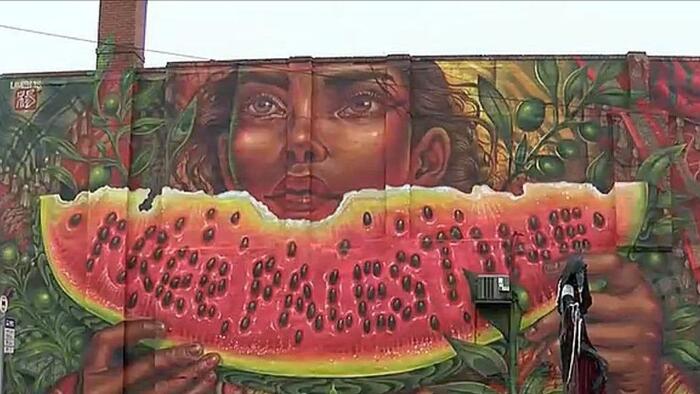
In Richmond, Virginia, a mural depicting a Palestinian woman holding a slice of watermelon has ignited significant controversy within the local Black community. The mural, located at the intersection of Brookland Park Boulevard and North Avenue, features the phrase “Free Palestine” spelled out with watermelon seeds. Created by Los Angeles-based artist Lauren YS, the artwork was intended as a statement against what supporters view as Israeli occupation. However, many residents perceive the imagery as a hurtful reminder of derogatory stereotypes from the Jim Crow era.
The mural’s placement in a historically Black neighborhood, now facing gentrification, has heightened sensitivities. Critics argue that the watermelon imagery evokes painful memories associated with racism. Jonathan Davis, former president of the Richmond Crusade for Voters, expressed his dismay, stating, “I was taken aback because of the imagery that it represents, a watermelon up to the mouth of a Black woman.” He emphasized the historical context of such images, which were often used to demean Black Americans during segregation.
Community Reactions and Historical Context
The watermelon caricature has deep roots in American history, used to undermine the dignity of Black individuals after the Civil War. Activists like William McGee, president of the Richmond chapter of the Southern Christian Leadership Conference, have called for a reimagining of the mural. McGee suggested incorporating symbols that honor both Black liberation and Palestinian identity without resorting to potentially offensive imagery.
Dr. Faedah Totah, a professor at Virginia Commonwealth University, defended the mural’s intention, explaining the connection between the watermelon and Palestinian activism. “The Palestinian flag has four colors—red, white, black, and green—which also happens to be the color of a slice of a watermelon,” Totah noted. This symbolism dates back to 1967, when the Israeli occupation led to the banning of the Palestinian flag, prompting activists to find creative expressions of their national identity.
Despite this explanation, the local community’s reaction has been overwhelmingly critical. Civil rights activist Gary Flowers proposed an alternative that would replace the watermelon with a Palestinian flag alongside a Black liberation flag. He also criticized the building owner and the artist for not engaging with community members prior to the mural’s installation.
Next Steps for the Community
In light of the backlash, a town hall meeting is being considered to facilitate community dialogue and gather feedback on the mural. The building owner and the artist are open to potential alterations based on this feedback. Lauren YS, who identifies as Chinese American, has stated that any association with racist caricatures was unintentional. In her defense, she emphasized the mural as a representation of “Palestinian heritage, nationality, longevity and steadfastness,” framing it as a symbol of perseverance and solidarity.
As the community navigates this complex issue, the mural serves as a focal point for broader discussions on identity, representation, and historical memory. The ongoing dialogue reflects the nuanced interplay between cultural expression and historical sensitivity, underscoring the need for careful consideration in public art.