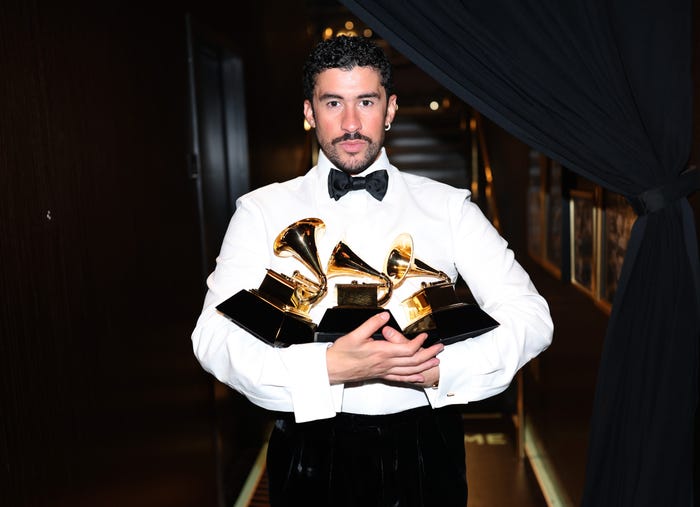
Bad Bunny made history at the 2026 Grammy Awards by winning the prestigious album of the year for his work “Debí Tirar Más Fotos.” This achievement marks a significant milestone as it is the first all-Spanish album to receive this honor. The ceremony, held in Los Angeles, resonated with a powerful message amidst ongoing anti-immigrant sentiments in the United States.
As the crowd erupted in applause, Bad Bunny, visibly emotional, shielded his eyes from tears while receiving the award. The lyrics of “DTMF,” a track that speaks to the importance of community and resilience, echoed throughout the venue. This victory transcends mere recognition of artistic talent; it serves as a political statement during a time when anti-immigrant rhetoric has intensified under the administration of former President Donald Trump.
A recent analysis from the University of California, Los Angeles, highlighted that Trump’s mass deportation efforts have disproportionately impacted Latino communities, further complicating the conversation surrounding immigration in the United States. The Supreme Court’s September 2026 decision to lift restrictions on racial profiling by Immigration and Customs Enforcement (ICE) has further exacerbated fears within these communities. In this context, Bad Bunny’s recognition becomes an implicit protest against these policies.
During his acceptance speech for the best música urbana album, Bad Bunny directly addressed these issues, making a pointed statement in English for wider impact. “We’re not savage. We’re not animals. We’re not aliens,” he declared. “We are humans, and we are Americans.” His choice to deliver a substantial part of his acceptance speech in Spanish highlighted the cultural significance of his win, reinforcing his identity as a proud Latino artist.
Art as a Reflection of Politics
While some argue that art should remain separate from politics, Bad Bunny’s success challenges this notion. The belief that artists should refrain from political commentary is prevalent among certain audiences and commentators. For instance, country star Jelly Roll sidestepped political questions during the awards ceremony, expressing that his opinions shouldn’t matter to fans. Similarly, actor Sydney Sweeney conveyed a desire to keep her artistic work separate from political discourse.
In contrast, Bad Bunny’s presence at the Grammys, regardless of the content of his speech, carries undeniable political implications. His album, “Debí Tirar Más Fotos,” addresses urgent themes such as identity, belonging, and cultural preservation. In an interview with The New York Times, he stated his goal was to “plant a seed” for young people in Puerto Rico, encouraging them to reflect critically on their roots and heritage.
The musical landscape has often been shaped by the socio-political environment of its time, making it impossible to separate art from its context. Toni Morrison, the Nobel Prize-winning author, famously asserted that “all good art is political.” She emphasized that even artists who claim to avoid political themes are, in fact, making political statements by maintaining the status quo.
Bad Bunny’s Grammy win is not merely a celebration of music; it is a testament to the cultural resilience of Latino communities. It acknowledges the struggles and stories that often go unheard. The award serves as a reminder of the power of art to transcend borders and speak to the shared human experience, particularly in challenging times.
In a world where art can serve as both a form of expression and a platform for activism, Bad Bunny’s triumph at the Grammys reinforces the idea that music is a vital vehicle for social change. As he continues to break barriers and challenge norms, his influence as an artist and advocate for his community will undoubtedly resonate far beyond the stage.