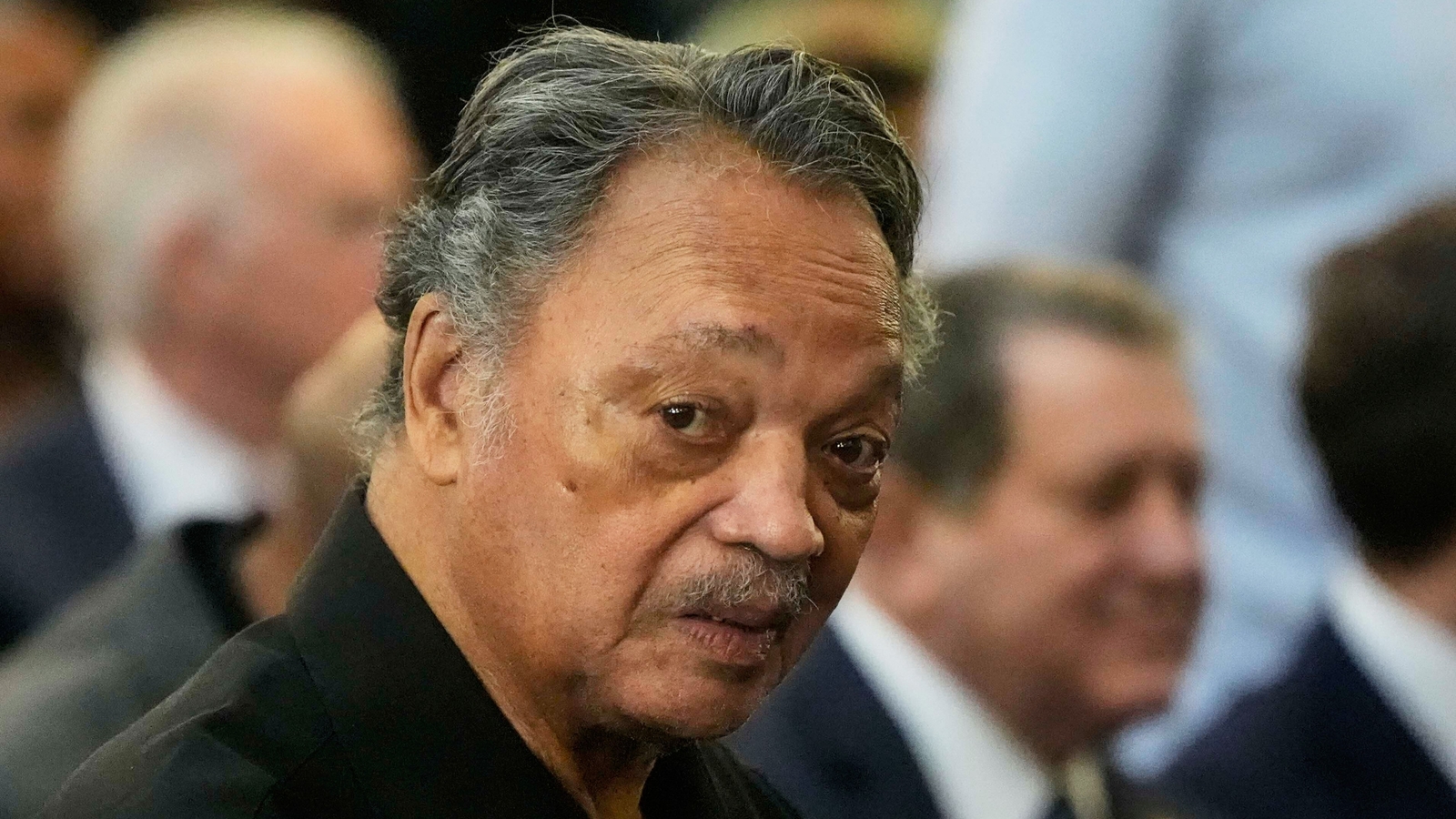
Civil rights leader Reverend Jesse Jackson has died at the age of 84, as confirmed by his family on Tuesday. They stated that he passed away peacefully, surrounded by loved ones. The Jackson family expressed their profound loss, stating, “Our father was a servant leader—not only to our family, but to the oppressed, the voiceless, and the overlooked around the world.” They urged the public to honor his legacy by continuing the fight for justice, equality, and love.
A Life Dedicated to Civil Rights
Born in the segregated town of Greenville, South Carolina, Jackson faced racial discrimination from an early age. His mother, Helen Burns, was a high school student when he was born, and Jackson learned the harsh realities of segregation, including being taught to sit at the back of the bus. He excelled academically and earned a football scholarship to the University of Illinois, but his involvement in civil rights activism began during a visit home when he joined a demonstration at a whites-only public library.
Jackson later transferred to North Carolina Agricultural and Technical State University, where he fully immersed himself in the civil rights movement. He famously declared, “I am somebody. I may be poor, but I am somebody.” His commitment to civil rights led him to march alongside Dr. Martin Luther King Jr. during the historic Selma to Montgomery marches in 1965.
Jackson’s dedication to social justice left a lasting impression on Dr. King, and he eventually became the director of Operation Breadbasket in Chicago. This initiative aimed to create job opportunities for African Americans and support Black-owned businesses. Tragically, Jackson was present in Memphis on April 4, 1968, when Dr. King was assassinated. Reflecting on that day, he recalled, “Shot, killed in cold blood, all I can remember is some voice saying, ‘one bullet cannot kill a movement: We must keep going.’
Founding a New Era of Activism
In June 1968, Jackson was ordained as a minister. He founded Operation PUSH (People United to Save Humanity) in 1971, which later evolved into the Rainbow PUSH Coalition. Based on Chicago’s South Side, this organization became a powerful advocate for economic development and diversity in hiring practices. Jackson utilized boycotts against companies like Coca-Cola, Anheuser-Busch, and Nike to push for change in corporate America.
Jackson’s influence extended beyond national borders. He engaged in private diplomacy, successfully negotiating the release of American hostages in Cuba and even traveling to Syria in 1983 to secure the freedom of a captured Navy pilot. His political ambitions led him to run for the presidency twice, first in 1984 and again in 1988. Although he faced controversies, including a scandal involving derogatory comments about Jewish people, he remained a significant figure in American politics.
In a historic moment in 2008, Jackson watched as Barack Obama accepted the Democratic nomination for president. Overcome with emotion, he stated, “I practiced not crying tonight… Tears would fill Jackson’s eyes three months later as he witnessed Obama become the first Black president of the United States. “We went from the balcony in Memphis, Tennessee, where Dr. King was killed, to the balcony of the White House in Washington,” he said.
In late 2017, Jackson announced he had been diagnosed with Parkinson’s disease, which later evolved into progressive supranuclear palsy (PSP). Despite his health challenges, he continued to advocate for civil rights, notably protesting against police violence following the shooting of Laquan McDonald.
In July 2023, Jackson stepped down from his role as head of the Rainbow PUSH Coalition. His contributions to civil rights and social justice were recognized with a Lifetime Achievement Award from the National Bar Association in July 2025. Rev. Jesse Jackson leaves behind a legacy of profound impact and a call to action for future generations.