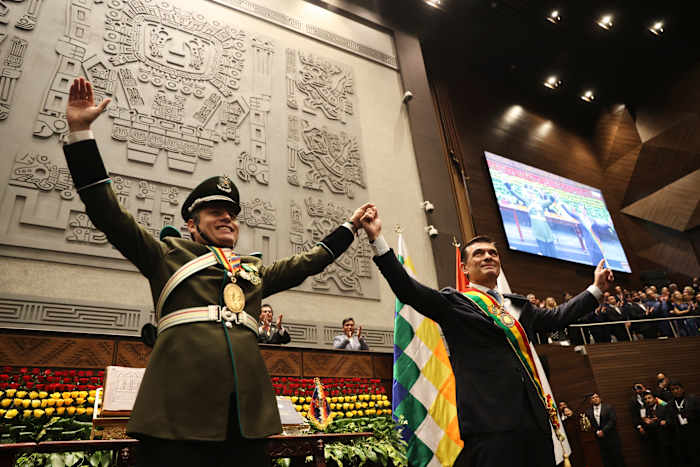
Rodrigo Paz was sworn in as the new president of Bolivia on October 20, 2023, marking a significant shift in the country’s political landscape after nearly two decades of governance by the Movement Toward Socialism (MAS) party. This transition follows a decisive election in which Paz surprised many by defeating his more established opponent, former President Jorge “Tuto” Quiroga, in a runoff vote.
During the inauguration ceremony held in the capital, La Paz, Paz took the oath of office in front of lawmakers and international dignitaries. He pledged allegiance to “God, country, and family” before receiving the presidential sash and medals.
Economic Challenges Ahead
Paz’s presidency comes at a time when Bolivia faces its most severe economic crisis in four decades, characterized by rampant inflation, acute fuel shortages, and soaring food prices. The country’s economic difficulties have intensified since the MAS party, founded by the charismatic former president Evo Morales, dominated the political scene during the commodities boom of the early 2000s. However, the subsequent decline in natural gas exports and the collapse of the party’s economic model have left the nation in dire straits.
The new president inherits an economy in turmoil, with many voters looking to him for immediate relief. While Paz has proposed substantial reforms, he intends to implement them more gradually compared to Quiroga, who has advocated for an International Monetary Fund bailout and more aggressive fiscal measures. This approach resonates with a populace eager for stability and recovery.
International leaders, including Javier Milei of Argentina, Gabriel Boric of Chile, Daniel Noboa of Ecuador, Yamandú Orsi of Uruguay, and Santiago Peña of Paraguay, attended the inauguration, reflecting the global interest in Bolivia’s new government.
Shifting Foreign Relations
In the wake of his election, Paz has signaled a desire to distance Bolivia from the ALBA bloc, which includes countries such as Cuba, Nicaragua, and Venezuela, and to strengthen ties with the United States. This development marks a notable change from the previous administration, which expelled the U.S. ambassador in 2008. Paz’s government is also engaging with international financial institutions to explore potential economic assistance programs.
One of his first significant moves includes reaching an initial agreement with the Andean Development Corporation for a loan of $3.1 billion, aimed at bolstering the economy over the next few years. This financial support could provide a vital lifeline as Bolivia navigates its recovery.
“After two decades of left-wing government, he can count on the goodwill of foreign investors and the international community,” noted Michael Shifter of the Inter-American Dialogue, a Washington-based think tank. “His task will not be easy. If he acts too slowly or his policies stagnate, he risks losing political capital.”
Additionally, Paz has expressed a commitment to collaborating with international organizations on security matters, including the U.S. Drug Enforcement Administration, which had been expelled under Morales’s administration. This cooperative approach may help to rebuild Bolivia’s relations with the U.S. and other nations.
As he embarks on his presidency, Paz faces the challenge of building coalitions within a fractured political landscape. His Christian Democratic Party currently holds only 39% of the 166 seats in the Legislative Assembly, necessitating strategic alliances to pass legislation and implement his reform agenda.
With a mandate to steer Bolivia out of its economic crisis, Rodrigo Paz’s administration represents both a new beginning and a formidable challenge for the Andean nation. As he navigates the complexities of governance, the eyes of Bolivians and the international community will be closely watching the outcomes of his policies and actions.