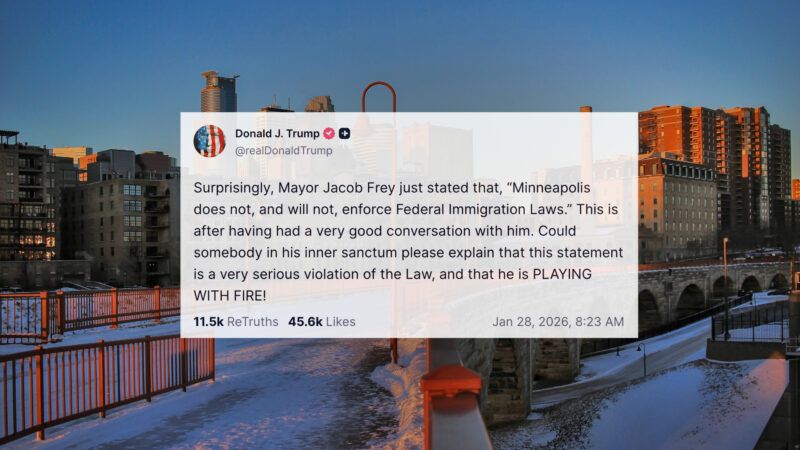
Tensions escalated in Minneapolis as federal immigration enforcement officers intensified their presence, resulting in chaos and the deaths of two bystanders. The situation has drawn attention to Minneapolis’ designation as a “sanctuary city,” where local officials generally refrain from cooperating with federal immigration authorities. In a recent post on Truth Social, former President Donald Trump criticized Mayor Jacob Frey, asserting that the city’s stance violates federal law.
Mayor Frey firmly stated, “Minneapolis does not, and will not, enforce federal immigration laws,” emphasizing the city’s commitment to community safety. He further clarified, “The job of our police is to keep people safe, not enforce federal immigration laws.” Trump’s comments, which included the phrase “playing with fire,” have sparked debate over the legal obligations of states and cities regarding federal immigration policy.
Legal experts argue that Trump’s assertion lacks grounding in established law. According to a piece published in Lawfare by Bertina Kudrin, Megan Thomas, and Niharika Vattikonda, judicial rulings from both the Trump and Biden administrations have reinforced that immigration enforcement is primarily a federal responsibility that cannot be imposed on states.
Legal Context of Immigration Enforcement
The legal foundation for this argument lies in the anti-commandeering doctrine, which the U.S. Supreme Court has upheld in various cases. In New York v. United States (1992) and Printz v. United States (1997), the Court established that states cannot be compelled to execute federal regulations. Justice Antonin Scalia articulated that the federal government cannot act directly upon states, as the Founding Fathers envisioned a system of shared authority between state and federal entities.
Despite the political pressure, both Frey and Minnesota Governor Tim Walz have maintained their positions against cooperation with federal immigration officers. While some may disagree with their decisions, they remain within their legal rights to refuse such cooperation.
Broader Implications of Federal Overreach
The implications of Trump’s stance extend beyond immigration enforcement. Critics have highlighted a potential slippery slope where federal authority could infringe upon state autonomy. Gun rights advocates, who have historically supported Trump, are wary of a federal overreach that could mandate nationwide background checks, as demonstrated by the controversy surrounding the killing of Alex Pretti by immigration officers, which has drawn mixed reactions.
The ongoing conflict in Minneapolis serves as a critical reminder of the complexities surrounding immigration law enforcement in the United States. As cities like Minneapolis assert their rights to define their policies, the debate over the balance of power between state and federal governments continues to unfold.