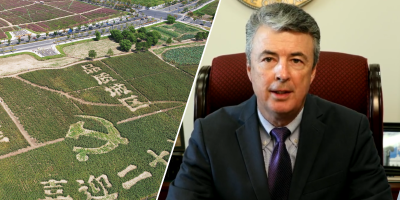
The security of American farmland is under increasing scrutiny as officials raise alarms about foreign ownership and potential threats to national stability. On March 15, 2026, Secretary of Agriculture Brooke Rollins and Secretary of War Pete Hegseth signed a Memorandum of Understanding aimed at implementing the National Farm Security Action Plan (NFSAP). This collaboration seeks to address vulnerabilities in the agricultural sector that could be exploited by foreign adversaries.
A concerning trend has emerged, with nearly 46 million acres of U.S. agricultural land owned by foreign entities, representing approximately 3.6% of all privately held agricultural land. In Alabama alone, foreign ownership exceeds one million acres. This situation raises significant concerns about food security and the potential for bioterrorism aimed at disrupting the agricultural system.
The NFSAP, announced in July 2025, underscores a commitment to safeguarding American farmland from both ag-terrorism and bioterrorism. In a statement, Secretary Hegseth highlighted historical precedents, noting, “shortly after 9/11, U.S. forces in Afghanistan uncovered Al-Qaida training manuals that specifically targeted America’s agriculture for attack…we’re not dealing with hypotheticals here.”
Alabama has taken proactive measures to address these risks. Recent legislation restricts land purchases by entities linked to nations such as China, Russia, Iran, and North Korea. While these laws do not force the sale of existing foreign-owned land, they impose stricter oversight on future acquisitions. Other states are now considering similar initiatives as they confront the challenges posed by foreign ownership.
The risks associated with foreign ownership extend beyond mere economic concerns. A 2023 Wall Street Journal investigation revealed over 100 attempts by Chinese intruders to breach U.S. military facilities since 2000. Under the guise of farming, these foreign agents have set up surveillance operations near military bases, monitoring troop movements and posing a direct threat to national security.
Despite the pressing nature of these issues, legislative action has been slow. The Agricultural Foreign Investment Disclosure Act (AFIDA), enacted in 1978, was designed to monitor foreign ownership of agricultural land. However, its effectiveness has been called into question, as it lacks comprehensive background checks and investigations into potential threats. Reporting on foreign holdings can be inconsistent, with only the primary investor listed, allowing countries like China to be underreported.
The NFSAP aims to address these shortcomings by bolstering the enforcement of AFIDA. The plan emphasizes identifying certain foreign land ownerships as national security threats, increasing transparency through improved reporting, and imposing penalties for inaccurate disclosures. Additionally, it seeks to collaborate with the Department of the Treasury to ensure agricultural land sales and biotechnology investments undergo thorough security screenings.
The economic implications of these issues are significant. In Alabama, the agricultural sector contributes over $70 billion to the economy, supporting essential services such as healthcare and law enforcement. A disruption in this industry would have catastrophic knock-on effects not only for local farmers but for all Americans.
As Secretary Rollins stated, “Farm security is national security. When our farmland is threatened, the welfare of our entire Nation is put on the line.” The push for stronger regulatory measures reflects a recognition of the critical role that agriculture plays in the nation’s security and overall prosperity.
Steve Marshall, Alabama’s Attorney General and Republican candidate for the U.S. Senate in 2026, has voiced his commitment to advocating for these issues. He emphasizes that Americans deserve the assurance that their land is managed by individuals loyal to the nation. The urgency of this matter cannot be overstated, and the federal government is called to act decisively to protect American farmland from foreign threats.
In conclusion, as the landscape of agriculture continues to evolve, the implications of foreign ownership demand immediate and sustained attention. The NFSAP represents a proactive step towards ensuring the safety and security of America’s agricultural resources, fundamental to the nation’s future.