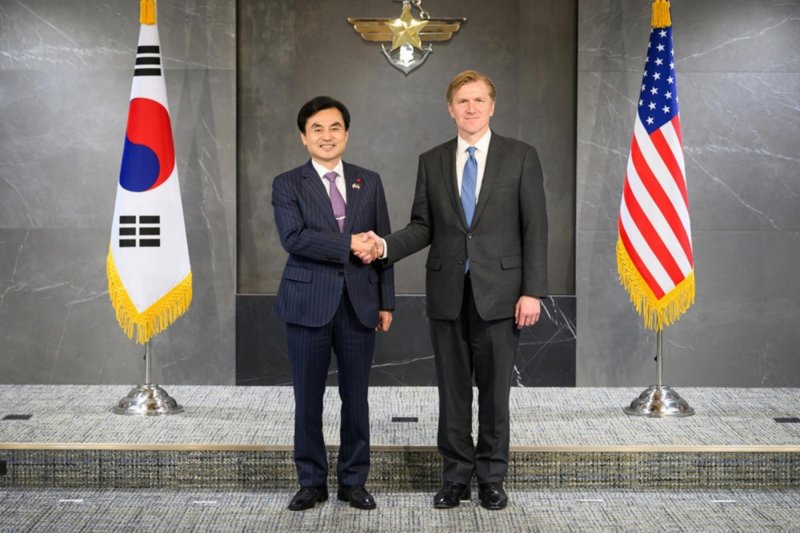
On February 2, 2024, remarks by Elbridge Colby, Undersecretary of Defense for Policy, at the Sejong Institute in Seoul have ignited discussions surrounding U.S. military presence in South Korea. Colby’s comments touched on the sensitive topic of potential reductions in American forces stationed on the Korean Peninsula, raising concerns among South Korean officials about the implications for regional security and deterrence.
Colby’s statements reflect an ongoing anxiety in Seoul regarding the future of U.S. military support. Reports indicate that discussions around the National Defense Strategy have frequently suggested a possible reduction in troop numbers, despite official reassurances to the contrary. This fear of withdrawal persists, influencing perceptions of U.S. commitment to South Korea’s defense. The potential movement of thousands of American troops has been a topic of debate for months, creating a narrative of uncertainty that contradicts the declared policy of maintaining a robust military presence.
In the context of military alliances, language plays a crucial role. As Colby outlined a new doctrine, referred to as “CBMLS”—”critical but more limited support”—the implications of such terminology can be profound. If allies perceive any ambiguity in U.S. commitment, it can embolden adversaries. The political warfare strategy of Kim Jong Un appears to exploit this uncertainty, aiming to fracture the South Korea-U.S. alliance and encourage the withdrawal of American forces.
Colby’s remarks underscore that the North Korean regime interprets discussions around troop reductions as signs of success in their efforts to undermine U.S. resolve. This perspective is critical, as North Korean leadership relies on demonstrating progress against the alliance to maintain influence internally. The normalization of force reductions may feed into propaganda narratives that reinforce their position domestically.
A proposed solution to mitigate such risks was shared by David Maxwell, executive director of the Korea Regional Review. He suggested a clear and assertive statement: “U.S. firepower, on-peninsula, offshore and U.S.-based, will defend the Republic of Korea against any threat.” This straightforward assertion aims to communicate continuity of support and complicate enemy calculations while reassuring allies of unwavering U.S. commitment.
Another aspect of Colby’s remarks that has drawn scrutiny is the terminology used to describe South Korea as a “model ally.” This phrase, while intended to convey praise, carries historical and cultural weight that may not resonate positively in the context of U.S.-South Korea relations. In Asia, particularly among educated policy elites, terms like “model ally” can evoke associations with hierarchical relationships and external evaluations. This perception risks framing South Korea’s contributions as conditional, which could undermine trust and confidence in the alliance.
The implications of this discourse are significant. As Maxwell pointed out, the impact of language often overshadows intent. While defenders may argue that Colby’s comments were meant to commend South Korea’s defense efforts, the reception of such statements can vary greatly across cultural contexts. In a region sensitive to issues of dignity and sovereignty, language that appears evaluative can weaken deterrence by suggesting that U.S. support is transactional rather than steadfast.
The dynamic between the United States and South Korea is further complicated by the broader geopolitical landscape, particularly with the rising challenge posed by China. As resources become constrained, there is increasing pressure for allies like South Korea to take on greater responsibility in regional security. Nonetheless, the manner in which these expectations are communicated is crucial. If South Korea is regarded as a top-tier partner, it warrants early consultation and mutual respect in collaborative efforts.
The recent media coverage in South Korea reflects a heightened awareness of Colby’s statements, with many articles mentioning the “model ally” phrase. While direct criticisms of the term remain limited, its frequent usage shapes public perception and encourages scrutiny of U.S. intentions. Trust among allies is built not solely on military efficiency but also on mutual respect and understanding.
In conclusion, the discussions surrounding U.S. military strategy in South Korea highlight the intricate balance of words and actions in international relations. As the geopolitical climate evolves, fostering a strong alliance requires not only military readiness but also a commitment to cultural awareness and respect. Misinterpretations and poorly chosen language can have lasting consequences, especially in a region where perceptions of honor and dignity are paramount. The stakes are high, and how the United States communicates its intentions to South Korea could ultimately determine the strength and resilience of their alliance in the face of potential crises.